Hydrocyclone Liquid Filtration
No moving parts, No consumption or blocking of filter elements, Easy to install, No electric or pneumatic control necessary, High efficiency, Low service demand, Simple construction, compact, Low investment.
Short explanation:
Hydrocyclones are simple, robust and selfcleaning separators that can separate fine particles with relative high concentrations under centrifugal forces without the use of a motor.
Working principle:
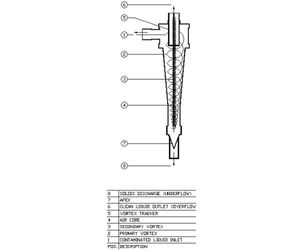
The hydrocyclone is built out of a cylindrical upper part with a top outlet in the middle and a tangential side inlet. The top part is connected to a conical bottom part with exchangeable drain part.
Dirty water is pumped under a constant pressure into the tangential inlet (1) and will be accelerated, as the primary vortex (2), into a spiral rotation towards the apex (7) which is connected to the cylinder in the middle and will produce a throttling effect. This effect will cause a secondary vortex down the conical shape to the drain, a cone with open apex (7). The centrifugal forces drive the particles with a specific gravity of more than 1.2 g to the outside of the spiral flow and push them together under an increasing velocity of up to several thousands of “G” forces down to the drain cone outlet. In the middle of the stream a vortex tracker (5) is created with low pressure.
Where there is high pressure at the outside of the stream. The low pressure water, without heavy particles, will leave the hydrocyclone via the vortex tracker (5) and the open apex overflow (6) at the top of the cyclone. The concentrated (8) heavy particles with a small water flow, less than 1% of the inlet flow, leave the hydrocyclone through the cone with small open apex (7) in the bottom.
The efficiency of the cyclone and the size of the particles that will be removed is related to the diameter of the upper cylinder, the diameter of the drain outlet and the counter pressure of the open top outlet. By changing these parameter one can influence the separator efficiency. Efficiencies of up to 98% can be reached.
The energy consumption of the cyclone is the pressure loss in the housing by acceleration of the flow. Average this is 1-1.5 bar for a cyclone of 5 cm diameter. At 2.5 bar inlet pressure the top outlet pressure is about 1 bar at the top of the cyclone. Particle size removal can be from 5 < d < 80 micron with a concentration up to 1 gr/l depending on size distribution and specific gravity. Field test are the best way to find out if a hydrocyclone is the proper technology for solving the filterproblem.