


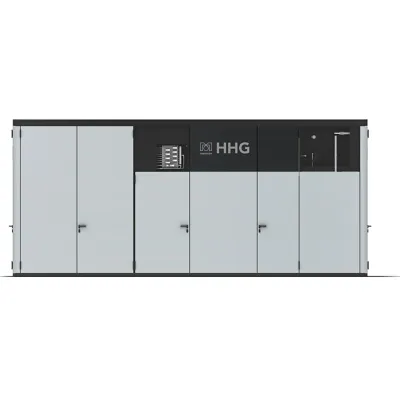
Metacon - Hydrogen Generator for Various Applications
In our proprietary and patented reforming process, hydrogen is produced through a technology that uses unique catalytic surfaces in a high-efficiency reactor. By blending the fuel with steam and using an advanced reactor, we can initiate a chemical process where the fuel is converted into hydrogen, carbon monoxide, and carbon dioxide. This conversion occurs by supplying heat to the steam/fuel mixture through via catalytic oxidation. Each reaction takes place on thin layers of catalysts, enabling very high efficiency. Later in the process, the amount of carbon monoxide can be reduced, and as an option, carbon dioxide can be captured and stored by coupling our system with a carbon capture and storage (CCS) system to significantly reduce carbon dioxide emissions.
- To initiate the reforming process, fuel is required – such as hydrocarbons like biogas or natural gas along with a sufficient supply of water (steam).
- When a fuel and steam mixture is reformed according to the process, involving thin film catalytic surfaces in a highly efficient reactor, results in the production of hydrogen, carbon monoxide, and carbon dioxide.
- In order to effectively start the reforming process, both air and fuel such as biogas or natural gas are heated up, before catalytic oxidation (combustion).
- The air and fuel mixture are combusted and converts to water and carbon dioxide for heat generation. The process is safer than conventional reforming processes as it does not rely on open flames. This results in reduced carbon dioxide emissions from the process, increased system efficiency and reduced size of the plant.
- The result of our process contains hydrogen and carbon oxides. Carbon monoxide is minimized, and the resulting mixture is then added to a Pressure Swing Adsorption (PSA) system for purification. The PSA process enables us to produce pure hydrogen, with a range from 99.9% to 99.999%. The system can be coupled (option) with a carbon capture and storage (CCS) system to significantly reduce carbon dioxide emissions.