


- Home
- Companies
- Airora, Division of Hydroxyl ...
- Products
- Hydroxyl - Filter-Based Air Purifiers
Hydroxyl - Filter-Based Air Purifiers
All traditional filter-based air purifiers - HEPA filters, electrostatic, ionising (ionic), and TSS (Airfree) - share the same two basic failings: they only filter out some types of pollutant, not all, and they only clean the air that is immediately adjacent or passes directly through them.
What that means:
- Filter-based technologies can only reach their theoretical maximum level of pollution reduction after some hours. However, well before that, new polluted air has already entered the room (typically, existing air is replaced by new air from outside at least once an hour).
- The filtered air they emit immediately mixes with existing, polluted air and is re-contaminated.
- Stratification (caused by warm air rising) and eddies (circling air) mean that some air in a room will never even reach the purifier.
- HEPA and electrostatic filters remove bacteria and viruses from the air passing through them (but not all of the air in the room) but do not kill them. Untreated, those bacteria and viruses colonise the filter / plates making cleaning and replacement potentially hazardous.
- Particulates (such as pollen, dust) quickly settle on surfaces; all it takes is a person brushing past a sofa to recontaminate the room again.
- Only some types of pollutant are removed (typically only larger particulates), but those types not removed may also cause infections or allergic reactions or act as irritants.
- As filters don`t produce a hydroxyl cascade, they don`t clean surfaces or neutralising viruses, bacteria, mould or pollens within the room
- While larger, more powerful, noisier fans can filter more air, in practical terms they can never overcome these failings.
The problem with rudimentary hydroxyl generators
(PCO, PECO, Photocatalytic)
In addition to the longstanding filter technologies, some manufacturers have produced air purifiers based on rudimentary Hydroxyl Radical technology.
While PCO / PECO / Photocatalytic devices share the wider scope of action of Airora, they lack our patented technology, which means that they cannot reliably cascade hydroxyls throughout a whole room and onto surfaces.
Consequently, these rudimentary hydroxyl based air cleaners rely mostly on exposing pollution to hydroxyl radicals within the device. As such they share the same shortcomings (see above) as all other filter-based air purifiers.
Sadly, there are grossly misleading claims being made for this basic technology. Such claims mislead by focusing on their effectiveness in cleaning the air passing through the device, not their overall effectiveness across a whole room and its contents.
Airora kills all types of human pathogen both in the air and on surfaces with none of these drawbacks!
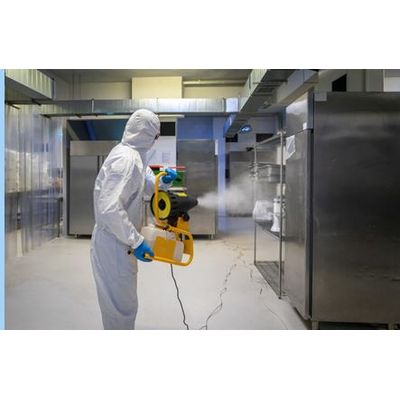
The problem with `Foggers`
A `Fogger` is a device that creates a chemical fog, such as ozone, to kill bacteria and / or viruses.
Such chemical `fogs` are dangerous to humans, and so foggers are used to fumigate spaces without people being present. While the process itself may be effective (for a short period), it has many obvious drawbacks compared to a technology which can achieve the same or better results, but safely run 24/7 with people present.
One major weakness is that as soon as someone walks into a newly fumigated room, it`s immediately re-contaminated.
Other drawbacks of using an ozone `fogger` as an anti-microbial device:
- Requires trained personnel working strictly in accordance with a safe method of work statement.
- Requires the room or space to be treated to be empty of people and secured so that people, pets etc. cannot accidentally enter the space being fumigated.
- Requires items likely to be damaged by the fumigant to be removed, and later replaced, to protect them from damage.
- Requires the transportation, storage or handling of toxic chemicals
A unique characteristic of UV light is that a specific range of its wavelengths, those between 200 and 300 nanometers, are categorized as germicidal – meaning they are capable of inactivating microorganisms, such as bacteria and viruses.
Devices known as `UVC Disinfectors` create intense UVC germicidal light (dangerous to humans) which is used to treat an empty room and its contents for a period, killing airborne and surface pathogens.
While the process itself may be relatively effective (for a short period), it has many obvious drawbacks compared to a technology which can achieve the same or better results, but safely run 24/7 with people present.
One significant weakness is that as soon as someone walks into a room newly disinfected with UV-C rays, it’s immediately re-contaminated.
- Requires trained personnel working strictly in accordance with a safe method of work statement.
- Typically needs a full time member of staff to move and operate the device so as to get sufficient usage to justify its high initial cost.
- Requires the space to be treated to be empty of people and secured so that people, pets etc. cannot accidentally enter the space being irradiated.
- Only destroys pathogens in a direct line of sight of the device, so there are always surfaces that will not be cleared of pathogens - it may well require repeated treatments with the device in different locations within the room in an attempt clear most surfaces.
- Requires the operator to move the curtains, take things off of walls, open drawers and cabinets, expose telephones, remote controls and other high-touch surfaces so that the light reaches them.