


- Home
- Companies
- Hywell Machinery
- Products
- Hywell - Model XF - Static Fluid Bed ...
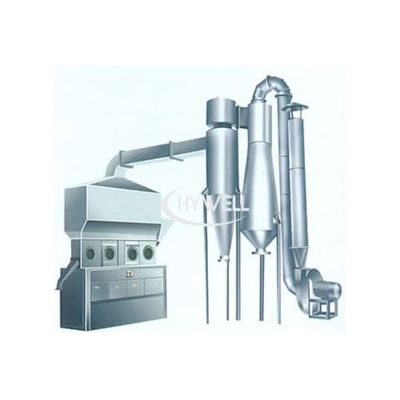
Hywell - Model XF -Static Fluid Bed Dryers
Static fluidised bed dryers or Continuous fluid bed dryers (dryers and coolers) are used on free-flowing fluidised bulk materials that have a particle size distribution. The static fluid bed dryer remains stationary during operation. Static fluid bed dryers can be continuous or batch operated. The other kinds of fluid bed drying machine is a shaking (vibrating) fluid bed dryer or cooler, where the body of the dryer oscillates, assisting the movement of material through the unit and supporting the fluidisation. it also has one kind of vertical fluid bed dryer that works as batch operation, but this kind of vertical fluidised bed dryer has some capacity and easy clean so that can reach GMP.
Static Fluid Bed Dryers Introduction
Hywell Machinery Static fluid bed dryers and coolers are ideal for products that are free-flowing. This type of dryer is referred to as a static fluid bed because the dryer remains stationary during operation. The static system provides an effective method of drying relatively free-flowing particles with a reasonable narrow particle size distribution. The feed may take the form of powders, granules, crystals, seeds, pre-forms, and agglomerates. A static fluidized bed dryer can be continuous or batch operation and may be round or rectangular. Because there is no mechanical drive system to move the product, the static dryers are lighter and simpler to manufacture - and hence cheaper than the dynamic fluid-bed dryers/coolers. Utilizing a multi-zone scheme allows each section of the fluid bed dryer to have independent temperature and airflow control. Each zone can support a different heating/cooling phase. Units in continuous and batch types for more uniform materials that do not tend to agglomerate.
Static Fluidized Bed Dryer Description
A granular Fluid Drying Machine is also called a fluidized bed dryer. It consists of an air filter, heater, fluidized-bed main machine, feeder, cyclone separator, cloth bag duster (optional), high-pressure centrifuge fan and air pipe, and control chest. Because the properties of raw materials exist differently, when equipping the dust-removing equipment, it should consider the practical need. It can select a cyclone separator and cloth bag duster at the same time or one of them. In general, it needs to select cyclone separator only for raw material that is large in specific gravity and cloth bag duster for powder and small granule raw materials that are light in specific gravity. Meanwhile, there is an air feeding device (sending air fan) and belt conveyor for selection. The raw material is fed into a fluidized-bed drier through the feeder. Fresh air through filtering and heating is sent to the bottom of the fluidized bed by fan and contacts with solid raw material on distributing plate. In this way, the fluidized state is formed and the heat exchange between air and solid is carried out. The dried raw material is discharged from the outlet and wasted gas is exhausted from the top of the fluidized bed which catches solid powder through a cyclone separator, and cloth bag duster. The heating way has different kinds of choice such as steam, electricity or hot air furnace can be used (it can be supplied as client request).
The main air heating system of the static fluidized bed dryer supplies the drying chamber with the designed amount of air. The air rate is calculated with Hywell machinery`s process calculation program. The program is based on the actual ambient conditions at the physical place where the dryer will be installed.
The main air system of static fluidized bed dryers consists of air filters, pre-heating systems, an air heater, a supply fan, and from time to time dehumidification system (Option) . The main air system is constructed according to the actual requirements of the product and the ambient conditions.
Fines and air filtration system of static fluid bed dryers process, The fines coming out of the drying chamber and the external fluid bed together with the exhaust air will be separated from the exhaust air before letting it into the atmosphere.
A bag filter (option) can be a standalone solution as this technology is able to remove the required powder fines before the outlet to the atmosphere. The fines are collected in a fines return system, thereby the powder loss is reduced to a minimum. The fines can be re-entered to the top of the drying chamber, to achieve agglomeration of the powder or they can be sent to the internal or external fluid bed. Again, the required powder specifications will decide the design of the fines system.
Powder sifter (Option): The final step of the drying system is the powder sifter. The powder sifter will separate the large powder particles from the powder, size is determined for the separation. The off size is bagged off and the powder can be either directly packed into big bags or conveyed to a silo system for other packing systems.