


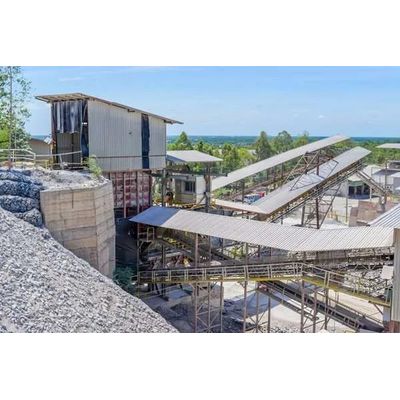
IAC - Crushing, Milling and Screening
Materials crushing, milling, and screening operations can be major sources of airborne dust due to the inherent nature of size reduction and segregation processes. Control of dust generated by these operations can be achieved with proper analysis of the sources, identification of appropriate control technologies, and consistent application and maintenance of selected controls.
Size reduction processes will always contain at least one crushing circuit, and many times will have multiple crushers, often of different types. Selection of crushers is based primarily on material size-reduction and throughput requirements. Secondary selection considerations include the composition, hardness, and abrasiveness of the feed material(s). The most common primary crusher type is the jaw crusher which operates by compressing the feed material between a fixed and moving plate or jaw. Cone or gyratory crushers may be used as primary or secondary crushers and also operate through compression.
Hammermills, impact breakers, and roll crushers operate primarily by impaction depending upon rotor speed at which the breaking force is transmitted from the crusher to the material. Compression involves a slower energy transfer than impaction, and compressive crushers produce somewhat less dust than impact crushers.
The mechanical action of crushers can generate air movement; i.e., jaw crushers can have a bellows-type effect, and cone or gyratory crushers can act as fans, although neither of these classes of crushers operate at high speeds. In contrast, hammermills operate with higher speed components and can act as centrifugal fans.
Milling, often called grinding, is a process by which granular minerals are reduced in size by compression, abrasion, and impaction. Mills may be classified into two broad types based on how they operate: tumbling mills and stirring mills. Tumbling mills generally operate in a horizontal orientation, and the shell of the mill rotates to impart motion to the contents or charge. Stirring mills may be horizontal or vertical and motion is imparted to the charge by an internal stirring element.
Tumbling mills employ some type of medium to perform the size reduction, often rods or balls, usually manufactured from iron or a steel alloy, or high density ceramic material when metal contamination of the product is a concern. Autogenous mills use the feed stock itself as the medium, and semi-autogenous mills use a combination of the feed stock and balls. Stirring mills reduce the size of the feed stock between fixed and rotating mill components.
The most important consideration for dust control within a grinding/classification/product storage circuit is dust containment, and the second is dust collection. All of the material conveying equipment related to a milling or grinding circuit must be enclosed. In addition, all transfer points must be fully enclosed.