- Home
- Companies
- iControls Technologies Inc. Division of ...
- Products
- iControls - Model ROC-3HE - Reverse ...
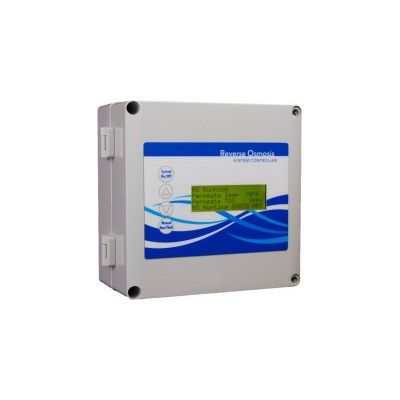
iControls - Model ROC-3HE -Reverse Osmosis System Controller
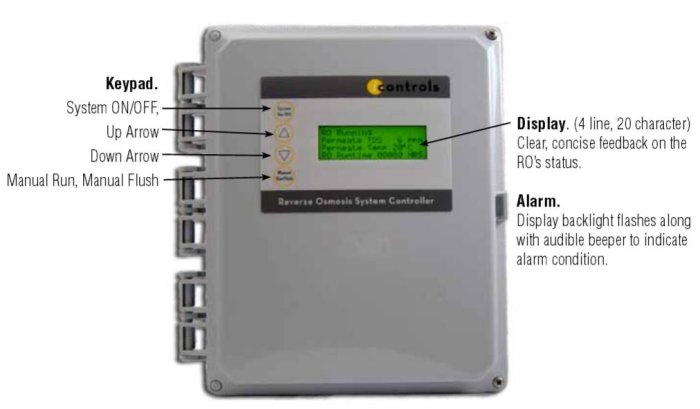
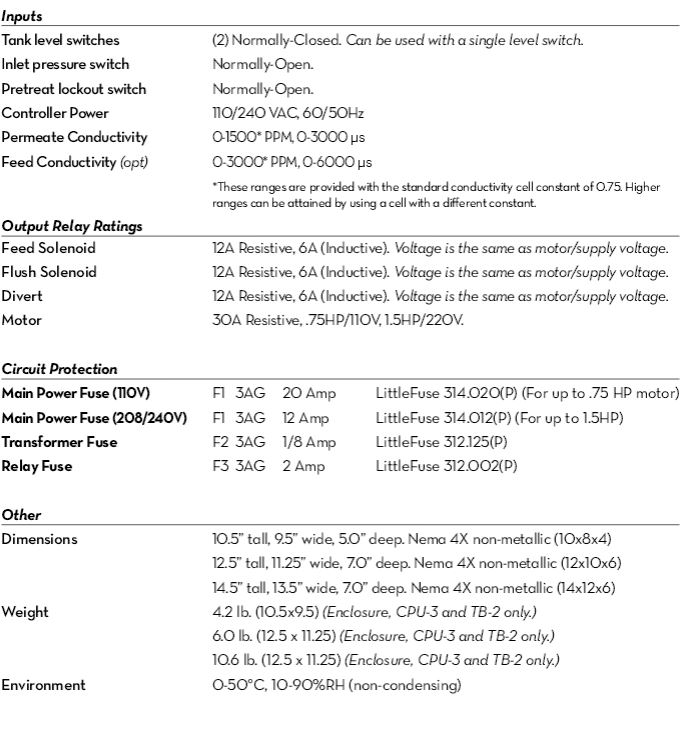
ROC-3HE RO Control Features; Powers up to 5HP Motors @ 240VAC. Rugged 40A contactor for extended life. Permeate TDS, Feed TDS and % Rejection. Extensive Flush Options. Fully Programmable. Low Cost Custom Graphics Available.
- For "Normal" operation use Program 1.
- For No Flush, use Program 2.
- For higher frequency and longer duration flush see Programs 3 & 4.
- See the following page for instructions on how to access the menu for selecting these programs.
- See Appendix A for a detailed explanation of the Parameters and their affect on the RO`s operation.
- See Appendix B for information on the programming interface.
Because the conductivity measurement is affected by the physical envioronment in which it operates, it is best to calibrate while installed in the system and operating under normal conditions. This requires an external conductivity measurement device that is known to be accurate to serve as a reference.
- Operate the RO long enough for the membranes, operating temperature and permeate conductivity reading to stabilize.
- Take a sample of the permeate and measure it with the reference meter.
- See Figure 7 for instructions on how to access the Permeate Calibration Menu.
- Enter the Permeate Calibration menu and use the UP or Down arrow until the value on the controller matches the value obtained on the reference meter.
- Exit and Save the calibration.
- The same procedure applies to the Feed Probe calibration.
NOTE: The probe calibration must be performed using solutions with conductivity of less than 900 ppm or ps. The conductivity calibration circuit will behave erratically if you attempt to calibrate using a higher value. When using a standard calibration solution, the NaCI PPM value can be used in place of the \js value if desired.