


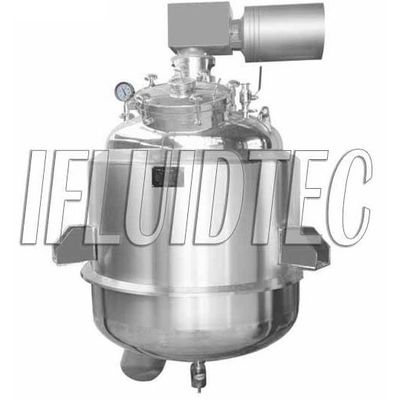
IFLUIDTEC - Stainless Steel Mixing Tank for Pharmaceutical, Chemical, and Food Use
A stainless steel mixing tank is a versatile piece of equipment widely used in various industries such as pharmaceuticals, chemicals, cosmetics, food, and beverages. These tanks are crucial for processes that involve mixing, dissolving, heating, or cooling of fluids and semi-fluids. The design configurations include liquid mixing tanks, milk and syrup preparation tanks, pharmaceutical vessels, and more. Options for heating or cooling are extensive, including full jackets for low-pressure applications and half-pipe coils for higher pressures with enhanced heat transfer efficiency. Agitators, an essential component, vary in design to suit different viscosities, ensuring effective homogenization and material distribution. The tanks are built in sizes ranging from small-scale laboratory models to large industrial capacities. Design considerations include stainless steel jacket thickness, mechanical seals, and baffle installation, addressing needs for efficiency, safety, and operational precision.
Stainless Steel Mixing Tank Application
Stainless Steel Mixing Tank has a wide range of applications in various industries such as pharmaceutical, chemical, cosmetic, food, and beverage. The classification of mixing tank is so wide, we will introduce you with some of them that are within our manufacturing ability.
Liquid mixing tank, milk mixing tank, syrup preparation tank, injection water tank, dissolving tank, jacketed heating mixing tank, jacketed cooling tank, pharmaceutical tank, stainless steel tank with agitator, pharmaceutical vessels, chemical mixing vessel, stainless steel jacketed mixing tank, magnetic stir tank.
Jacketed Mixing Tank Jacket Options
There are several types to make heating or cooling jacket for a mixing tank.
1# Full Jacket
Usually used for liquid heating and cooling media that run through vessel jackets. Considering jacket pressure determines the vessel wall thickness, also results in tank manufacturing cost, such jackets are more suitable for the low-pressure tank.
2# Coil jacket/half-Pipe Jackets
Useful for high pressures, half-pipe jackets are better for liquid than for steam. The heating or cooling media runs through the coil, zooming those areas. Theoretically, the space between coils the smaller the better for heat transfer; but due to operation difficulty, a 19mm distance is recommended. When reaches a certain coefficient, such space does not impact heat transfer efficiency. This is suitable for the high-pressure vessel.
3# Dimpled jacket
suitable for larger vessels, it can save stainless steel plate raw material, in a way to lower cost. But the pressure is better <3.5bar.
Media go inside the vessel jacket can be steam, hot water, cooling water and oil upon mixing need. Usually, a circulation system is adopted in the mixing system to increase efficiency and reduce waste.
Mixing Tank Baffle Options
Mixing tanks with baffles can scrap off material that sticks to the tank wall. Many paste-like solutions like cream, sun cream need it which can save raw material waste. For products like water, juice, syrup, the mixing baffles are not very helpful.
Mixing Vessel Size Choices
About the tank size, theoretically, we can make any size that asked by clients, but normally, we make 50L, 100L, 150litre and integer number size of tanks.
Different Types of Agitators inside Mixing Tank
The agitator plays a great deal in material mixing, dispersing, dissolving, stirring and emulsifying& homogenIzing. Various designs come up to meet users’ needs in our years of tank manufacturing projects in dairy, beer, wine, fermentation, bioreaction, chemical, pharmaceutical, and other fields. There are many aspects to consider, to name a few:
1. The stirring speed and electricity power of agitators are carefully calculated, selected; more viscous material, bigger power and stronger shaft and agitators.
2. Whether the motor is directly driving agitator or via reducer gearbox;
3. Whether motor installed top-down or bottom-up, vertically or horizontally.
4. What size of mixing shaft should be strong enough.
5. The height of the jacketed mixing vessel.
6. The kind of mechanical seal or lipseal is used.
There is a wide range of ‘types of agitators’ that we can install into our mixing tanks. Each agitator works well on certain material and certain production conditions. Below shows some types of agitators, for the buyer who doesn’t know how to choose, feel free to contact us, we will provide professional advice. For agitator not showing above, contact us for more info.