


Aquaculture Tilapia
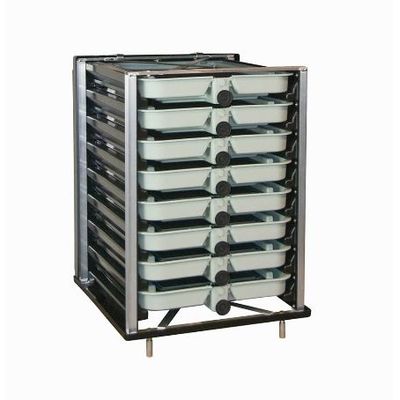
Incubator
Incubator is a device simulates fish incubation by keeping the eggs at a good water flow rate, mixing the eggs with a balance, keeping the oxygen flow in a good condition and incubating artificially in tilapia farming. Purpose of the incubator is to ensure that tilapia eggs are placed in appropriate incubators and maintained in a proper way to maintain a healthy life.
Most popular related searches
incubator
water flow rate
water flow rating
water circulator
water protection
water regulations
water mixing
oxygen water
ultraviolet water
- Adequate oxygen
- Sufficient temperature
- Clean and plank-free water
- Elimination of metabolic waste (CO2 and NH3)
- Same water flow
- Protect the ultraviolet rays
CIRCULAR INCUBATOR
- Features:Continuous water circulation and elimination, easy access
- Size:Diameter - 2m - 4m, Depth - 1m
- Advantages:Creates a natural condition, provides suitable use of space, can be used in large scale production.
VERTICAL TRAY INCUBATOR
- Features:Less space is required, the same water can be used.
- Advantages:Easy to use, low cost, large eggs can be incubated.
OTHER TYPES OF INCUBATORS IN THE WORLD
- Round bottom, drop-down containers.
- Grooved type incubators.
- Rotary barrel or drum incubators.
- Incubators with double enclosure.
- Bucket incubators.
REGULATION OF WATER FLOW DURING INCUBATION
During the incubation, regulate the water flow according to the development stages of the fish egg as follows. These stages:
- The time during egg swelling.
- The phase from the first to the end of the morula phase
- The process until the eye of embryos from blastula stage is seen
- The stage from the embryo to the exit from the embryo
- Length of Incubation Period
- The time required for the fertilized egg to turn into a fish larvae depends mainly on the species of fish, the water temperature and the dissolved oxygen content of the water.
CAUSES OF EGG DEATH DURING INCUBATION
- Lack of oxygen
- Unsuitable temperature
- Injuries during stripping or artificial insemination
- Mechanical disturbances
- Larvae or other animals caused by attacks by bacteria, fungi (Saprolegnia) and carnivorous (Cyclops) or breeding of insects
TREATMENT OF EGGS DURING INCUBATION
- Crustaceans and insect larvae can be filtered or controlled by treatment with 1 ppm of organic phosphoric acid ester insecticides.
- Bacterial attack can only be avoided by using clean water in the hatchery.
- Malachite green is widely used against fungal infection. Infected eggs are treated with it once a day. In the case of limited infection, the treatment is carried out directly in the incubator (jar, funnel or groove) with 5 ppm malachite green solution for 30-60 minutes.
- Formalin treatment is also used against fungal infection, but the method requires high sensitivity and care.
- A single treatment with tannin has proven to be very effective against fungal attacks under tropical and subtropical conditions. Newly prepared 5-8 g tannin solution is used in this process.