


- Home
- Companies
- Geodesign Barriers, Inc
- Products
- Geodesign - Model P61, P81, P101, P121 ...
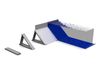
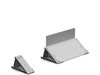
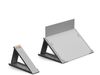
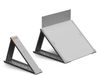
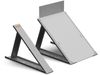
Geodesign - Model P61, P81, P101, P121 -Industrial Flood Barrier
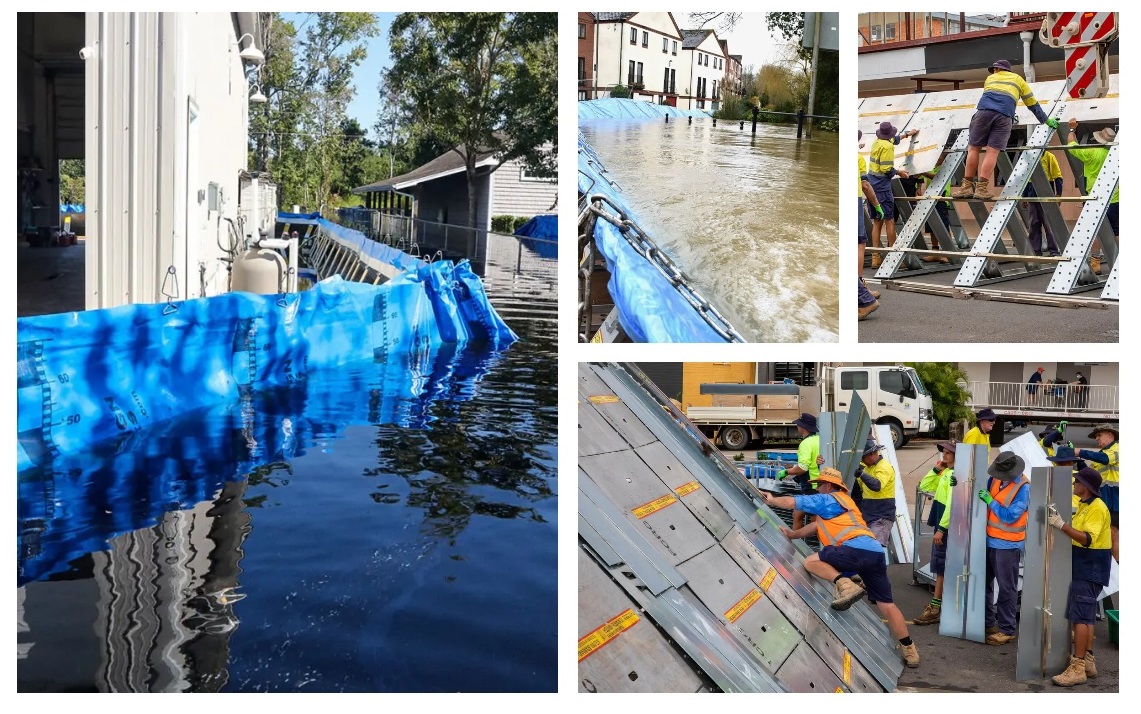
Our Industrial series is engineered for optimal handling, with lightweight components and fewer parts. This series comprises three distinct models, each optimised with dam heights of: 61cm, 81cm, 101cm, and 121cm. Designed for convenience and efficiency, our Industrial series offers compact storage, with all necessary components for a 50-meter linear length in a single, stackable metal crate. This streamlined approach allows for easy logistics and deployment, making our Industrial series an ideal solution for large-scale flood protection. Dam height 61 - 121 cm.
- Maximum Dam height: 61 - 121 cm
- Set up time 100 m / 5 persons: 35 - 70 minutes
- Footprint barrier: 57 - 146 cm
- Section Width (ctc): 80 - 100 cm
- Barrier support Weight: 9 - 15 kg
Available models: P61, P81, P101, P121
The Industrial Flood Barrier is expertly engineered to achieve the ideal balance between speed, simplicity, and functionality. Using advanced sheet metal technology from Swedish SSAB, which is trusted by the automotive industry, our components are lightweight and exceptionally durable.
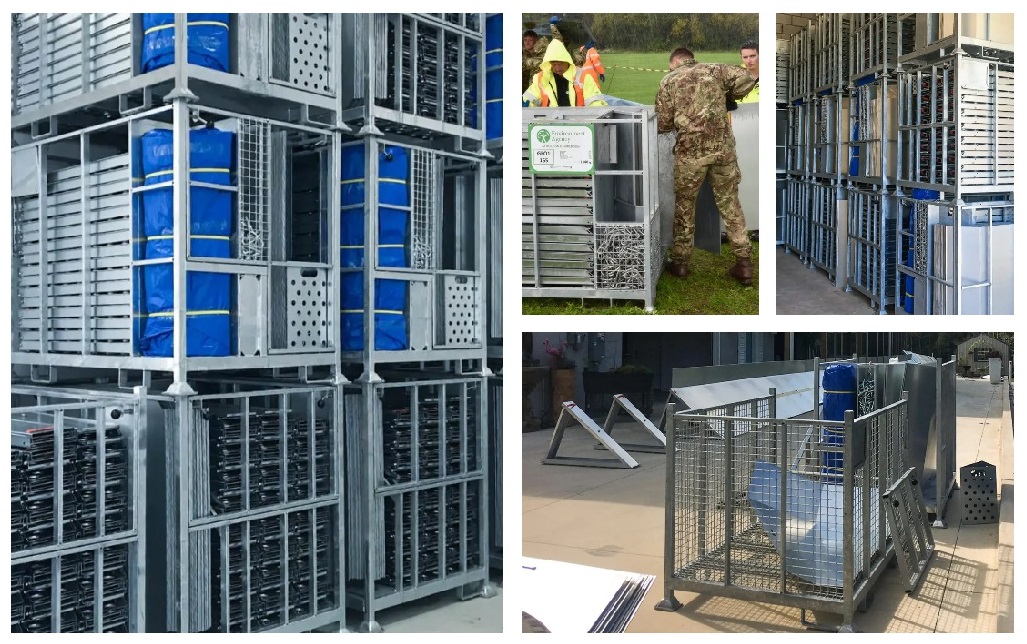
Designed with efficiency in mind, everything needed for 50 meters of flood protection is conveniently packed into a specially crafted metal cage, taking up only 2 square meters of space. This innovative design makes our flood protection system perfectly suited for large-scale applications.
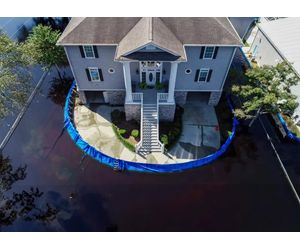
Geodesign`s Industrial Flood Barrier is a highly effective solution for protecting large areas from flooding in a short amount of time. Available in four different models - with dam heights of 121 cm, 101 cm, 81 cm, and 61 cm - the Industrial flood barrier makes it easy to create a customised solution following the topography of any site.
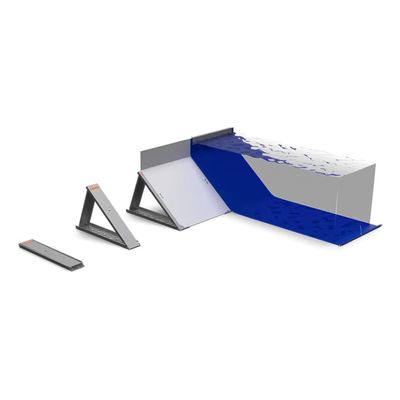
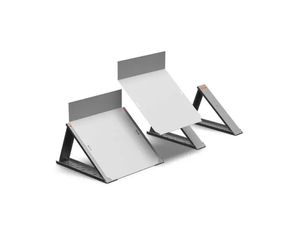
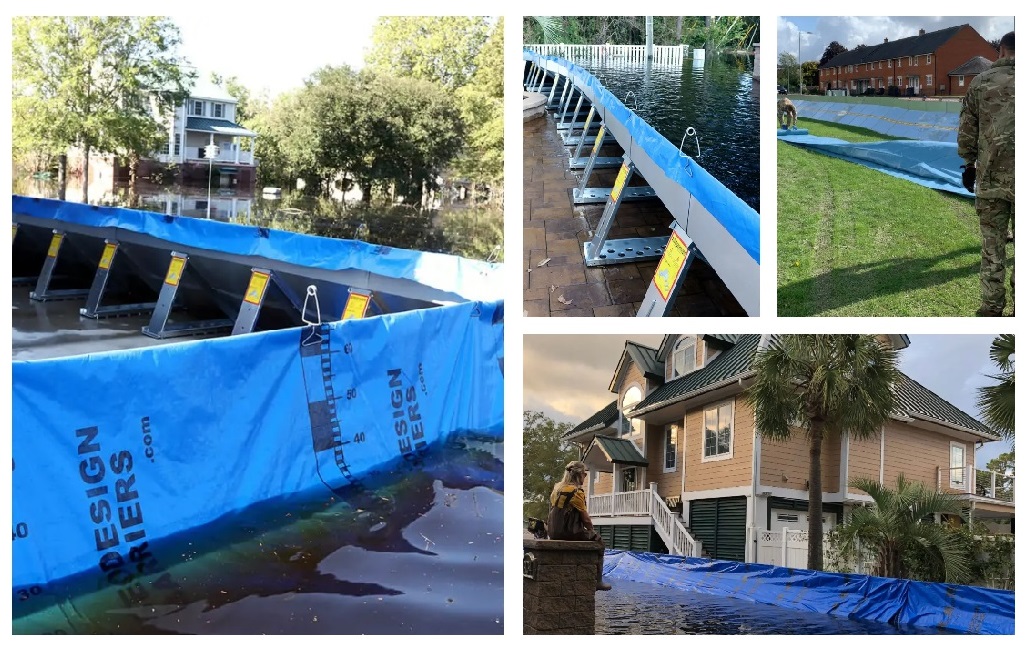
The Industrial Flood Barrier consists of two main metal components: a barrier support and a metal sheet covered with a plastic membrane. This unique design enables fast installation without the need for tools, heavy equipment, or a large workforce. The barrier`s ingenious simplicity has made it a favourite among government entities for its logistical advantages.
Our Industrial series is designed for convenience and efficiency, offering compact storage with all necessary components for a 50-meter linear length optimised into one sturdy, stackable metal crate. This streamlined approach allows for easy transport and deployment – an ideal solution for large-scale flood protection.
Dam height 61 cm
P61 Industrial
Flood Barrier
- Max water column: 0.61 m
- Section width: (ctc): 100 cm
- Setup time: (100 meters / 6 persons): 35 mins
- Footprint: (With poly liner): 184 cm
- Footprint: (Only barrier): 57 cm
- Weight / section: 17 kg
- Storage vol: (One set, 50 sections): 1.5 m3
Dam height 81 cm
P81 Industrial
Flood Barrier
- Max water column: 0.81 m
- Section width: (ctc): 100 cm
- Setup time: (100 meters / 6 persons): 50 mins
- Footprint: (With poly liner): 310 mm
- Footprint: (Only barrier): 88 cm
- Weight / section: 22 kg
- Storage vol: (One set, 50 sections): 2.0 m3
Dam height 101 cm
P101 Industrial
Flood Barrier
- Max water column: 1.01 m
- Section width: (ctc): 100 cm
- Setup time: (100 meters / 6 persons): 50 mins
- Footprint: (With poly liner): 305 cm
- Footprint: (Only barrier): 114 cm
- Weight / section: 27 kg
- Storage vol: (One set, 50 sections): 2.5 m3
Dam height 121 cm
P121 Industrial
Flood Barrier
- Max water column: 1.21 m
- Section width: (ctc): 80 cm
- Setup time: (100 meters / 6 persons): 1 h 10 mins
- Footprint: (With poly liner): 405 cm
- Footprint: (Only barrier): 145 cm
- Weight / section: 33 kg
- Storage vol: (One set, 40 sections): 2.9 m3
Our Industrial flood barrier is engineered with lightweight components, allowing for quick and efficient setup, transport, and storage without compromising functionality. Despite its lightweight design, this barrier has a high safety margin and is built to withstand strong currents, high water pressure, and additional loads such as waves and floating debris colliding with it at high speeds.
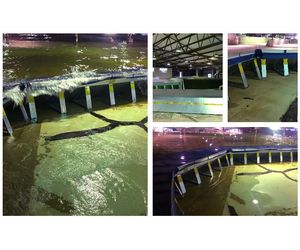
To ensure its reliability, our flood barrier was rigorously tested at the US Army Corps of Engineers Coastal and Hydraulics Laboratory in Vicksburg, MS. The tests were conducted in accordance with the FM ANSI 2510-2020 standard and demonstrated the barrier`s capability to withstand the most challenging flood conditions.
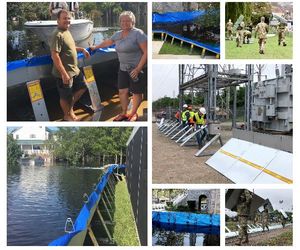
The Industrial Flood Barrier is designed to cope with challenging conditions, in both infrastructure and natural environments. Thanks to its unique flexibility, the system can be easily installed around, over, and up against obstacles such as undulations, kerbs, walls, fences and other permanent structures.
Also, Geodesign Flood Barriers are all compatible with each other, which allows for endless possibilities and combinations to suit the specific topography and conditions on site.
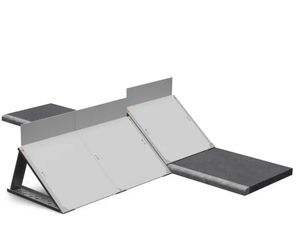
To create an adjustable section with the Industrial Flood Barrier, begin by laying the metal sheet over the desired section that is less than one meter. Fix one side of the plate in the usual way, and allow the other side to rest on top of the mount button. Next, let the bottom of the panel rest in the slot located by the toe of the metal support. This will ensure that the panel remains securely in position. With these steps, you can create an adjustable section that can be tailored to your specific needs and the unique challenges of your project.
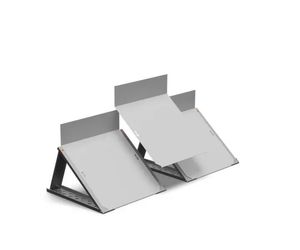
To handle sudden shifts in level, such as curbs, steps, or uneven ground, start by placing the sloping beams of the A-frames aligned and their sides flush against each other. Then, clamp together the front beams to ensure that they remain securely in place. Once the A-frames are properly aligned, you can continue building the barrier on the new level. With this technique, you can easily navigate obstacles and uneven terrain to create a sturdy and reliable barrier that meets the specific needs of your project.
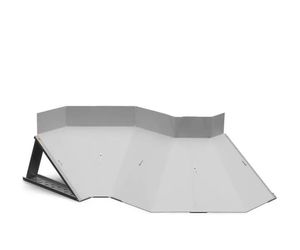
The Industrial Flood Barrier features specially designed corner panels that enable sharp 45-degree inner and outer turns. These panels provide the flexibility needed to navigate corners and create a barrier that conforms precisely to the contours of your project site.
To achieve a secure fit, adjust the length of the barrier so that it aligns flush against the wall. To attach the barrier safely to a vertical foundation or structure and minimize seepage, we recommend using our wall connection kit. This kit is designed to facilitate a reliable connection between the barrier and the foundation or structure. By utilizing our wall connection kit, you can ensure that your barrier is firmly anchored and capable of providing optimal protection against potential hazards.
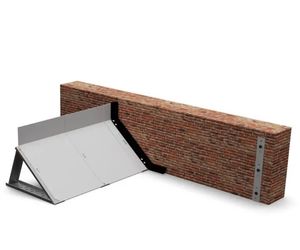
The Industrial Flood Barrier is not only compatible with other models within the same product family, but it can also be seamlessly integrated with the taller Heavy-Duty series. This compatibility allows for increased flexibility and adaptability in designing flood protection systems, making it easier to customize solutions that are tailored to your specific needs and requirements. The Industrial Flood Barrier offers a versatile and reliable solution for protecting your property and assets from flood damage.
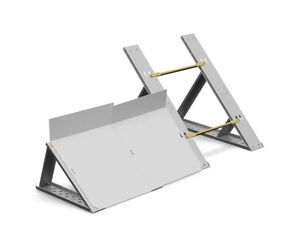
Thanks to the flexibility of its modular structure and thin steel panel, the Industrial Flood Barrier enables larger bends with a 90-degree turn radius of 10 meter using only straight sections. This feature makes it easier to design custom flood protection systems that can adapt to the layout of your property and minimize the need for additional components or complex installations.
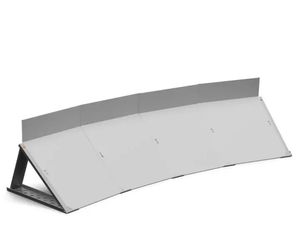
Geodesign`s Industrial Flood Barrier has been expertly designed and engineered for quick installation without the need for heavy equipment, tools, or a large workforce. This innovative steel barrier has become a top choice for government entities due to its logistical advantages and unparalleled simplicity.
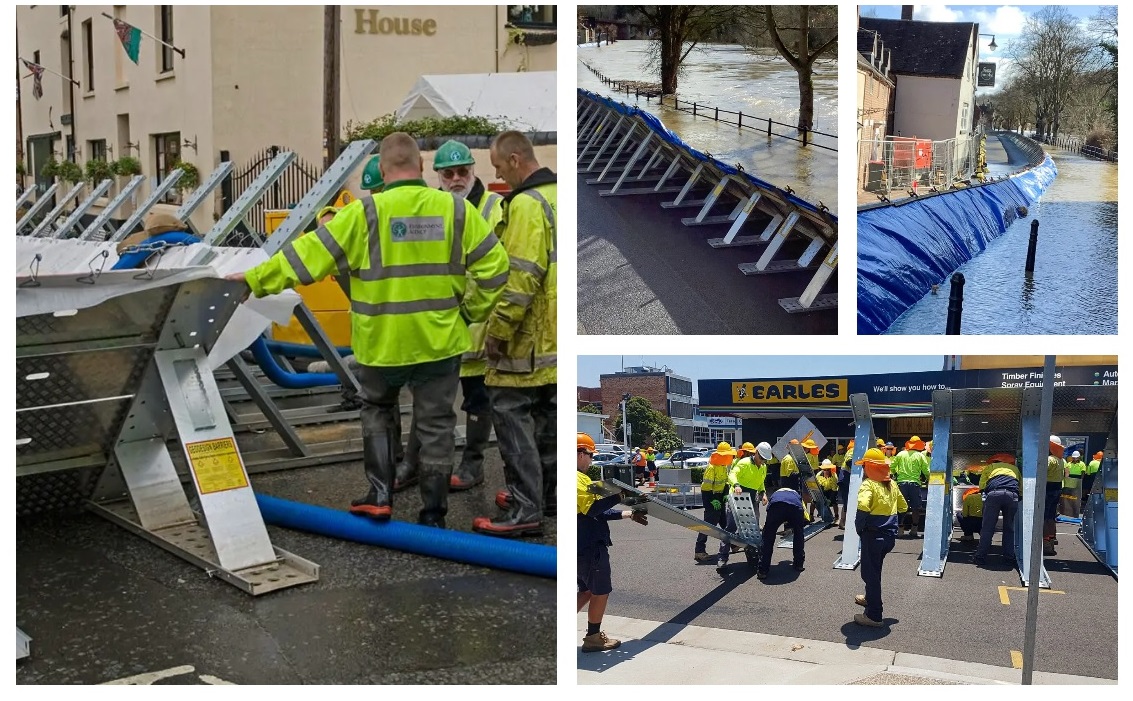
`To set up the barrier, begin by placing the supports along the intended barrier line, spaced at 1 meter intervals. Then, fold up each support by lifting up the front beam and unfolding the support beam. After fully extending the support beam, locate the snap lock at the bottom of the support beam and use it to lock the support in an upright position with the bottom beam. This will help ensure the barrier`s integrity before the water rises and provide stability.
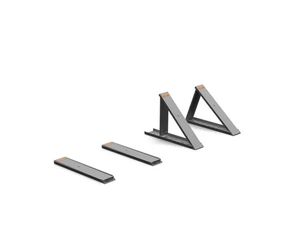
Hang the panels between the frames by sliding the cutout over the protruding mount knobs on the supports and overlapping the neighboring panels.
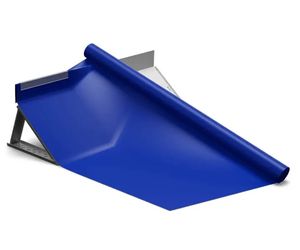
To install the membrane, roll it out along the barrier and secure it in place using panel clips at the top of the barrier. Then, attach a chain to the outer edge of the membrane on the ground and fasten it securely with cable ties.
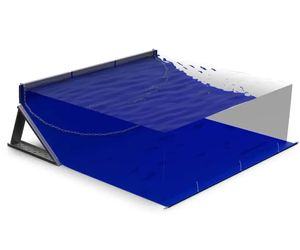
Allow the flood water to rise onto the barrier to generate the necessary pressure to self-anchor the system. This process ensures that the barrier is firmly secured in place and can withstand the pressure of rising water levels.
The Industrial Flood Barrier is an exceptional system that has been carefully crafted with the use of premium Swedish SSAB steel, resulting in a perfect balance of lightweight construction and remarkable durability. The team at Geodesign has over 25 years of experience in the industry, and through ongoing dialogue with clients, the system has been continually refined and improved to ensure optimal deployment efficiency.
Every component of the Industrial Flood Barrier has been designed with the primary goal of simplifying and accelerating deployment. As a result, this robust and secure system has achieved FM certification, ensuring its reliability and safety. Incredibly, a team of just 20 people can deploy 1,000 meters of the P101 system in less than an hour, showcasing the system`s unparalleled speed and effectiveness.
To enhance the grip and stability of the bottom beam, punched metal collars have been added underneath. These collars work by increasing the friction between the beam and the ground surface providing the necessary stability to ensure the structure`s integrity and safety.
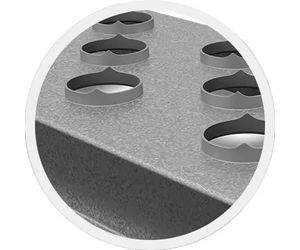
As shown in the illustration, our smart and innovative solution provides a simple and efficient method for fixing the Industrial metal sheet to the Metal Support. The solution features a keyhole design that allows for easy threading over the mounting button and a straightforward push-down installation to a fixed position.
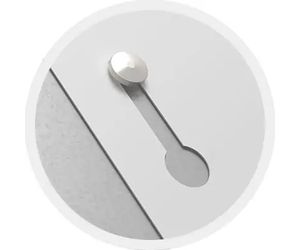
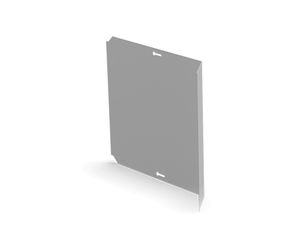
Our 1 mm thick sheet made from hot-dipped galvanized special steel features dual-phase steel from Swedish SSAB, providing excellent stretchable qualities and high strength. With a weight of only 12 kg, it is easy to handle and install, making it ideal for applications that require both strength and ease of use.
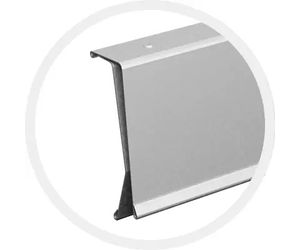
Our panel clip is an easy-to-use solution for securely fastening the membrane to the barrier. With a simple and intuitive design, this clip can be quickly and easily applied by pressing it down over the membrane and the metal panel. This user-friendly clip ensures that the membrane remains firmly in place, providing enhanced safety and security.
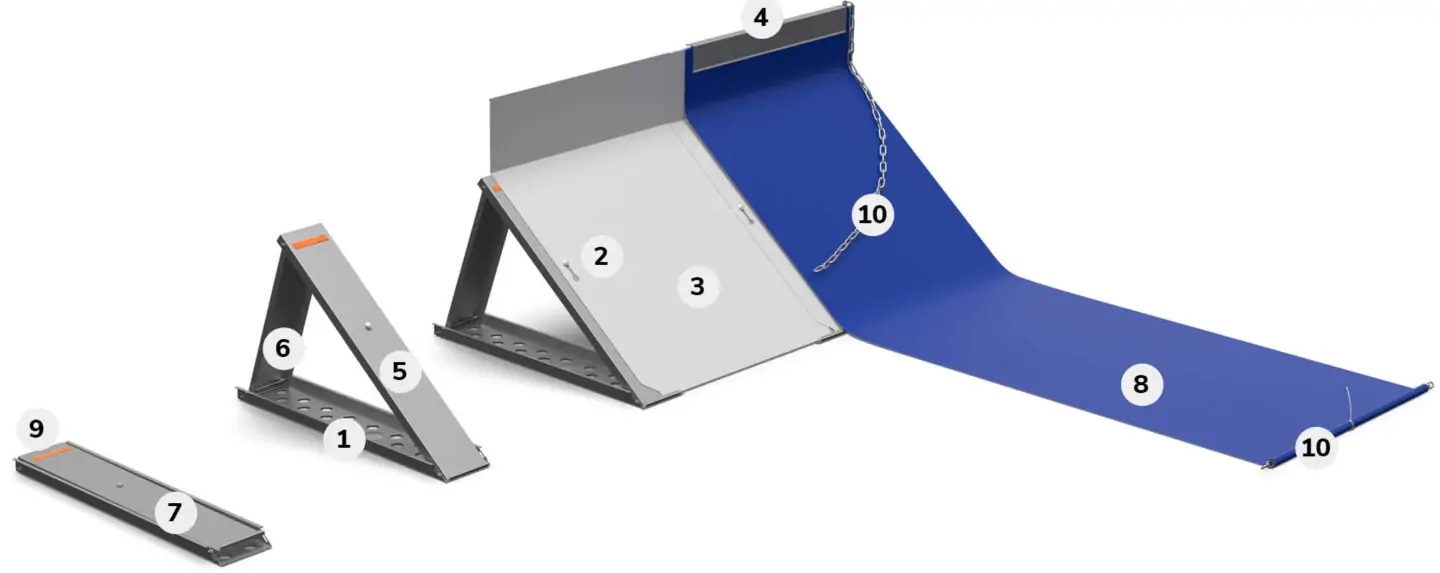
5. Triangular Industrial metal support
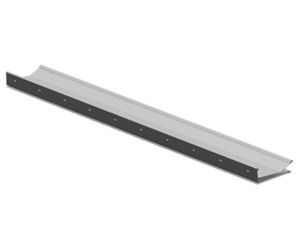
Featuring a collapsible and stackable design, our triangular metal supports provide increased user-friendliness and optimal storage. The support beam efficiently transfers water pressure to the bottom beam, which includes punched friction collars for enhanced stability.
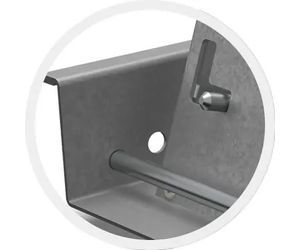
Our outer support beam is equipped with a spring-loaded snap-lock for easy and tool-free securing in the upright position. This streamlined process saves time and effort while ensuring a secure and reliable structure before water enters the barrier, providing enhanced stability and safety.
7. High strength steel
To guarantee long-lasting durability, we use high-strength steel for all components that experience high loads. To provide additional protection against corrosion, we hot-dip galvanize these components, ensuring an outstanding level of resistance to environmental wear and tear. This approach maximizes the lifespan of our components, ensuring that they remain reliable and perform optimally for an extended period of time.
8. Plastic membrane
Optimally sized and quality laminated, our laminate-coated high-density polyethylene (HDPE) material minimizes leakage and maximizes self-anchoring forces. Its durable laminate coating ensures a reliable and long-lasting solution for containing liquids and creating a secure barrier. With its enhanced durability, this material is ideal for a wide range of applications that require high-quality containment solutions.
9. Handle
Specially designed nylon strap minimizes accidents during the unfolding of the metal support, ensuring safe and effective deployment.
10. Chain - DIN 763
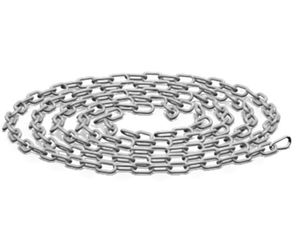
To secure the membrane before water enters the barrier, our system is equipped with a 12 mm x 5 m galvanized steel chain, including carabiners. This effective and reliable solution ensures that the membrane remains securely in place, providing enhanced stability and safety to the system during operation.
The Industrial Flood Barrier is delivered, transported and stored in a special crate designed to fit all components needed to install 50 meters of a complete barrier. The crate is divided into separate compartments and both short sides have detachable gates that ease and speed up loading and unloading. A fully loaded crate weighs up to 1386 kilograms and can be moved with a pallet jack. The outer dimensions vary between the models and all crates are stackable three high.
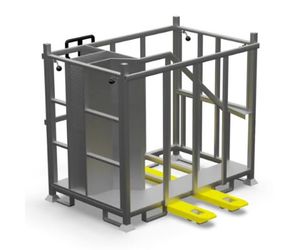
An industrial metal crate contains 50 folded metal supports arranged in three rows. The first two rows have 17 supports each, while the third row has 16 supports, totaling to 50 supports.
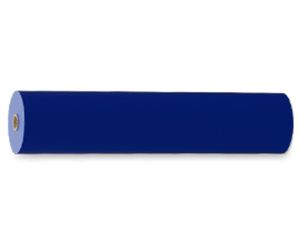
Plastic membrane are folded 4 times and rolled. Stored upright in the Industrial metal crate.
Chain of 5 meters with carabiners at the ends.
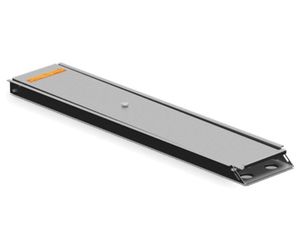
The metal sheets are vertically arranged and tightly packed together to minimize the space they occupy.
The pack contains 100 cable ties that are intended for single-use and cannot be re-used.
50 pcs
When it comes to purchasing a flood barrier, there are many factors to consider. While each flooding event is unique, taking a comprehensive approach to understanding your specific situation can increase your chances of finding the right solution. With our 25 years of experience, we want to assist you in making an informed decision. To aid you in this process, we have compiled a list of crucial criteria to consider:

Ensure that any flood barrier system you consider is certified by a trusted third party for reliability. A failing flood barrier can have catastrophic consequences, causing significant damage and endangering people and property.
Verify that the barrier system has quality certificates from a reputable third party. Flood operation activities and safety should always require certified products with rigorous testing and evaluation procedures as the standard.

Ensure that any flood barrier system you consider is certified by a trusted third party for reliability. A failing flood barrier can have catastrophic consequences, causing significant damage and endangering people and property.
Verify that the barrier system has quality certificates from a reputable third party. Flood operation activities and safety should always require certified products with rigorous testing and evaluation procedures as the standard.

When it comes to flood systems that require filling materials such as sand, water, gravel, or air, it`s important to consider all logistics involved to ensure full operational function.
This includes factors such as accessibility and handling of the filling material, which may require heavy machinery, manpower, pumps, and sufficient pumping capacity to supply the required amount of material in a timely manner to the designated flood area. Calculating these logistics and associated costs is crucial when comparing different flood solutions. In addition, it`s important to note that materials like sand and water can become contaminated after a flood, and proper handling and disposal procedures must be followed to ensure responsible post-flood management.
It`s important to consider the impact on your site if the flood barrier system needs to be anchored. This may involve additional costs or disruptions to the ground surface.
Additionally, it`s essential to factor in the expenses of reinstating the ground surface after a flooding event. These considerations can help you evaluate the total cost and feasibility of a flood barrier system for your site.
It`s crucial to assess whether a flood barrier system can withstand the challenges posed by tough terrain and real-world conditions. Uneven surfaces, steps, slopes, urban street furniture, overtopping, and floating debris are just a few of the obstacles that the system may encounter.
By taking these factors into consideration, you can ensure that the flood barrier you choose will perform effectively in the face of adversity.
When buying flood barriers, consider the price in relation to the expected lifespan, and the impact of usage, sunlight, water, and temperature. The cost of deploying, installing, and maintaining the barrier, including filling materials, spare parts, repairs, training, deployment equipment...
...and personnel, should also be factored into the total cost of flood protection. This helps you make a cost-effective investment in flood protection.

When it comes to flood barriers, a well-designed setup is essential for a smooth and easy set-up and take-down process. A quick installation time is critical to ensure that the flood protection is in place before flooding occurs, and it can also help to conserve resources.
However, it`s important to note that some systems may look straightforward but can be cumbersome in practice due to various connections and small parts that need to be assembled into a coherent barrier. Therefore, it`s crucial to select a flood barrier system that has been carefully thought out and designed to ensure a hassle-free setup process.

When floods occur, flood defenses may become exposed to contaminated water. This can pose a challenge for flood barriers that rely on materials like sand or water, as they may become contaminated as well.
Additionally, some plastic-based systems cannot be effectively cleaned if they come into contact with contaminated water and may need to be replaced entirely. To ensure that you are well equipped to handle such situations, it is crucial to choose a flood barrier that can effectively manage and mitigate the impact of contaminated water.
There are certain costs associated with maintaining and handling flood barrier systems to ensure that they are ready for the next flood. Activities such as system inspections, removal, and clean-up can pose significant challenges if the design of the system does not facilitate easy access and maintenance.
For example, clogged fabrics that cannot be reused or sealed tubes that are difficult to dry out from contaminated water can make post-maintenance time-consuming and costly. Additionally, it`s important to consider repair, replacement, and proper disposal of damaged parts.
To make an informed decision, it`s recommended that you ask the supplier for more details or preferably references from other users of the system. By doing so, you can ensure that the system you choose is reliable and cost-effective in the long run.
When it comes to flood barriers, the market offers a wide range of options. Regardless of the type you choose, however, all flood barriers share the ability to hold back water in various ways and to varying degrees without being dislodged by the pressure exerted by the water.
These methods can generally be classified into four distinct concepts, each with its own strengths and limitations. By understanding these concepts, you can make an informed decision when selecting a flood barrier.
Filling material
The concept behind these types of flood barriers is to use a filling material such as sand, water, gravel, or stones to provide weight and create a flood defence system that stays in place. To install this type of barrier, trucks need transport the filling material to the site, where it is placed within the barrier`s structure. If water is used as the filling material, it`s important to have access to a water source prior to a flood event.
VS.
No filling
These types of flood barrier systems are designed to create an anchoring force that is stronger than the pushing force of floodwaters. As a result, no additional filling material, such as sand or water, is required to secure the barrier in place.
Anchored
In order to withstand the pushing forces of floodwaters, some flood barrier systems require additional anchoring beyond their own construction. This is typically accomplished by fastening the barrier to the ground using various methods.
VS.
Freestanding
The design and/or weight of the system are such that it has sufficient anchoring power to remain stable and in place without the need for additional anchoring.
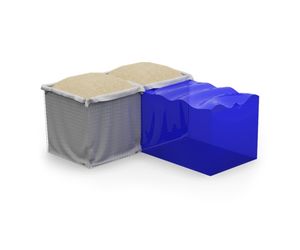
There are many types of flood barriers available on the market, each with its own unique form and operational characteristics. By considering the four different concepts presented - filling material vs. no filling material and freestanding vs. anchored - we can explore the various flood barriers available on the market in more detail. Below is a brief description of some of the flood barrier types.
Gabions are cellular barriers that can be connected together to form a flood barrier line. They are typically constructed with permeable materials like geo-fabric and reinforced with frames made of wire mesh and pins. To provide stability against floodwaters, gabions are filled with materials such as sand, water, or gravel stones. These systems are considered gravity dams because they rely on the weight and shape of the filling material for stability.
- The height of the system can be increased during use, making it flexible and adaptable to changing flood conditions.
- However, installing gabions can be time-consuming because it requires a large amount of filling material.
- Additionally, heavy machinery such as trucks and water pumps are needed to provide the filling materials.
- After a flood event, disposing of large volumes of contaminated filling material can be challenging.
- Moreover, clogging of the fabric material can make it difficult to clean, and the gabions may not be reusable.
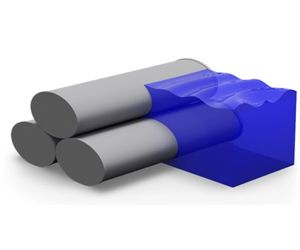
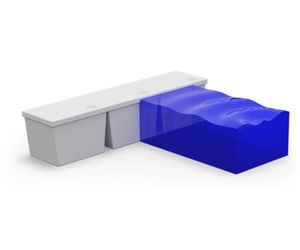
These flood barriers consist of large, prefabricated tubes made of reinforced PVC plastic. The tubes are connected to each other to form a flood barrier line. Because they rely on the weight and shape of the filling material, these systems are considered gravity dams and can provide stability against floodwaters.
Installing the system requires machinery such as trucks and water pumps to fill the tubes with sand, water, or another suitable material. Water-filled tubes are generally suitable for long lengths of protection close to a water source.
- One advantage of these systems is that they require relatively small storage space.
- However, they must be deployed close to a water source, which can limit their use in some areas.
- These systems are highly susceptible to vandalism or damage by sharp objects.
- Additionally, any tears or punctures can rapidly lead to failure of the whole system, which can compromise its effectiveness.
- Finally, the tubes require relatively flat surfaces for deployment, which may not be feasible in all locations.
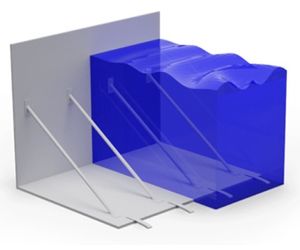
These flood barriers are made up of rigid, self-supporting elements that interlock to form a continuous wall. The elements are typically prefabricated and jointed, with an L-shaped structure that utilizes the weight of the floodwater to create an anchoring force. However, additional anchoring may be required to prevent movement, which could involve ground investigation and/or pre-installation. This anchoring can make these systems less versatile compared to freestanding systems. The front edge of the system is designed with a sealing list to prevent seepage.
- One advantage of these systems is their relatively small footprint on the ground.
- However, the need for ground anchoring can make the preparation of the flood protection process similar to demountable systems.
- These systems are not suitable for use on uneven ground.
- Finally, the longer deployment time needed for anchoring in the ground may be a disadvantage in some situations.
These flood barriers consist of rigid self-supporting elements that are connected to form a continuous flood barrier wall, similar to anchored vertical walls. The L-shaped structure uses the weight of floodwater over the front edge of the system to provide stability and create a seal towards the ground.
However, it`s important to note that:
- These barriers may not be suitable for natural surfaces like grassland or arable land, as seepage under these systems can be significant, especially in uneven terrain due to their rigidity.
- These barriers are best suited for diverting water flows rather than withholding water due to the high seepage underneath the system.
- While they are quick and easy to deploy, it is essential to consider their limitations.
- They may not work for higher flood levels, and they are not suitable for uneven ground.
- Despite being cheap and easy to deploy, the high leakage underneath the rigid elements must be taken into account when selecting the right flood protection system.
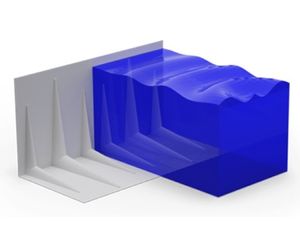
Frame barriers are a modular flood barrier system consisting of rigid frames covered with impermeable materials. They are freestanding and use the weight of the water for stability, making them self-anchoring. This engineered construction allows them to withstand floodwater and do well in uneven terrain. Assembling them is easy and follows a logical step-by-step procedure, and no parts are heavier than two persons can carry.
Key features of frame barriers:
- Modular barrier made of rigid frames and impermeable materials.
- Freestanding and self-anchoring, using water weight for stability.
- Engineered construction that withstands floodwater and works well in uneven terrain.
- Easy assembly with logical, step-by-step procedure.
- Lightweight parts that are easy to carry.
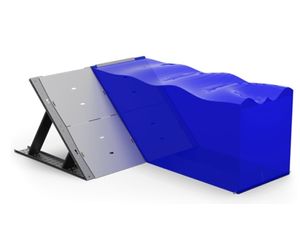
These barriers are designed to protect against floodwater and are composed of free-standing sections made of flexible and impermeable plastic. The system is anchored to the ground for stability, and the floodwater itself is used as filling material. Stability is achieved through the weight of the water acting on a long skirt located in front of the system. During critical moments, manual labor is required to ensure that the floodwater enters the system correctly.
- Uses floodwater as filling material
- Requires manual labor during critical moments
- Comes in fixed lengths
- Risk of collapsing if floodwater overtops
- construction
- Not very flexible
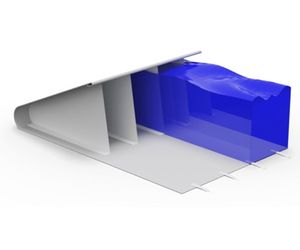
These flood barriers consist of water-filled containers that are cellular in structure and can be linked together to form a line of defense against floodwater. They are often made of impermeable materials such as polyester, polyethylene, and plastic, and achieve stability through their shape and weight of the filling material. However, they are prone to sliding when overtopped. These gravity dams require machinery such as trucks and water pumps for installation, and the mobilization and deployment process is affected accordingly. Minor leaks can usually be repaired in service. The system has a rigid bottom and is not suitable for uneven terrains.
- Made of impermeable materials such as polyester, polyethylene, and plastic.
- Achieves stability through the shape and weight of the filling material.
- Prone to sliding when overtopped.
- Requires machinery for installation.
- Not suitable for uneven terrains and has a rigid bottom.
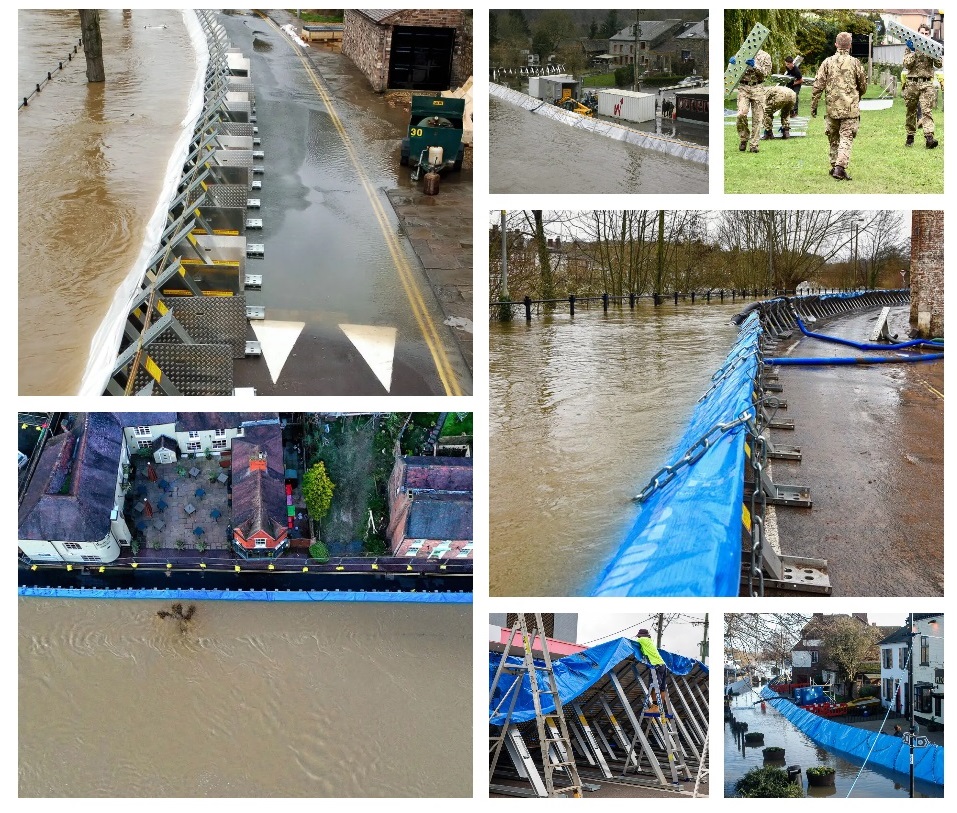
In the UK, Geodesign has been awarded the honorable duty of supplying the Environment Agency and the UK Army with flood protection barriers. The UK Flood Barriers are stored strategically placed depots throughout the country and military personel train regularly with deployment and usage. It is a combination of Geodesign’s steel and aluminum flood barriers as well as a number of high capacity flood pumps that have been selected to make up the nation’s flood defence. The testaments from the UK Environment Agencyrepresentatives have been undividedly positive after working with Geodesign Barriers. The steel structure instills trust and reliability, yet increase work speed and flexibility compared to inflatable water barriers.
Water barriers are flood barriers filled with water. No, we don’t offer an inflatable flood barrier – they are dangerous and unreliable as a concept – but we offer a steel canal that we fill with water to make it virtually impossible to move. A water barrier for homes with a dam height of 16 inches weighs more than 400 lbs per linear foot! Hurricanes and storms are not able to move the water barrier when a few yards of barrier have been deployed properly. Water barriers to prevent flooding after hurricanes are an ideal solution to an enormous problem.
Many home owners have approached us about home flood barriers in the last few years. Our solution is a real residential flood barrier made of high strength steel. It comes in dam height of 16, 24, 32 and 40 inches and is easily deployed and mounted by one man or woman. The barrier consist of the a-frame supports, the flood shields and waterproof membrane. No tools are needed and no part weighs more than 25 lbs. Just mount the steel plates to the supports by hanging them on the knobs located on the front beam of the barrier support. When the complete barrier is deployed, roll out the membrane along the barrier line and attach the sealer clips to the top of the flood shields to hold the membrane in its place.
A flood barrier is essentially a wall constructed to stop flood water from damaging property or entering an area. The first flood barriers were built with sandbags and required a lot of personel to erect. For decades, military and volunteers have been hauling these sand bags to build flood barriers around their but it has been slow, ineffective.
Unfortunately, we cannot control if, when or where flooding will occur. The nature of floods is very unpredictable and permanent walls and levees have rarely provided a good solution since flooding often occur in different places and with irregular time intervals. Instead, successful flood control has come to rely on temporary flood barriers, high performance flood pumps and a prompt response to the first flood warnings. The flood control barriers from Geodesign are being used an emergency response to flooding throughout the world today. Quick deployment and reliable, durable steel are success factors in continously diverting flood water from urban and rural areas.
A flood wall to stop water from entering your area or your building can easily be set up with Geodesign Flood Barriers. The inclination of the barriers require slightly more ground space to deploy the flood wall but it is freestanding and leaves no marks on the property after demounting.
The Geodesign Flood Barriers have been designed for flood rescue operations under the most difficult conditions imaginable. Since the start in 1995, numerous flood engineers, emergency managers, city planners and military personell have contributed with feedback to improve the products to what they are today: Quick, lightweight, low volume, strong, durable and versatile. The solution to flooding is here and ready to be deployed. Preparation, the right flood barrier and a prompt response are keys to success.
QUICK & EASY TO DEPLOY
No fill material, pre-installments or tools. The logical assembly of the Geodesign Barriers make them the fastest flood barriers to install.
OPTIMAL STORAGE AND TRANSPORT
With its ingenious design, the collapsible supports and thin flood shields enables optimal storage and transport. Our flood barriers are delivered in stackable steel crates.
ROBUST AND DURABLE
Reinforced high strength steel has a lifespan of 100+ years and withstands overtopping as well as hits from debris. Sound engineering keeps you safe and
25 YEARS OF EXPERIENCE
Our flood barriers are delivered with a complete flood protection plan for your property and a full day of training. Take advantage of our experience.
Water barriers, Flood control and Cofferdams with 25 years of experience
Temporary and demountable cofferdams have great advantages where there is a need for a quick dam with little to to no permanent marks on the site. It is a fast and efficient way of drying up riverbeds, lakes, ponds and even boat docks. With our temporary barriers, nothing is anchored to the ground and no tools are needed to create a stable and dry cofferdam in 10 foot deep water. We have 25 years of experience and the best product to offer a complete cofferdam at a competitive price. Ask us for details and pricing here.
A quick dam might sound like a simple, almost playful, idea of building a dam. The truth is that the forces applied to a flood barrier when used for building temporary dams are tremendous and the importance of a correct setup cannot be understated. However, speed is always a factor when problems with water need to be solved and a quick dam is exactly what we aim to deliver. With decades of experience and a superior product, Geodesign and its engineering partners are able to construct complete temporary dams within a few hours of work. We offer quick, secure and cost effective dams across America.
The development of flood control plans has evolved rapidly over the last 10 years. The notion that “nothing can be done about floods” has been changed with the emergence of flood control products. Today, most cities and towns in the western world that are prone to flooding, has some sort of flood control plan or flood control preparedness. Geodesign Barriers work together with clients to set up proper flood control measures, that involve everything from city planning and flood watch to flood barriers and pumps.
To plan for flood prevention and mitigate risk, one must assess the project as disaster relief and with a mindset of fighting back, much like fighting fires. Planning and preparation is absolute key to successful flood fighting and the best flood prevention plans contain training as well as flood protection products.
Flood barriers are a great solution to one of the oldest problems societies face – flooding. A market has emerged with plenty of alternatives to sand bags and most towns, communities and even house owners know that there are ways to protect their property and infra structure. Among the different options for flood protection, we strongly believe that flood barriers of steel should be atop your list. Steel is strong and withstands pressure from water and floating debris. Steel is durable and last a lifetime. Steel is also less susceptible to sabotage or accidents involving sharp object.
In recent years, the flooding after hurricanes Katrina, Harvey, Sandy and Irmahave caused enormous damages to American homes and infrastructure. The costs of hurricane Harvey is estimated at approximately $125 billion and the cost of hurricane Katrina stands even higher at $160 billion. It is clear that anything that can be done to reduce these damages will greatly help the local community, the home owners, the federal emergency resources and the state. Geodesign’s water barrier is a water canal that stands above ground weighs up to 1.2 tons per linear foot. In other words, an extremely heavy and stable water barrier that withstands hurricane type winds and protects against flooding.