

Industrial Reverse Osmosis Systems
Reverse osmosis systems are todays` most recent and rapid developing water treatment technology. In the previous years, as R.O. systems were so new and expensive, they were only used in waterless districts to obtain drinkable water from sea water and in industries like medicine and cosmetics which derive high quality water. But today, as their operating systems are simplified and their prices became affordable, the usage of RO systems are spreaded.
- Industrial reverse osmosis systems are preferred in;
- Obtaining drinkable water from municipal and acrid well water
- Processes that require water with very low conductivity
- Concentrate water recycling processes
- Treatment of water with high metal concentration
- Obtaining drinkable water from sea water
There are the semi-permeable membranes in the basic of RO treatment systems. The semi-permeable pore structure on the membrane have a bigger diameter than pure water but smaller than the diameter of substances dissolved in water. When high pressure water is pushed through the membrane, only pure water molecules and 1-3 % of the solution in water can penetrate through the pores. So, the dissolved substances in water are hold minimum by 98% according to their diameter, while the suspended solid particles and the microorganisms like bacterias and viruses are filtered. Molecules with higher density can`t pass through the membrane, they are led to the drainage and the clogging of membrane is prevented. As the process is completely physical, it is also environment friendly.
Using R.O. systems you can derive a higher quality water than spring water.
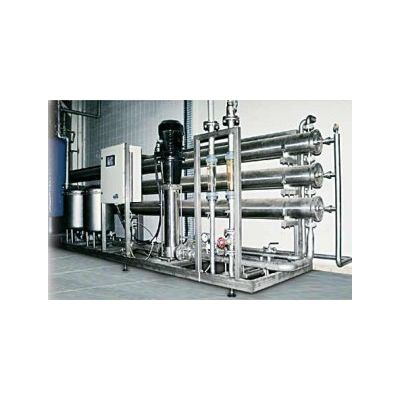
- IDEAL Industrial RO systems are PLC controlled, full automatic, and practical to use.
- System is stainless constructed to have a prolonged service life and to minimize painting and conservation costs.
- Membrane housing may be selected either stainless or FRP.
- High pressure pump is vertical axis centrifuge and SS316 steel.
- Have different models serving up to 1,000 m3/day.
- Flowmeter and TDS meter displaying instant system performance are also included.
- To maintain a prolonged use of membrane, autoflash (automatic washing solenoid to delay chemical cloggins that may possibly occur in the system) and a recycling adjustment valve for system recycling and pump rate of flow stabilization are used.
- Our specialized engineers will choose the best protective treatment and chemical dosing systems to increase the efficiency of RO systems operating depending on the desired water quality and the rate of flow.
The reverse osmosis systems established to obtain energy savings by decreasing the condensed drain in high conductivity raw inlet feeded cauldrons, will amortise in between 6 to 15 months due to the raw inlet conductivity.