

Spartan - Model A30 -Industrial UV Ozone System
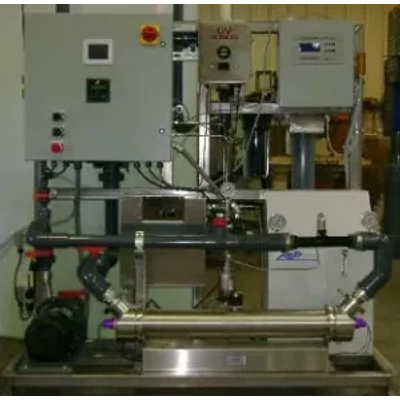
The SPARTOX A30 UV system here is designed for methanol removal from DI water for a water reclamation application in the U.S. The SPARTOX Ozone UV System here is for an industrial wastewater treatment application in Canada.
The advantages and disadvantages of the ozone (O3) UV system are the removal efficiency of the combined UV ozone process is typically higher than the additive removal efficiencies of ozone and UV alone.
The combined O3/UV process is more efficient at generating hydroxyl radicals than the combined H2O2/UV process for equal oxidant concentrations using LP-UV. This is because the molar extinction coefficient of O3 at 254 nm is two orders of magnitude greater than that of H2O2, indicating that a higher UV intensity or a higher H2O2 dose is required to generate the same number of hydroxyl radicals for these two processes.
However, for MP-UV lamps, H2O2/UV processes will generate more hydroxyl radicals than O3/UV processes. MP-UV process has some disadvantages versus LP-UV, however.
Despite the fact that O3/UV is more stoichiometrically efficient at generating hydroxyl radicals than H2O2/UV or H2O2/O3, the O3/UV process is less energetically efficient than H2O2/UV or H2O2/O3 for generating large quantities of hydroxyl radicals due to the low solubility of O3 in water compared to H2O2. Thus, operational costs are expected to be higher if large amounts of contaminant are present. Gaseous O3 must be diffused into the source water, resulting in potential mass transfer limitations relative to H2O2, which is fed as a liquid solution.
UV light penetration into the source water can be adversely affected by turbidity. There are also many interference compounds that absorb UV light (e.g., nitrate and iron) and, thus, reduce process efficiency. A well designed AOP can overcome some of these problems by first dealing with contaminants such as iron or suspended solids prior to the radical formation step. For example, pretreatment with ozone and filtration.