


- Home
- Companies
- Influent Separation & Environmental ...
- Products
- Influent - Calming Baffles (Perforated ...
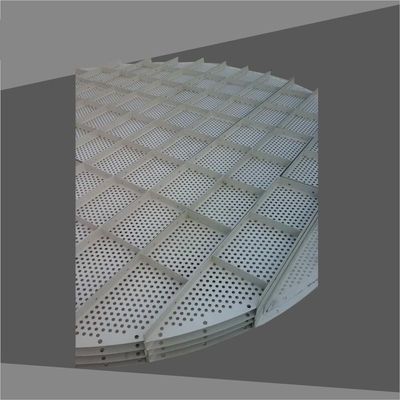
Influent - Calming Baffles (Perforated Plates)
Calming baffles, also known as perforated plates, are commonly used in liquid-liquid separation processes to help separate immiscible liquids of different densities. The baffles are typically placed in a tank or vessel and help to reduce turbulence and promote laminar flow, which enhances the separation of the two liquids.
The perforations in the plates allow the liquid to flow through the baffle, while also helping to prevent any large-scale mixing or agitation of the liquids. This helps to promote the settling of the heavier liquid to the bottom of the tank, while the lighter liquid is able to flow over the top of the baffle and collect in a separate compartment.
There are a variety of different designs and configurations for calming baffles, including horizontal and vertical plates, as well as more complex configurations with multiple plates or specialized geometries. The choice of baffle design will depend on a number of factors, including the specific properties of the liquids being separated, the size of the tank or vessel, and the desired separation efficiency.
Overall, calming baffles are an effective and relatively simple solution for liquid-liquid separation, and are widely used in a variety of industrial applications, including oil and gas, chemical processing, and wastewater treatment.
- Stainless steels
- Duplex steels
- Alloys
- PP, PVDF, PVC
Calming baffles (perforated plates) shall be installed between the inlet and settling compartment of the vessel. The function of these baffles is to promote an even flow in the settling compartment which will facilitate the separation of the two liquid phases.
The quiescent flow regime provides an environment in which liquid-liquid separation is optimized. Without the calming baffle turbulent flow occurs in which the two phases are constantly mixed and therefore strict separation calculations
cannot be met irrespective of whether a large amount of residence time is made available.
Plate thickness: typically 3mm with SS
Hole Pitch Angle:60° or 90°