


- Home
- Companies
- J&C Bachmann
- Products
- J&C Bachmann - Model IBERIA - Inline ...
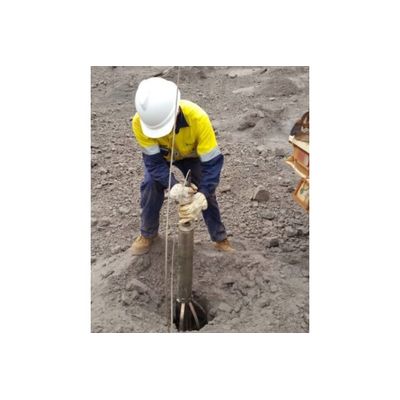
J&C Bachmann - Model IBERIA -Inline Borehole Element Recognition and Identification Analysis
The reconnaissance of deposits is done by extensive exploration drilling. The borehole debris is collected for later analysis in the laboratory. This is a time-consuming and expensive procedure. Furthermore, the derived samples represent an average of a remarkable drilling distance so that information about small shifts will be lost.
The borehole probes developed by JCB are based on X-ray fluorescence and offer the logging of the borehole immediately after drilling. The results are therefore available in time and can be transferred automatically into a deposit map. This enables an active control of the deposit reconnaissance, using the BOSTON software.
Partner organizations in mining countries like Australia, Canada, Chile, South Africa or Peru are ready to support local operation of IBERIA probes.
There are many different applications with a variety of requirements for IBERIA. Therefore several different versions of IBERIA were developed to meet these demands. All diameters of IBERIA are also available as REE version which uses a special X-ray tube to excite rare earth elements.
All IBERIA downhole probes can be operated from standard 4-wire winches. Together with our custom operator unit it can be quickly deployed and integrated into different winches and on-site setups.
This tool has evolved from the Iberia 95 and is expanding the target element range to lighter elements while also providing shorter measurement times at the same precision. Furthermore this probe is the first to include software and hardware based distance correction for the XRF measurement system.
With a diameter of 70 mm this borehole probe can be used for most exploration holes. Besides blast holes, diamond drilled holes with sizes NQ/76mm and larger can be measured. A changeable X-Ray-window configuration ensures good measurements on different borehole wall conditions. A cooling system keeps up the measurement performance for operations in hot environments, even with desert-like temperatures of up to 50°C.
Transmission signals may be disrupted when they are obstructed by too much interference of ore (e.g. iron, copper). To counter any loss of precious measurement data we developed a probe that utilized a communication technique which enables measurement in great depth, limited primarily by the water level in the hole. Together with a data buffer in the probe this leads to a connection that would withstand rugged conditions – and without losing precious data.
IBERIA 70 and IBERIA 53 were developed together. With its eponymous diameter of 53 mm it rounds off the portfolio downwards and is particularly suitable for diamond drilled NQ but also for BQ holes. The features of the 70 mm probe are also found in the little sister; interference-free transmission with data buffer, shorter measuring time compared to the previous probes as well as an effective distance correction.
The greater length of the IBERIA 53 is reduced to less than 1 m for transport by cutting it in the middle. With the highly portable operator unit, the system forms a mobile unit that can be easily transported and quickly deployed.
Real time measurement of element concentrations by utilizing our MPT technology. The Metal Probing Tool (MPT) contains a x-ray fluorescence based detector which measures metal concentrations. The detector is build in a small probe which can be advanced into the tailings material by static force.
We can use all kind of equipment for pushing the probe like CPT-trucks and units, Direct Push rigs (Geoprobe) or hydraulically driven stand alone rigs.
This tool has an outer diameter of 95mm. Designed for bigger diameter exploration holes, this tool provides a fast downhole survey down to 200m depth while continously delivering elemental analysis data of the borehole wall. The window layout and ruggedness targets heavier elements at typical concentrations.
Iberia 125 has an outer diameter of 125mm. It is designed to quickly survey production holes with diameters of more than 150mm. The elemental composition of the material blasted next is available directly after probing and therefore allows to increase the resolution of the rescource model and to do short term mine control.