


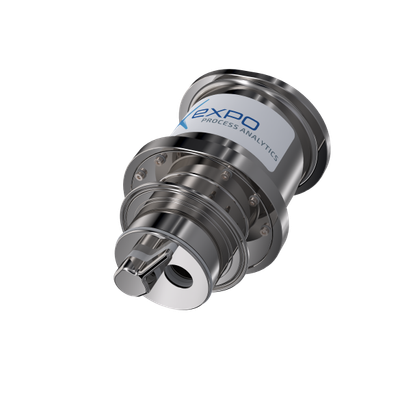
Expo Process Analytics - Model Rado™ -Inline Process-to-PAT Interface System
The Rado™ inline process-to-PAT interface is engineered for the effective use of Process Analytical Technology (PAT) in solids processing, a critical element in pharmaceutical manufacturing. The process-to-PAT interface features a mechanical wiper that maintains a clean PAT probe window by continuously removing accumulated materials. This design mitigates issues associated with accumulated granules on PAT windows that could otherwise skew measurements and lead to inaccurate analysis of critical quality attributes such as moisture content and particle size. The Rado™ is further enhanced with an optional heating element, which raises the probe window temperature just above the process environment to improve wiping efficiency and operational reliability. The innovation negates the need for additional utility lines or compressed air, allowing for an automatic, hands-free cleaning operation. This makes Rado™ a robust solution for integrating PAT models and advancing manufacturing efficiency without compromising the production environment.
Unit operations for solids processing involves the ability to effectively process and measure a variety of stream types. For example, granulation often results in a dense and “sticky” particle stream and spray drying results in a disperse and dry particle stream. The ability to measure these solids inline with PAT inform on critical quality attributes of particle size, moisture content, and crystallinity in real time. These PAT data are the foundation for advanced manufacturing approaches such as risk-based process development, advanced process control, digital twins, and real-time release. Based on our years of experience in pharmaceutical solids manufacturing, we have developed novel process-to-PAT interfaces to ensure robust PAT in solids and enable advanced manufacturing approaches.
Rado™
Granulation is a mixing technique for solids. Wet granulation uses a liquid binder and agitation to form a conglomerate particle called a granule. Dry granulation uses mechanical means to form a granule. PAT probes are often installed inside powder and granule dryers and granulators for real-time moisture and particle size prediction. However, these granules can accumulate on the window of a PAT probe because of its moist or adhesive properties. The accumulated materials on a PAT window has a serious consequence of the PAT only measuring the accumulated material rather than the granules in flow. This biases the PAT measurement and can eventually lead to inaccurate modelling of critical quality attributes.
The Rado™ is an inline process-to-PAT interface that uses a mechanical wiper to continually clean the PAT probe window. It is a proven approach to significantly reduce probe fouling. A heating element option is also available to further improve wiping performance by elevating the probe window temperature slightly above the process temperature. This approach has advantages over compressed air streams because it does not require a new utility line, does not introduce a new substance into the process, and can be automated for hands-free operation.