


- Home
- Companies
- Plansee India High Performance ...
- Products
- Inserts for Extrusion Dies
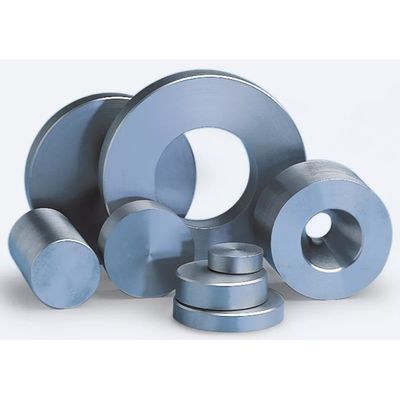
Inserts for Extrusion Dies
Inserts made of molybdenum-hafnium carbide for extrusion dies. Extrusion presses are used to form non-ferrous metals such as brass, copper-nickel, and aluminum-bronze, as well as stainless steel, into rods, wires, or tubes. The metal blank is first heated to its forming temperature and then is pressed through the die using a ram. This gives the metal its external shape. Extrusion dies are exposed to high mechanical pressures. A very high level of frictional heat is also generated between the die and the workpiece during processing. By adding small quantities of hafnium carbide, we get our molybdenum ready for a long service life in your extrusion press.
Your advantages at a glance:
- Optimum dimensional stability
- Low tendency of crack formation for edged pressed profiles
- High high-temperature stability
- Good thermal hardness
- Low thermal expansion
- High thermal conductivity
Molybdenum-hafnium carbide (MHC) is particularly temperature-resistant, has a high thermal conductivity and a low coefficient of expansion. MHC retains its shape even at operating temperatures up to 1550°C. MHC is suitable for use in die inserts for temperatures up to 800°C. At higher temperatures, we recommend using MHC for full dies.
We supply our MHC dies in disc form with or without a drilled starter hole.
Drilling:
- Carbide ISO HW-K15
- Point angle: 120 degrees
- Clearance angle: 10 degrees
- Cutting speed: 80 m/min (with cutting emulsion)
- Feed: 0.01 – 0.05 mm
Turning:
- Carbide ISO HW-K15
- Rake angle: 25 degrees
- Clearance angle: 7 degrees
- Cutting speed: 100 – 150 m/min (with cutting emulsion)
- Feed: 0.05 - 0.20 mm
- Cutting depth: up to 3 mm
Grinding:
- Silicon carbide grinding wheel
- Speed: 28 m/s
Spark erosion:
- WCu electrodes
- Wire eroding possible
If you have any questions regarding machining our materials, we would be happy to help.