

- Home
- Companies
- Jiangsu Guangyang Dynamic Environmental ...
- Products
- Integrated Underground Sewage Treatment ...
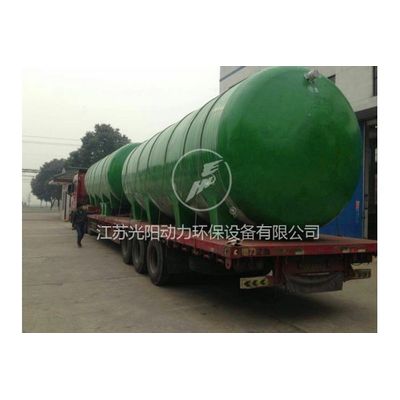
Integrated Underground Sewage Treatment Equipment
Integrated sewage treatment equipment is an equipment that integrates the hydrolysis tank, I and II level contact oxidation tanks, secondary sedimentation tanks, and sludge tanks, and performs blast aeration in the I and II level contact oxidation tanks to make the contact oxidation process Effectively combined with the activated sludge method, it has the advantages of both and overcomes the shortcomings of both, further improving the level of sewage treatment. When buried underground, the upper part can be used for greening. The factory area occupies less space and there are fewer ground structures.
Design principles
Tne integrated underground sewage treatment equipment is mainly designed to treat domestic sewage and similar industrial organic sewage. Tne water quality parameters are calculated based on the general domestic sewage quality, and the incoming water BOD5 is calculated as 200mg/L.
Main components: 1. Hydrolysis acidification tank: 2. Contact oxidation tank: 3. Sedimentation tank, 4. Disinfection treatment: 5. Sludge aerobic digestion tank.
Hydrolysis acidification tank
The main purpose of this process is to pretreat sewage before treatment, conduct a certain amount of anaerobic fermentation of the wastewater in the water, and improve the biodegradabiiity of the sewage. This is an important step before sewage treatment and can directly affect the later sewage. Treatment efficiency and treatment time can improve the efficiency of sewage treatment and reduce consumption.
Contact oxidation pond
Oxidation tanks are divided into several levels according to the degree of pollution of water treatment, ordinary type and enhanced type. It is generally judged based on the processing time, if the treatment time is no more than four hours, use the ordinary oxidation tank, if the treatment time is between 4-6 hours, use the enhanced oxidation tank. Mainly, the effluent from the hydrolysis acidification tank flows to the contact oxidation tank for biochemical treatment. Most of the organic matter in the raw sewage is degraded and purified here. The aerobic bacteria use the filler as a carrier and use the organic matter in the sewage as food to decompose the organic matter in the sewage into inorganic salts, thereby achieving the purpose of purification. For the survival of aerobic bacteria, there must be enough oxygen, that is, there must be enough dissolved oxygen in the sewage to achieve the purpose of biochemical treatment. The air in the aerobic pool is provided by a fan. The pool uses a new type of elastic three-dimensional filler. The filler has a large surface area ratio, long service life, is easy to film, and is corrosion-resistant. A rotating mixing aerator is used at the bottom of the pool to achieve a high transfer rate of dissolved oxygen. At the same time, it has the advantages of light weight, no aging, not easy to block, and long service life. The air-to-water ratio of the contact pool is about 12:1. (0.5-5 m/h contact tank is second level)
Sedimentation tank
After the sewage is treated in the biological contact oxidation tank, the effluent flows into the sedimentation tank, where it is further precipitated to remove the shed biofilm and some organic and inorganic small particles. The sedimentation tank is based on the principle of gravity. When the sewage containing suspended solids flows from bottom to top At this time, the material will settle down due to the action of gravity. The upper part of the sedimentation tank is equipped with an adjustable outlet weir to adjust the outlet water level: the lower part is equipped with a conical sedimentation area and a sludge airlift device. The air source is provided by a fan, and the sludge is transported to the sludge aerobic digester by airlift.
Disinfection
The disinfection pool is 30 minutes in accordance with the standard «TJ14-74». if it is hospital sewage, the residence time in the disinfection pool is increased to 1-1.5 hours. Our company uses a chlorine dioxide disinfection device. The disinfection pool and disinfection device can continuously change the amount of medicine added according to the water output, so as to achieve the purpose of adding more medicine with more water output and less medicine with less water output. If other devices are needed, they can be prepared separately. (If it is used for industrial sewage, the disinfection tank and disinfection device are not required.)
Sludge aerobic digester
The remaining sludge discharged from the sedimentation tank undergoes aerobic digestion and stabilization treatment in the tank to reduce the volume of sludge and improve the stability of the sludge. The amount of sludge after aerobic digestion is small. During cleaning, a suction truck can be used to extend from the inspection hole of the sludge tank to the bottom of the sludge tank to suction and then transport it out (cleaned once every six months). The upper part of the sludge aerobic digester is equipped with a supernatant reflux device to allow the supernatant to overflow to the hydrolysis acidification tank.
Advantages
- The hydrolysis tank has the function of balancing water quality and improving the biochemical properties of sewage. The average residence time of the contact oxidation method is more than 6 hours, and the ability to withstand impact loads is strong.
- By adjusting the structure of the equipment, it can have the ability to remove nitrogen and phosphorus, and achieve the ability to treat industrial wastewater, domestic sewage, and urban sewage.
- Most of the fillers in the contact oxidation tank are combined soft fillers, which are lightweight, high-strength, stable in physical and chemical properties, large in specific surface area, strong in biofilm adhesion, and high in contact efficiency between sewage and biofilm.
- An aerator is used in the contact oxidation tank for blast aeration, so that the fiber bundles continuously float, the aeration is uniform, and the microorganisms grow maturely, which has the characteristics of the activated sludge method.
- The effluent quality is stable, the sludge production is small and easy to handle.
- The submersible pump can be installed in the equipment to reduce project investment.
- Easy to complete automatic control and simple management and operation.
- Buried underground can reduce land occupation, and the ground can be greened, which is beneficial to environmental beauty.