


Applexion
  1. Companies
  2. Applexion
  3. Products
  4. Ion Exchange Technology

Ion Exchange Technology

SHARE
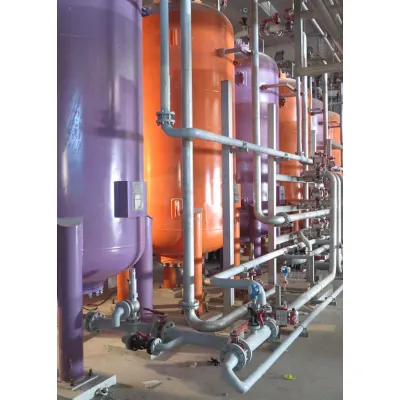
Ion exchange (IEX) is a sophisticated method employed for the removal of ions and other impurities from liquid solutions through a reversible interchange with similarly charged ions on a resin substrate. This process is pivotal across multiple industries including water treatment, electronics, mining, metal refining, chemical manufacturing, pharmaceuticals, food, and biotechnology. The crux of this technology lies in ion exchange resins, which are polymer matrices embedded with functional groups that facilitate the selective removal of ions based on their ionic charge, hydrogen bonding, and hydrophobic interactions. Applexion has honed this technology for optimal efficiency, robustness, and quality, delivering scalable solutions from lab-scale validations to full-scale industrial implementations. Their continuous ion exchange systems offer uninterrupted flow and steady-state operations, maximizing resin usage and productivity while ensuring high purity outputs and cost-effectiveness through resin regeneration. Applexion's methodology, which combines rigorous lab testing, process simulation, and pilot scale validation, ensures minimized risks and enhanced performance for any purification project.
Most popular related searches

Ion exchange (IEX) is a mechanism that removes ions or other compounds, often considered as impurities, from a liquid solution by exchanging them with ions of similar charge on a resin through a reversible interchange. This basic principle involves the use of an ion exchange resin, which is a polymer matrix containing functional groups capable of linking and exchanging ions.

Adsorption is a mechanism for separating molecules from a liquid mixture using the capacity of a porous resin to link reversibly with certain molecules in particular.

Given the similarities of these two mechanisms, often happening together, at Applexion, we call purification processes using these two mechanisms under Ion exchange technology. This technology is commonly used in numbers of industries such as water treatmentelectronicsmining & metal refiningchemical, pharmaceuticals and of course Food, Functional ingredients, Fermentation, Biotech and Biobased molecules.


Ion exchange is used for numbers of applications, to remove specific components for a liquid (macromolecules, color, all or some specific salts).

For doing so, it uses low temperature, low energy, solvent free properties of the different components in a product, that will interact with the ion exchange resin, such as ionic charge, H-bonds or hydrophobicity.

The efficiency, the robustness and the quality obtained by using Ion exchange are key to its popularity. Here are some key advantages of Ion exchange technology:

Allow for selective removal of specific ions from a solution. This selectivity is crucial in applications where the targeted removal of particular ions, such as contaminants, calcium or unwanted metals, is essential.
 

Can be applied to various industries and processes, including water treatment, wastewater treatment, pharmaceuticals, food and beverage, and chemical manufacturing. The flexibility of ion exchange resins and their ability to target different ions contribute to this versatility.


Feasibility: Validate purification levels and technical feasibility.


Scale-up: Validate industrial performances and optimize process.


Small production: Produce samples for market testing or full production of small quantities.

Capability of producing high purity by removing impurities in principal streams but also for effluent treatments.

Resins can be regenerated hundreds of time, extending their lifecycle and participate to make the process cost-effective.

Can be scaled up for industrial applications, making them suitable for both small-scale and large-scale operations.

Multiple hundreds of highly specialized systems and thousands of m3 of specific consumables (resin) currently in use.


Resins, the fuel of the industrial
ion exchange process

The fuel of the ion exchange process is the resin.  Operating conditions and the properties of the resin influence the separation and are critical parameters to be studied in details.

These resins are typically made of organic polymers with special functional groups attached to their structure. The functional groups determine the type of ions the resin can exchange. The functional groups on the resins are charged, either positively (cation exchange resin) or negatively (anion exchange resin). Resins are classified onto different categories :

  • Strong acid cationic resins.
  • Weak acid cationic resins.
  • Strong base anionic resins.
  • Weak base anionic resins.
  • Polymeric adsorption media and activated carbon.