- Home
- Companies
- Energy Storage Systems (ESS, Inc.)
- Products
- ESS - Iron Flow Chemistry
ESS - Iron Flow Chemistry
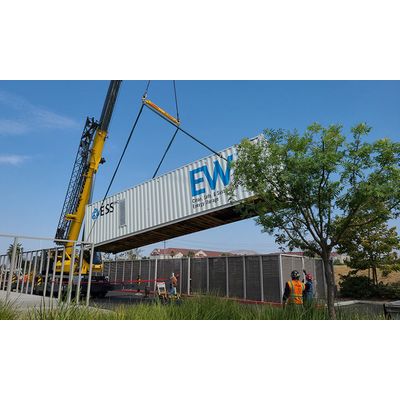
Powerful technology transforming the utility grid. ESS iron flow battery solutions are mature, second-generation systems that offer unmatched cost and sustainability with performance guaranteed through an independent insurer: Munich Re. Conventional battery chemistries, with limited cycle life, deliver a 7- to 10-year lifecycle before requiring augmentation. ESS iron flow chemistry delivers 25 years or more with no capacity fade or degradation.
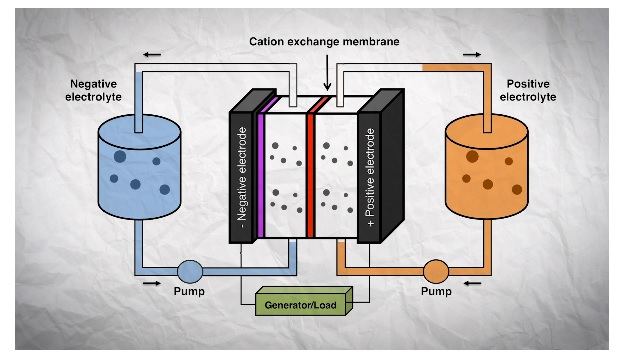
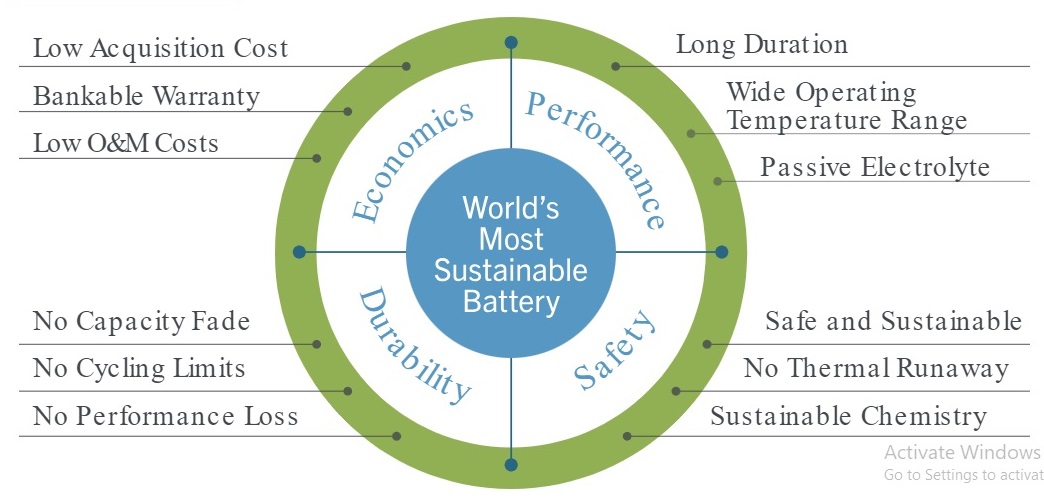
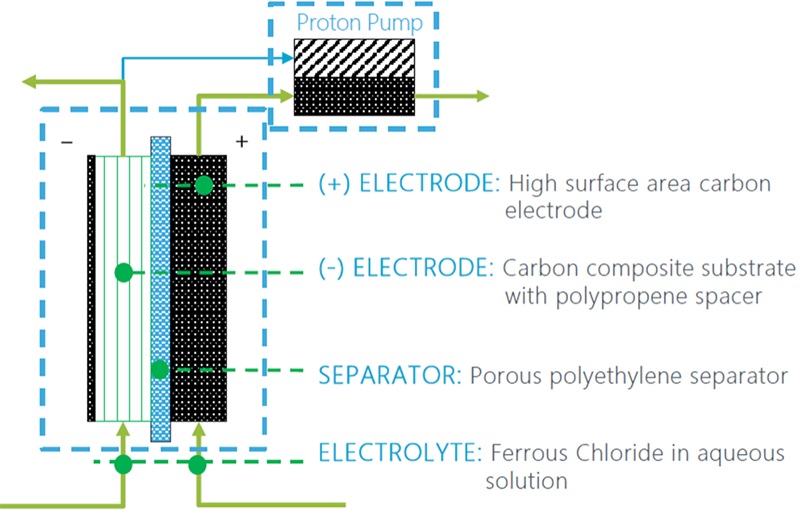
Zero degradation over 20,000 cycles: Iron flow batteries circulate liquid electrolytes to charge and discharge electrons via a process called a redox reaction. The word “redox” is a contraction of the words “reduction,” which represents a gain of electrons, and “oxidation,” or a loss of electrons. ESS uses the same electrolyte on both the negative and positive sides of the equation, eliminating cross-contamination and degradation. This is why ESS chemistry remains stable for an unlimited number of deep-cycle charge and discharge cycles.
Our patented electrode design and control system, coupled with our simple electrochemistry, allows ESS systems to operate longer, at deeper discharge levels. Unlike typical batteries packaged as fixed cells or modules, a flow battery has more energy storage capacity, which gives the user the flexibility to align both the power output and energy storage capacity precisely to a project’s requirements.
ESS iron flow batteries are safe and sustainable, reducing the need for fire suppression equipment, secondary containment, or hazmat precautions. Iron flow chemistry has a pH similar to soda or wine and contains iron, salt, and water. In addition, the battery system is substantially recyclable at end-of-life.
Zero degradation over 20,000 cycles: Iron flow batteries circulate liquid electrolytes to charge and discharge electrons via a process called a redox reaction. The word “redox” is a contraction of the words “reduction,” which represents a gain of electrons, and “oxidation,” or a loss of electrons. ESS uses the same electrolyte on both the negative and positive sides of the equation, eliminating cross-contamination and degradation. This is why ESS chemistry remains stable for an unlimited number of deep-cycle charge and discharge cycles.
Our patented electrode design and control system, coupled with our simple electrochemistry, allows ESS systems to operate longer, at deeper discharge levels. Unlike typical batteries packaged as fixed cells or modules, a flow battery has more energy storage capacity, which gives the user the flexibility to align both the power output and energy storage capacity precisely to a project’s requirements.
Enhanced electrolyte health management: The ESS electrolyte health management system cleans and rebalances the electrolyte in real-time, eliminating the need for frequent downtime for recovery or rebalancing required with other flow battery systems. The system also works in conjunction with the closed-loop plumbing system to prevent electrolyte evaporative losses and to allow the system to run at near-atmospheric pressures. This improves safety, increases scalability, and eliminates the need for electrolyte augmentation during the life of the product.