


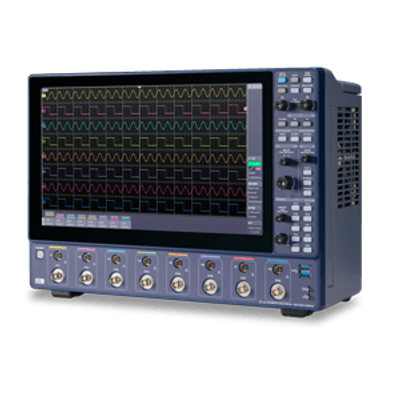
IWATSU - Model DS-8000 Series -Digital Oscilloscope for High Resolution Signal Analysis
The IWATSU DS-8000 Series is a high-resolution digital oscilloscope designed for precision signal measurement, offering a frequency bandwidth of up to 1GHz and handling up to 8 channels. It features a sampling speed of 5 GS/s when channels are coupled and boasts a vertical resolution of 12 bits, extendable to 16 bits in high-resolution mode for detailed waveform analysis. The oscilloscope's 15.6-inch Full HD touch panel enhances usability by providing a clear and detailed view of waveforms while simplifying operation through intuitive touch controls and manual buttons. This oscilloscope is ideal for applications in automotive, component, and semiconductor industries, where rapid startup and low-noise signal analysis are critical. Additionally, its design allows for quick boot-up, four times faster than other products, enabling immediate measurement operations.
Digital Oscilloscope DS-8000 Series High resolution oscilloscope
- Large screen 15.6-inchFULL HD
- Intuitive operation Touch panel & button/knob & mouse
- Up to 8 CH
- High resolution 12 bits (equivalent to 16 bits in high resolution mode)
- Maximum memory length of 120M points as standard
- High-speed data transfer 15 times faster than before
The DS-8000 Series accurately displays the measured signal with a maximum frequency bandwidth of 1GHz, a maximum number of channels of 8 CH, a sampling speed of 5 GS/s (when the channels are coupled), and a vertical resolution of 12 bits. High-speed start-up up to 4 times faster than competitor products and a 15.6-inch FULL HD touch panel greatly improves measurement efficiency.
- Maximum frequency : Up to 1GHz
- Memory length : Up to 120M points
- Number of analog channels : 4 or 8
- Vertical resolution : 12-bit
- Power device switching (ON voltage, etc.) observation
- Lightning surge waveform observation
- Waveform observation of voltage, current, sensing and ECU signals of automotive inverters
- Behavior at the time of power-on of the device, confirmation of the stability of the power converter, observation of changes in waveform distortion such as encoder pulses