


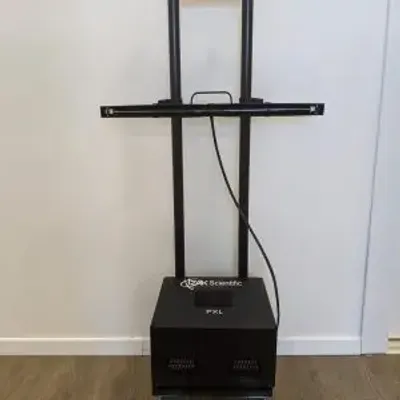
IZAK Scientific - PXL Sanitizer
The PXL Sanitizer is a sophisticated UV light disinfection device designed to address the critical need for effective sterilization in environments prone to bacterial and viral contamination. Employing advanced pulsed UV-C light technology, this system targets a spectrum of harmful microorganisms, including antibiotic-resistant strains like MRSA and E. coli. Notably, the PXL Sanitizer, validated by third-party microbiological testing, offers a strategic solution for decontaminating high-contact areas such as kitchens, countertops, and various surfaces in food and beverage industries. Its compact design allows easy installation over specific surfaces, while its dual power options - battery or direct electrical connection - enhance user convenience. This targeted application ensures comprehensive coverage, which increases efficacy with prolonged illumination, making it a preferred choice for maintaining stringent hygiene standards in both residential and commercial settings.
The PXL Sanitizer uses enhanced UV light to disinfect surfaces from bacteria and viruses.
Testing by a third-party analytical microbiology laboratory found that the PXL Sanitizer can virtually eliminate bacteria with antibiotic resistance.
PXL Sanitizer: Light Disinfection for Bacteria and Viruses
Benefits of the PXL Sanitizer
- Disinfect surfaces including handles, toilet seats, keyboards/mice, plates, pens, remote controls, and more
- Easy operation
- Proven by third-party laboratory testing to efficiently disinfect surfaces, see details below
About UV Light Disinfection
UV light disinfection technologies can play an important role in reducing the transmission of various bacteria and viruses, based on current scientific data and empirical evidence. UV is a known disinfectant for air, water, and surfaces that can help to reduce the risk of acquiring an infection in contact with many micro-organisms when applied correctly and safely.
UV Light Disinfection Effectiveness. A Review Of Scientific Studies.
Prevention of infections from drug-resistant bacteria such as methicillin-resistant Staphylococcus aureus (MRSA) currently presents major health care challenges. A 2018 study featured in the journal “Plos One” concluded that far-UVC light has bactericidal qualities and can prevent transmission of drug-resistant infectious agents. [1] These findings confirm previous studies that evaluated the effects of UVC radiation on various Gram-positive and Gram-negative bacteria, including Staphylococcus aureus [2], E Coli, Salmonella, and microbes resistant to antibiotics such as methicillin‐resistant Staphylococcus aureus (MRSA), vancomycin‐resistant Enterococcus species (VRE) and Klebsiella pneumonia ATCC 700721. [3].
 UVC Light Treatment For Coronaviruses. Any potential for Sars-Cov-2 disinfection?
UV light, between 200-280nm, was found to inactivate at least two coronaviruses related to the novel Sars-Cov-2 virus: SARS-CoV-1 [4]and MERS-CoV [5], [6]. It should be mentioned that this inactivation has been shown under controlled conditions i.e. in laboratory settings. The effectiveness of UV light in practice will depend on various factors including the exposure time and the ability of the UVC rays to reach these viruses in water, air, and on various materials and surfaces.
UV Light Disinfection. Safety concerns
UVC rays are safely used on various surfaces, but humans should limit exposure to them. UVC rays can cause skin and eye damage. Although the research found that UVC rays within a specific range do not cause skin damage [1], humans should avoid exposure, and this therapy should be used on various surfaces and spaces only.
Pulsed UV light treatment Versus Continuous UV Light Treatment
Pulsed UV light treatment is more effective and rapid for microorganism inactivation than continuous UV light sources [7].
Pulsed light technology has received significant attention as a strategy for decontaminating food, packaging, water, and air and could also be used to decontaminate surfaces in hospitals. Pulsed UV light has the ability to kill micro‐organisms by using ultrashort‐duration pulses of an intense broadband emission spectrum that includes UV‐C germicidal light (200–280 nm band) [3]
The PXL Sanitizer Advantage: Effective UV Light Disinfection for Bacteria and Viruses
The PXL Sanitizer uses enhanced pulsed UV light to disinfect surfaces from bacteria and viruses. It could be the ideal option for disinfecting surfaces in the food and beverage industry, where multiple tools are shared in kitchens and other spaces that contain food and drinks. This device can be easily installed above the surface that has to be disinfected (ie fridge, countertops). It can also be used to disinfect handles, toilet seats, keyboards/mice, plates, pens, remote controls, and more. It is user friendly and has a compact design, using battery power or direct electrical connection. When turned on, the PXL sanitizer will illuminate the surface that has to be disinfected.
PXL Sanitizer- UV light disinfection effectiveness. PXL Sanitizer was tested by a third-party analytical microbiology certified laboratory, which found that this device is highly effective and can virtually eliminate bacteria with antibiotic resistance.