


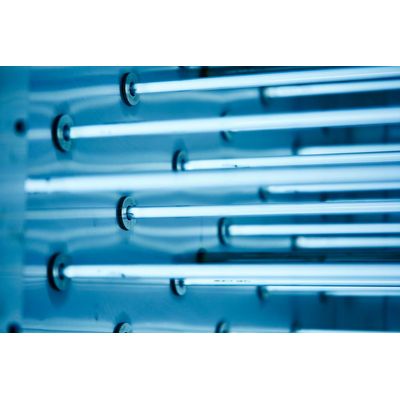
Jimco - UV-C Air and Surface Disinfection System
The airborne microorganisms are accessible for the UV-rays, while the conventional means of air-disinfection are useless or not applicable. No matter how indispensable and important they may be in the field of disinfection of medical equipment. In favorable conditions, many bacteria form resistant lasting/permanent spores (these spore-producing bacteria are also collectively termed as bacilli (germs). Generally, spores are more resistant to high temperatures and UV-radiation than bacteria, which is why it is necessary to choose ten times the dose that would be necessary for the destruction of bacteria. Under favorable conditions, the spore develops into a new bacterial cell.
Surface disinfection
Disinfection procedures of packaging materials in the food industry, as well as manufacturing
Possibilities and problems in the area of disinfection as mentioned in the following are dependent on so many conditions related to plants, that the stated values are only usable as a first step towards the specification of a disinfection plant. As many as possible of the theoretically stated values should be compared through examination in practice.
The result of a surface disinfection depends heavily on the character of the material to be free of germs. Through UV-radiation it is – as already mentioned – only possible to inactivate the bacteria that are reached by radiation. This means that for the application of radiation for disinfection it is important to consider that disinfection of solid objects only succeeds, when the total surface of the object is exposed to radiation, and when this surface has no irregularities where bacteria can hide and thus be protected from radiation. As, however, the surface roughness causes the formation of micro-shadowiness many bacteria may escape. Bacteria located deeply are generally not reached at all – due to the low penetration depth of the radiation. However, because of bends, the serious effect of forming of micro-shadowiness is somewhat reduced.
In practice, disinfection – or better still – the removal of bacteria from solid surfaces and packaging materials (which may be of widely varying artificial materials: glass, sheet metal, cardboard, folio, etc.) must be carried out with intensive direct radiation.
Often it is found that further disinfection with ordinary disinfection means is useful for a good result. Besides, it is important that once sterilized material may be kept very much free of germs on the further road of manufacturing with UV-radiation, as the germ contents of the air are strongly reduced through the simultaneously obtained air radiation. Should the disinfection be limited to similar materials, protection of staff is relatively simple: The plant is completely protected. Also, indirect (reflected) radiation should not reach outside.
With the use of air disinfection, the effect is that the total level of airborne bacteria in a room is considerably reduced. As the natural circulation of air at some point leads all layers of air once through the area of radiation thereby preventing contagious sources from the air, which are of considerable significance which plays a role for many illnesses and infections. However, one must always be aware that bacteria-free air or even with a reduced number of germs does not in itself have any disinfecting effect.
Water quality and disinfection
The quality of water has a decisive influence for the influence of the disinfection. Substances that make the water unclear can have influence on the efficiency. The advantage of UV-C radiation is that it is not depending the visible light. Decisive is, if the small particles in the water absorb or reflect the UV-C radiation, where this influences the degree of penetration. If the water quality is poor, the sterilization can be improved by usage of active coal or sand filters. Obtaining the thresholds for drinking water, it is possible to get a full UV-C sterilization without any problems at all!
Algar
This description covers a range of spore plants with about 8000 living kinds – varying from single-celled to larger types.
Some important groups are:
- Split algae (blue green algae)
- Diatomeen (Silicon algae)
- Green-, brown- and red algae
Algae contain chlorophyll, at times supplemented by other coloring matter, which means that they can nourish themselves through assimilation. UV-dose values for some types of algae are mentioned here. A remarkable feature here is the very high dosage, in some cases with potencies at higher levels than e.g. the dose for bacteria.
BACTERIA
Bacteria is a major group of single-celled plant organisms which multiply by division. They cause illness, fermentation, and aging. Fundamental forms for bacteria cells are:
- Ball (Coccus)
- Small rods (Bacillus and Bacterium in the most restricted sense)
- Corkscrew (Spirillum, Vibrio, Spirochete)