

- Home
- Companies
- KEDA SUREMAKER, Brand of Anhui KEDA ...
- Products
- KEDA SUREMAKER - Model AAC - Autoclaved ...
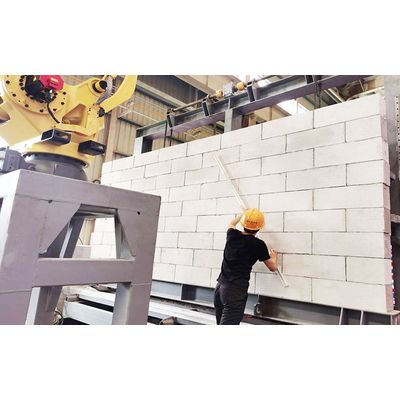
KEDA SUREMAKER - Model AAC -Autoclaved Aerated Concret
Autoclaved aerated concrete (AAC) is a versatile building material known for its lightweight, insulating, and eco-friendly characteristics. It comprises siliceous materials like sand or fly ash and calcareous materials such as lime and cement, mixed with aluminum powder. The production involves raw material preparation, mixing, reinforcement for panels, pre-curing, aerating, cutting, pre-autoclaving grouping, steam autoclaving, and packaging. AAC products, especially blocks, are used for wall insulation, while panels serve as roofing, flooring, and wall materials. KEDA SUREMAKER, a prominent Chinese company, offers comprehensive AAC plant solutions. Their innovations include self-insulating panels and ultra-low density blocks. Originating from 1920s Sweden, AAC's potential in automation for construction, driven by global labor shortages, enhances productivity. KEDA SUREMAKER supports clients with design, manufacturing, installation, and consulting services.
Autoclaved aerated concrete is made of siliceous materials (sand, fly ash or tailings, etc.) and calcareous materials (lime and cement) with aluminum powder paste and other materials, through the production process of raw material preparation, batching and pouring, reinforcement section (for panel production), pre-curing and aerating, demoulding and cutting, grouping before autoclaving, high-pressure steam autoclaving and packing.
- Light Weight and High Strength
- High Precision
- Fire Resistance
- High Impermeability
- Eco-friendly
- Thermal Insulation
- Sound Insulation
- Safety and Durability
The weight of AAC products is 1 / 3-1 / 10 of that of traditional wall materials, which can effectively reduce the self weight of buildings and improve the seismic resistance of buildings.
The fire resistance of AAC wall with thickness of 100mm is up to 4 hours.
AAC products are non-toxic and harmless, can be recycled and are really green and environmental new building materials.
AAC products have double functions of sound insulation and absorption. When they are used as walls, their weighted sound insulation can reach 40-60db, which fully meets the requirements of building sound insulation.
AAC is accurate in size and easy to process, which provides a reliable guarantee for efficient assembly construction.
As AAC is composed of many closed pores and constructed with special materials, it has high impermeability.
The dry thermal conductivity of AAC products is 0.055-0.17 w/(m*k), can effectively improve the level of building energy saving and reduce the energy consumption.
After autoclaving, the product has stable performance and good durability.
Autoclaved aerated concrete is widely used in industrial and civil buildings, such as shopping malls, schools, hospitals, residential buildings, etc. Autoclaved aerated concrete products can be used in almost all parts of building envelope, among which autoclaved aerated concrete blocks are commonly used for internal / external wall insulation; Panels are often used as roof panels, floors, interior wall panels and exterior wall panels.
- Waterproof Interface Agent
- Crack-resistant Mortar
- Alkali-Resistant Glass Fiber Gridding Cloth
- Base Putty for Coatings
- Exterior Paint·
- Base Putty For Building Interior Wall
- Finish Putty for Building Interior Wall
- Interior Paint
- Interior Wall Paper
- Waterproof Interface Agent
- Crack-Resistant Mortar
- Alkali-Resistant Glass Fiber Gridding Cloth
- Tile Adhesive
- Simulated Decorative Surface Tiles
Origin of Autoclaved Aerated Concrete
AAC was first developed in Sweden in 1920s, when an architect Axel Eriksson first combined the conventional concrete mixture of cement, lime, water, and sand with a small amount of aluminum powder. In 1929, the world's first AAC plant was built in Sweden, then "Ytong" & "Siporex" two production process systems were gradually formed in northern Europe and several highend equipment suppliers appeared, and then AAC was gradually developed to the whole Europe and even all over the world.
AAC Initial Trial Production Period in China
- In 1958-1962, the Chinese Academy of Building Sciences organized experts to study and trial produce AAC.
- In 1965, the first AAC plant in China was built with Siporex technology, then China AAC industry entered a slow development period.
- In 1992, the State Council issued the notice on accelerating the innovation of wall materials and promoting energy-saving buildings, China entered the new wall materials era, then AAC block gradually replaced solid clay brick to be the main wall material.
AAC Industry Emerging Period in China
- In 1995, Nanjing JT imported the second-hand equipment of Wehrhahn. Mr. Xu Shunwu, who was the engineer of Wuhan Building Materials Research Institute, upgraded the equipment to produce AAC smoothly.
- In 1996, China Xujian imported second-hand cutting machines of Siporex plant from Japan. Mr. Xu Shunwu was responsible for the overall design of auxiliary machines.
- In 2003, Yinghai Industrial Group imported the second-hand equipment of Wehrhahn from South Korea, and Mr. Xu Shunwu up graded the automation level of the plant.
AAC Localized Production Period in China
- In 2004, Mr. Xu Shun wu established Wuhan Suremaker Building Materials Technology Development Co., Ltd.
- In 2006, Wuhan Suremaker provided the auxiliary machines for the AAC plant of Changxing Ytong Co., Ltd. established by Xella group in Changxing, China.
- In 2007, Wuhan Suremaker built China's first automatic AAC bolck plant in Anhui province.
- In 2008, Wuhu Suremaker Industrial Co., Ltd was established, and provided the auxiliary machines for Xella Tianjin AAC plant.
- In 2011, Wuhu Suremaker built China's first high-end intelligent AAC panel plant in Shandong province. In the same year, Suremaker production lines was exported to Vietnam & Indonesia.
- In 2012, KEDA cooperated with SUREMAKER to build the KEDA SUREMAKER brand, then the company changed from an equipment manufacturer to a holistic AAC plant solution supplier.
AAC Rapid Development Period in China
- Attended the 6th International AAC Conference in 2018 and made a speech on customized AAC equipment.
- Up to now, the AAC plants supplied by KEDA SUREMAKER have been installed all over 30 provinces in China and exported to Asia, Middle East, Europe, South America & other area of the world.
- KEDA SUREMAKER successively edited 5 national standards, 12 industry standards and 2 group standards.