


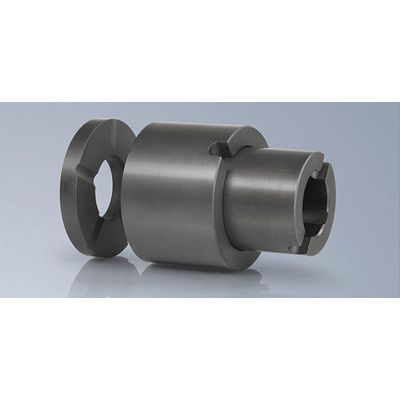
Keramikprofi - Silicon Carbide Ceramic Material
The ceramic material silicon carbide has a multifaceted range of properties that can be tailored to exact requirements. Its extreme hardness combined with low weight, temperature stability and corrosion resistance make this material ideal for sliding bearings in chemical and process engineering plants where aggressive media is often used.
Whether for kitchen hand mixers, rotating machine components, magnetic drives for agitators or pumps in the construction of chemical plants and equipment – sliding bearings often cope with billions of revolutions in the course of their life. Together with roller bearings in machine and equipment construction, sliding bearings are among the most commonly used types of bearings. Their functional principle is based on contactless movement with a tiny gap between shaft and impeller with minimal friction – during industrial manufacturing processes they’re exposed to enormous temperature and pressure fluctuations. Nevertheless, sliding friction always causes resistance, so there’s also a measure of wear when the sliding surfaces touch the contact surfaces. Constant lubrication with oil, grease or the conveyed medium itself is therefore important – and combining low-friction materials is crucial in this pairing.
Safe operation in harsh industrial environments
“Sliding bearings made of silicon carbide (SiC) have proven themselves extremely effective in pumps and drive systems when compared to metals,” explains Georg Victor, Manager of Product & Application Development at 3M Technical Ceramics. Ceramic material – which in its crystalline structure resembles diamond – has a higher degree of hardness than conventional steel materials, combined with excellent dimensional stability and very good wear resistance. Because of this, the largely maintenance-free life of the bearings is extended many times over – and life cycle costs are subsequently reduced. With their low weight and correspondingly low centrifugal forces, SiC ceramic sliding bearings are well-suited to high-speed and space-saving applications.
In chemical or process plants it’s often the case that the only lubrication available to the sliding bearings is the media being processed. These often contain aggressive acids and alkalis, corrosive fluids, hot and dirty water or even abrasive suspensions, often combined with high-temperature or thermal shock loads. It’s exactly under these conditions that silicon carbide reveals its full potential, impressively maintaining its outstanding tribological properties. It’s therefore even possible to install SiC sliding bearings directly in the area of the conveyed media. This has the advantage of making space-saving constructions and hermetic applications particularly feasible. In addition, SiC sliding bearings can even be operated in a mixed friction environment for a longer period of time – without fusing or seizing up.