


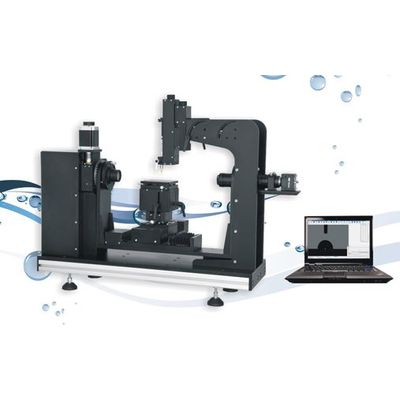
KINO - Model C60 -Drop Shape Analysis System
The C60 Drop Shape Analysis System is designed for precision measurement of interfacial chemical properties. It facilitates the analysis of surface tension and its components such as dispersive and polar forces, and surface free energy of solids. The system uses advanced optical mechanics and vision systems, including a high-speed video system operating at 87-340 frames per second, telecentric lenses, and precision positioning stages. The included CAST 3.0 software integrates the ADSA-based Young-Laplace equation fitting method, enabling accurate drop shape analysis for various liquid-gas, liquid-liquid, liquid-solid, and liquid-liquid-solid interfaces. The modular design of the C60 system allows for numerous configuration possibilities, enhancing its adaptability to different high-precision measurement needs in interfacial chemical analysis. This system is particularly suitable for industries dealing with high-viscosity materials, high-temperature environments, and complex simulations, making it a robust tool for both research and quality control applications.
C60 is drop shape analysis based system which focuses on measuring interfacial chemical properties. It can be used to analyze interfacial chemical characterizations like surface tension and its contributions (dispersive force, polar force), interface tension, surface free energy of solid and its contributions (dispersive force, polar force, hydrogen bond force, Lewis acid & base and more), interface rheology, interfacial viscosity, adhesive work, wetting line, wetting behavior via analysis of drop shape or lamella profile of drop / bubble that shaped on interface of liquid-gas, liquid-liquid, liquid-solid or liquid-liquid-solid. It also can be used to characterize / analyze / predict / describe various vital physical chemical properties, such as spreading, wettability, adhesion, absorption, competition, sedimentation, penetration, biocompatibility, foaming, solubilization and surface heterogeneity, as well as research of new material (super hydrophobic / hydrophilic material simulation), QC (analysis of surface cleanness).
Their modularized design makes tens of thousands of possible different combinations available, which are undoubtedly your above-all choice for your high measurement precision in interfacial chemical analysis. The integral instrument is consist of sophisticated optical mechanics, optical vision system, precision dosing system and professional interfacial chemistry analytical software CAST® 3.0. Global advanced telecentric lens, parallel background light, high-speed video system of 87-340 frame/second, precision positioning stages, and ADSATM based CAST®3.0 are all standard configurations, which provide you state of the art and most professional research conditions.
Measuring principle
First, single or several dynamic images of drop/bubble are captured for us to analyze its key information like drop shape edge and geometric dimension via sub-pixel image recognition technology; By inputting some important parameters like density, gravitational acceleration, magnification and others, we compare and fit the real drop shape profile with theoretical curve generated by sophisticated mathematical analytical models (such as circle, ellipse, polynomial, spline curve and especially Young-Laplace equation fitting) using least square method; and finally surface tension of liquid-gas, interface tension of liquid-liquid, contact angle of solid-gas/liquid-liquid-solid are calculated.
Our great achievement is: initiating ADSA based Young - Laplace equation fitting method and apply it into analysis of interfacial chemical properties after our 3 decades endeavor.
Main Measurement
Indicators can be measured
→Surface tension: Dynamic surface tension dependend on temperature, concentration, time, pressure, electrical field and more; surface tension of liquid (pure liquid, mixture liquid, melts)-gas.
Pendant drop method and sessile drop method that C60 adopts is quite suitable for following industries: (1) high-viscosity material, such as adhesive, polymer and resin; (2) material that requires high temperature, such as metal and coal; (3) environments simulation such as high pressure and temperature of oil recovery field.
→Interface tension of liquid / fluid system: Interface tension between two dissoluble liquids and its critical micelle concentration (CMC)
→Surface free energy and its contributions (dispersive force, polar force, hydrogen bond force, Lewis acid & base, etc.)
→ Wetting behavior analysis, wetting envelopes
→Dynamic contact angle, contact angle hysteresis: advancing contact angle, receding contact angle, roll-off angle, thermodynamic intrinsic contact angle, equilibrium contact angle;
→ Analysis of spreading / adsorption, e.g. dynamic spreading area / diameter, adsorption area of liquid, contact angle, wetting line
→ Interface rheology, surface elasticity, relaxation study, hydrostatic pressure, etc.
International Norms and Standards
→ASTM D 724: Standard Test Method for Surface Wettability of Paper (Angle-of-Contact Method)
→ASTM D 5946-2004: Standard Test Method for Corona-Treated Polymer Films Using Water Contact Angle Measurements
→ISO 15989: Plastics- Film and sheeting - Measurement of water - contact angle of corona-treated films