


Kiruna
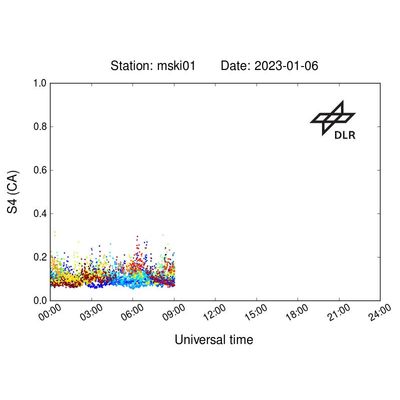
Trans-ionospheric radio signals of global navigation satellite systems (GNSS) like GPS, GLONASS, and GALILEO may suffer from rapid and intensive fluctuations of their amplitude and phase caused by small-scale irregularities of the ionospheric plasma. This phenomenon, which is called radio scintillation, can strongly disturb or disrupt the signal transmission. For technical applications it is useful to derive and to provide the well accepted S4 and σΦ indices describing the amplitude/ intensity and the phase fluctuation of a received signal, respectively. For that purpose the DLR operates several GNSS high-rate receivers in Europe providing the necessary receiver-satellite-link specific amplitude and phase information, cf. http://dx.doi.org/10.1051/swsc/2014020dx.doi.org/10.1051/swsc/2014020. Location and coordinates of Kiruna GNSS high-rate receiver operated within DLR’s Experimentation and Verification Network (EVnet)
Specification: Description
External parties: The GNSS receiver stations are hosted by Swedish Institute of Space Physics, SUPAERO Laboratory of Electronics and Physics, the Universidad de La Laguna, and the German Aerospace Center.
Data providers: GNSS stations are part of DLR’s experimentation and verification network (EVnet)
Input data: 50 Hz GPS phase and amplitude measurements
Input sampling rates: 50 Hz
Reliability of data source: Cycle slip detection is conducted as preprocessing step for σΦ
Region of sensors: Europe
Spatial resolution: Computation of scintillation indices at the location of the GNSS stations
Temporal resolution: 1 min
Time information: UTC Time
Reference coordinate system: ECEF coordinate system with WGS84 reference ellipsoid
Algorithms: The S4 index is the coefficient of variation of the squared amplitude. The σΦindex describes the standard deviation of the phase measurements.
File format: ASCII
ASCII file format:
1> "GPS Week,"
2> "GPS TOW - End of epoch,"
3> "GPS PRN"
4> S4 based on L1/CA
5> σΦ in radian