

- Home
- Companies
- Konstrack LLC
- Products
- Konstrack - Bag Filter
Konstrack - Bag Filter
Bag filter, aspiration unit, equipment for cleaning industrial emissions. What is it, why and where is it used, how to choose and how much does it cost. How not to make a mistake in choosing a supplier and type of equipment.
- Guaranteed reduction of air emissions
- Lowest price for complete solutions due to manufacturing cooperation
- We adapt the design of the bag filter to the conditions of your production
- The value and effectiveness of proven solutions is much higher than the price
- You don`t just get bag filters, you get all of our expertise and experience
We communicate with our customers every day and we know that you do not want to jeopardize your business because of possible penalties or prescriptions of the bodies of environmental control, or lose money seeing as your product goes down the drain.
To do this, you need to reduce your plant’s emissions.
But the problem is you don’t always know how to do it for the minimum amount of money and with a guaranteed result.
That’s why we have developed a set of proven solutions specifically for your technology using bag filters from our own production.
To take advantage of our expertise and experience, you just need to contact us in any convenient way and get concrete steps to solve your problem for a fair price and within an agreed time frame.
No more looking at smoky chimneys or dusty equipment.
Instead, you can focus on solving basic production problems and trust the professionals to ensure environmental standards.
A little bit of theory. How does a bag filter work?
The principle of operation of bag filters is based on the precipitation of dust particles on the surface of the filter media.
In this case, the formed dust crust is an additional filtering layer. The dust layer on the surface of the filter fabric grows as the filter works. Accordingly, the hydraulic resistance of the entire installation grows.
When the hydraulic resistance reaches a certain predetermined level (e.g. 1200 Pa), the filter bags must be cleaned of the dust which has accumulated on them. This cleaning process is called regeneration.
It is performed by pneumatic compressed air impact into the filter bag filter element.
Regeneration of filter bags is carried out with compressed air at a pressure of 4-7 bar. The requirements to the quality of compressed air are not worse than 2-3 class according to ISO 8573-1.
Regeneration mode is automatically controlled by a controller located in a separate cabinet.
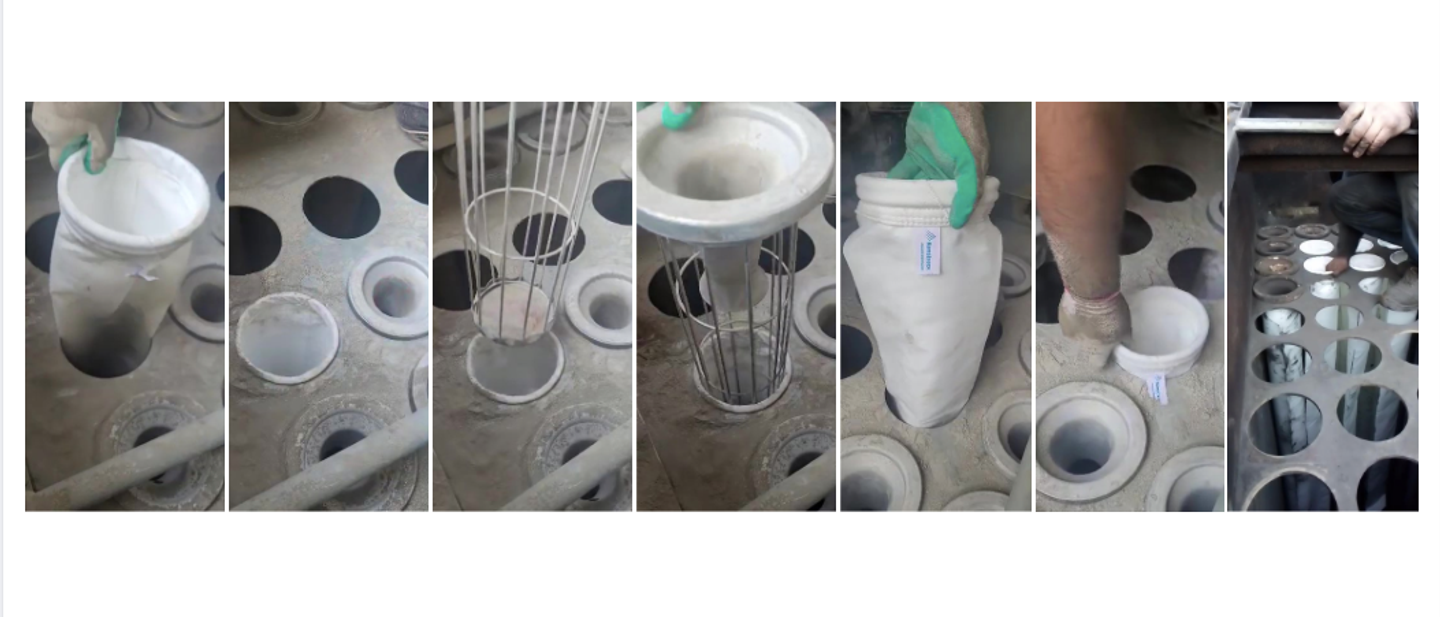
Filter bags are suspended vertically on a mounting plate (sieve), which serves for separating chambers with incoming contaminated and cleaned air.
Each filter bag has an internal wire mesh (skeleton) to support it and prevent it from collapsing.
Aspirating air through the system of gas ducts enters the bag filter. The differential pressure differential sensor of the controller measures the pressure difference between the clean and dirty gas chambers of the filter. When the set differential pressure is reached, the regeneration cycle starts and continues until the bottom set point of the bag filter resistance is reached.
The start and stop values of the regeneration process are determined individually for each filter by representatives of the adjusting organization (supplier) during commissioning.
How is the compressed air pulse fed into the filter bag?
There are pulse (blow-off) valves for this.
The controller sends a signal to the solenoid valve at the right moment, allowing a pulse of compressed air to flow into the blow-off tube.
During the regeneration process, the dust is deposited in a hopper, from which it is removed by a screw conveyor or a sluice feeder.