

- Home
- Companies
- Konstrack LLC
- Products
- Konstrack - Cartridge Filters
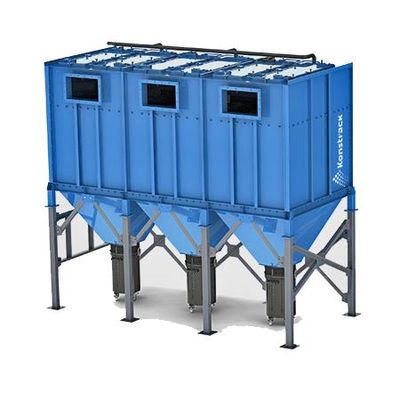
Konstrack - Cartridge Filters
Cartridge filters functionally do not differ from the bag filters. However, they have a number of design differences.
- The filter element is a cartridge, which differs from the filter bag by more developed filtration area.
- The cartridge has a rigid structure – there is no need for a wire frame (basket) to maintain the shape.
- Due to the nature of the cartridge filter, to achieve a given area of filtration requires a smaller number of filter elements than a bag filter.
- Smaller dimensions compared to a bag filter.
The cartridge filter is more compact compared to the bag filter, which greatly simplifies its placement in the cramped conditions of operating production. However, the peculiarities of the cartridge design introduces certain restrictions on the possibility of its use in a number of technological processes.
In particular, these are processes with high aspiration air temperature, with large input dustiness, high productivity, etc.
Below we will discuss in more detail the advantages and disadvantages of cartridge filters.
- Guaranteed reduction of air emissions
- Lowest price for complete solutions due to manufacturing cooperation
- We adapt the design of the bag filter to the conditions of your production
- The value and effectiveness of proven solutions is much higher than the price
- You don`t just get bag filters, you get all of our expertise and experience
Due to the vacuum created by the fan, dust and gas emissions through the inlet gas ducts get inside the filter housing, where they are cleaned by means of cartridges. Cleaned air is removed from the filter through the clean air chamber nozzles.
Pneumatic and electrical equipment ensures automatic regeneration (cleaning) of the cartridges as they become contaminated. The degree of contamination of the cartridges is monitored by a differential manometer, the controller gives a signal to regenerate the cartridges when the set level of contamination of the cartridges is reached.
The differential pressure differential sensor measures the pressure difference between the “clean” and “dirty” air chambers of the filter. When the set differential pressure is reached, the regeneration cycle begins and continues until the lower set point is reached. These data are indicative and are set individually for each facility during the adjustment of the filter.
Regeneration of the cartridges is carried out by shaking the dust settled on the outer walls of the cartridges. Such shaking is performed by pulse blowing of the cartridges with compressed air. At the command of the controller there is a pulse periodic opening of the solenoid valves, installed on the regeneration blocks, whereupon the compressed air from the blowing blocks comes into the filter housing through pipes for blowing the cartridges in a sequence, set on the controller. Dust, settled by shaking the cartridges, falls into the hoppers, and then along the inclined walls of the hoppers falls into the dust collectors, from which it is periodically removed as they are filled.
The FC cartridge filter is designed for dry cleaning of dust and air emissions of industrial plants. The environment and the air to be cleaned must not contain aggressive gases and vapors. The filter operates under negative pressure and is installed in front of the exhaust fan. The filter is equipped with a device for contamination control of filter elements (cartridges) and their automatic regeneration (cleaning from settled dust) as they become contaminated. Shaking is carried out by pulse blowing with a stream of compressed air.
The filter consists of the following main components: housing, cartridges, regeneration units, dust collector, control cabinet with controller.
Housing is a hollow metal structure made of profiles and sheet metal and consists of three main parts: hopper with support belt, cartridge chamber and clean air chamber.
The hopper serves for dust extraction to the dust collector from the cartridge chamber during filter regeneration. All parts of the hopper are made of steel sheet.
The cartridge chamber is used to place the cartridge elements. The chamber is a hollow metal box with an open bottom and top, assembled from special curved panels made of steel sheet. The mating surfaces of the panels are lubricated with sealant before assembly to prevent air suction.
Cartridges are a hollow cylinder with a slotted net inside, they are open at the top and have an annular sealing rubber gasket, which they pressed to the mounting plate during their assembly.
The clean air chamber houses the compressed air supply pipes for cartridge regeneration. The bottom of the chamber is a mounting plate (sieve) for fixing the cartridges to it. For this purpose, holes are made in the mounting plate, through which dust and air emissions from the cartridge chamber enter the clean air chamber.
The regeneration unit serves for accumulation and supply of compressed air for regeneration of cartridges. It is a cylindrical container with compressed air inlet and outlet pipes. Each block includes electromagnetic valves and purge tubes. Regeneration units are fastened to the side wall of the vessel on special brackets. Connection of the blocks outlet nozzles with the compressed air supply pipelines is carried out by the pressure hoses on the clamps.
Dust collector (accumulation reservoir) is designed for collecting dust deposited in the hoppers during cleaning of dust and air emissions in the cartridge chamber. Dust collector is a metal container on wheels, welded from a thin sheet steel. Dust collectors are attached to the bottom of the hopper with a quick-release locking mechanism.