

- Home
- Companies
- Konstrack LLC
- Products
- Konstrack - Dust Collector Cyclones
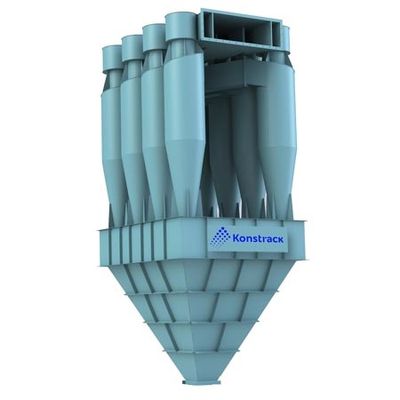
Konstrack - Dust Collector Cyclones
Cleaning efficiency of 85%-99% depending on the size of the dust particles. Operate over a wide temperature range. Simple cyclone design requiring minimal maintenance. Allow for dust reduction as a first degree of cleanin.
How to reduce atmospheric emissions in the simplest, fastest and inexpensive way? There is a solution – our cyclones will 100% help to solve this problem.
Of course, the efficiency of cyclones, multicyclones, battery cyclones, etc. strongly depend on the dispersion composition of dust. And it’s not always possible to reach the norms of dustiness at the outlet within the limits of the current legislation (it is achieved by means of bag filters). In any case, a properly selected, sized and manufactured cyclone can reduce emissions by up to 90% in most cases.
Contact our specialists, leave a request through the form on our website and we will provide you with the best solution to reduce dust emissions for your production technology!
The cyclone operating principle is based on centrifugal forces generated by rotary motion of the dust and gas flow.
The centrifugal force acts on the dust particles and throws them to the cyclone walls, after which they fall into the hopper and are discharged outside. The cleaned air exits through the openings in the upper part of the cyclone.
Cyclones are dry inertial cleaning devices. They are widely used for flue gas cleaning in boiler plants, elevator complexes emissions, process emissions from cement production, metallurgy, etc.
A significant advantage of cyclones – simple design, relatively low price and the ability to work at high temperatures of the dust and gas flow.
Cyclones type CN-15 with a pyramidal hopper are one of the most popular models in the cyclone series.
It serves for dry gas purification from explosion-proof dust.
They can be made both in a single version and in a group version.
Depending on the dust type and dust flow rate, our engineers will select the optimal cyclone construction and wall thickness – typically from 3 to 8mm.
They can be additionally equipped with sealed dust discharge equipment and support structures.