


- Home
- Companies
- KRÜSS GmbH
- Products
- KRÜSS - Model DSA100E - Drop Shape ...
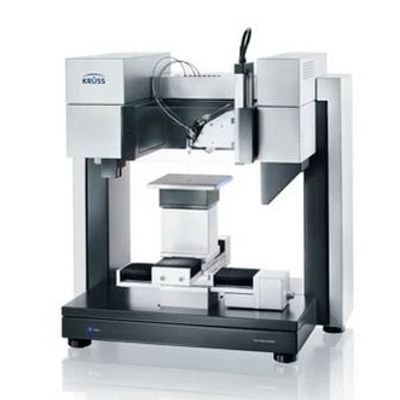
KRÜSS - Model DSA100E -Drop Shape Analyzer
The automated premium solution for wetting and adhesion analysis of solids and liquids.
The Expert version of the DSA100 Drop Shape Analyzer system solution enables solids and liquids in wetting and coating processes to be analyzed comprehensively. The high degree of automation with easy programmable procedures provides for user-independent contact angle and surface tension results, which is ideal for the use in quality control. However, the DSA100E is also frequently used in R&D due to its versatility in controlling thermal conditions, its multi-dosing option with up to eight test liquids, and its scientific tools for analyzing the solid/liquid contact.
-
Contact angle of a drop on a solid surface
-
Contact angles of two drops dosed in parallel
-
Automated position-dependent contact angle measurement and evaluation
-
Contact angle using a gas bubble beneath a solid surface in a liquid
-
Roll-off behavior and advancing/receding contact angle of a drop on a tilted surface
-
Surface free energy of a solid using contact angle data
-
Calculating adhesion-related scientific parameters for the interfacial contact
-
Surface or interfacial tension using the curvature of a drop or bubble at the tip of a needle
-
Carrying out a measurement up to 20 consecutive times and displaying the results together
-
Calculating the polar and disperse part of the surface tension from contact angle and surface tension data
-
Static contact angle
-
Advancing and receding contact angle
-
Contact angle using a bubble in a liquid
-
Roll-off angle
-
Surface free energy (SFE) according to the following models: Owens/Wendt/Rabel/Kaelble (OWRK), (extended) Fowkes, van Oss & Good, Schultz, Wu, Zisman
-
Position-dependent contact angle and SFE
-
Surface tension of a liquid and interfacial tension between two liquids
-
Work of adhesion, solid/liquid interfacial tension, spreading coefficient
-
Temperature
-
Quality assurance and optimization of activation processes such as plasma treatment, flame treatment, or corona treatment before coating or bonding
-
Analyzing the wettability of plastics, glass, ceramics, wood, paper, or metal
-
Analyzing the effectiveness of hydrophobic coatings and other coatings
-
Analyzing coating liquids and adhesives and assessing their adhesion
-
Assessing long-term stability of coatings
-
Analyzing (super-) hydrophobic and self-cleaning surfaces
-
Analyzing homogeneity of cleanliness and wettability and measuring differences between coated/uncoated or treated/untreated areas
-
Wetting analysis at controlled temperature and/or humidity
-
Measuring surface tension of hot liquids, e.g. hotmelts