
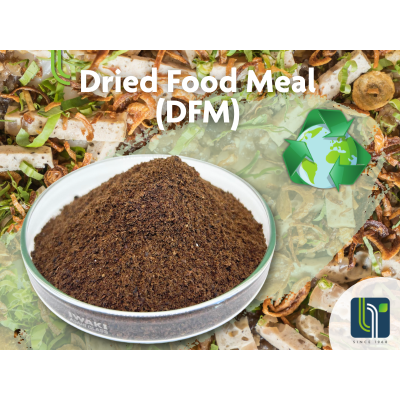
Lam Tak - Dried Food Meal (DFM)
A circular food system offers a practical solution by minimizing waste and maximizing resource use. Unavoidable food losses and waste that are unfit for human consumption can be repurposed into animal feed, reducing reliance on conventional feed sources while supporting sustainable agriculture.
Ensuring Biosafety in Food Waste-Based Feed
Biosafety concerns regarding food waste in animal feed are addressed through strict heat treatment regulations. In Korea, registered “Ecofeed” manufacturers must heat-treat food waste containing meat for at least 30 minutes at 70°C, with 80°C being the common industry practice. The feedstock biomass is then dried to a moisture content below 10%, ensuring a safe and stable Dried Food Meal (DFM).
Under the Feed Management Act (FMA), all DFM products undergo quality control testing (Article 30, FMA) to ensure they meet strict safety standards and contain no harmful contaminants.
DFM: A Smart Alternative to Corn-Soybean Meal Diets
Using food waste in animal diets is not a new concept. It offers a nutrient-rich and digestible alternative to conventional feeds. Westendorf and Dong (1997) reported that protein digestibility in food waste-based diets (88.2%) was higher than in traditional corn-soybean meal diets (84.3%), although nitrogen retention rates remained similar. Additionally, Myer et al. found that pepsin digestibility and available lysine levels in dried food waste were moderately higher than in corn but slightly lower than in soybean meal. These findings highlight DFM’s potential as a flexible and efficient ingredient, providing a viable substitute for conventional feed components while enhancing feed formulation options and reducing reliance on volatile commodity prices.
Why Incorporate DFM?
- Dried Food Meal (DFM) provides a cost-effective, sustainable alternative to partially replace conventional corn-soybean meal diets. By using DFM, you can:
- Stretch your existing feed supply over a longer period
- Gain flexibility in feed formulation
- Reduce dependence on volatile feed commodity prices
- Improve cost efficiency and increase profit margins
Choosing a Dependable Source of DFM
One challenge in using food waste-based feed is nutrient variability, making source selection crucial. Lam Tak partners with FMA-registered Korean facilities that meet ISO 22000:2018 (food safety management) and ISO 9001:2015 (quality management) standards, ensuring consistent, high-quality DFM.
- Nutrient-Rich – High in proteins, carbohydrates, fats, fiber, and minerals, with low salt content
- Cost-Saving – Reduces overall feed expenses and enhances feed formulation flexibility
- Sustainable – Supports eco-friendly livestock farming by closing the food production loop—an initiative that can be effectively integrated into your marketing story.
- Eco-Conscious – Lowers the environmental footprint of food production