
LandfillGrade - Sealant Application for Certified Landfill Capping
Providing a Multi-Use, Self-Compacting, Bentonite-Based Seal for Repair of Penetrations to Certified Landfill Caps.
In typical landfill operations there are numerous and routine occasions that the certified cap of a landfill must be excavated – some examples might include:
- Placement of environmental monitoring wells
- Construction of methane gas collection systems
- Installation or Repair of Risers for Gas Piping
- Other general repairs related to erosion.
Upon breaching a previously certified, low-permeability landfill cap for the purpose of installing general leachate piping or a piping system for extraction of landfill gases, the re-creation of low-permeability conditions around the installed piping and/or well casing are required. This is to maintain low permeability for both minimization of percolation of water and precipitation into the landfill and to provide an air-tight seal around the annular space, to minimize air intrusion into the landfill (which can result in combustible conditions).
The breaching of a previously certified, low-permeability landfill cap for the purpose of installing either piping or a gas extraction well system (for collection of methane and other gases) may qualify as a “violation” of the cap that requires mitigation or repair to re-establish low-permeability conditions (equal to or less than 10-7 cm/s) within the area of the installed well as per various state environmental regulations on landfill permit conditions.
Current construction practices to re-establish low-permeability conditions, which are dictated by existing and relevant regulations, commonly involve the following general procedure: digging trenches of various depths or drilling a boring (up to three feet in diameter) through each of the surficial protective layer, the low-permeability cap (including the FML component, if present) and finally down into the landfill material. In the case of a vertical pipe section with a 6-12-inch diameter perforated well casing in the boring, screened at the appropriate interval, the annular space would be backfilled above the screened interval with low permeability soils (e.g. clay) or grout, plus the overlying protective layer, in an effort to re-establish low-permeability conditions around the well casing.
- Thickness required by state/site permit conditions for frost, erosion, etc.
- Thickness varies by state/site permit requirements.
- State/site conditions may require specific FML repair steps including use of clamped boots.
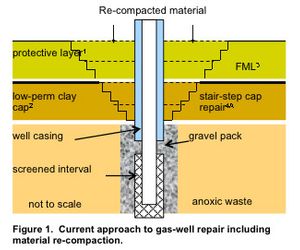
- Typical repair requirements for re-compacted soil barriers require multiple loose lifts of soil with minimal vertical interfaces and QA/QC certification for cap repairs (Figure 1).
- AquaBlok based alternative involves minimal impact through vertical excavation and backfilling (Figure 2).
Whether in a piping trench or in a vertical gas pipe configuration, the reestablishment of a required landfill cap is critical. This is illustrated in Figure 1, where the typical process to achieve targeted low permeability in the liner is shown. First, the clay capping material must be added in multiple lifts and mechanically compacted. To accomplish this, the compaction process may require use of a backhoe tamper, small roller or “turtle” or “jumping jack” across progressively elevated, stair-stepped benches constructed in the well vicinity. Excavation of additional liner and protective materials from around the original boring location will also be needed to facilitate the compaction. In addition, in order to demonstrate that the process has achieved optimal compaction levels, it may be necessary to do neutron probe testing throughout the process to provide necessary re-certification of a disturbed cap.
From constructability and function-based perspectives, the construction practice described above presents several significant challenges. Firstly, use of even hand-held mechanical equipment in the vicinity of piping increases the risk of damage during installation. And secondly, and most importantly, construction of an inadequate, low-permeability seal within the backfilled area and adjacent to the piping or well casing may not meet the low-permeability requirement, but also will greatly increase the risk of air intrusion down into a well system, thus “short circuiting” the system. Lack of an air-tight seal around a methane well greatly increases fire-hazard potential as well as adversely impacting the desired, anaerobically driven landfill processes.
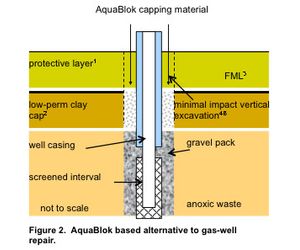
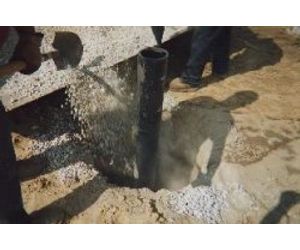
A diagram depicting the use of a low-permeability AquaBlok cap during landfill gas-well construction is provided as Figure 2. Use of an AquaBlok cap instead of compacted clay material would still involve drilling a borehole, installing the well casing, and placing of a surficial protective layer over the capping material. A similar approach is used in the use of AquaBlok for horizontal pipe bedding and sealing, where the landfill liner has been breached. A photo of AquaBlok being applied in such a horizontal pipe section is shown (Photograph 1).
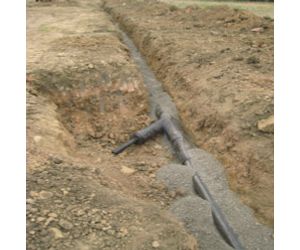
Use of AquaBlok for cap penetrations and as a pipe sealant has a number of technical, economic, and regulatory based advantages over current construction methods, including:
Formulations of the product are comprised of sodium bentonite clay, and the low-permeability (10-9 cm/s) and resiliency, or re-sealing ability, of such material is well known to the environmental community.
The aggregate core provides for self-compaction when wetted and hydrated. Consequently, the material can be placed as a single dry lift, with water added afterwards. The material’s self-compacting ability precludes the need for additional excavation and therefore use of clay and protective material, as well as compaction-driven backfilling. In the case of a gas well, it can be constructed exclusively within the confines of the existing borehole.
In its dry form, the product handles easily, like aggregate. Thus, it can be delivered to a site in packages varying from 50-lb sacks to two-ton super sacks and either poured or shoveled by hand, as shown (Photograph 2).
The amount of water needed to initially hydrate the product, once placed into the annular space, is not critical, thus precluding the need for neutron probe testing during well construction.
Creation of an air-tight seal around a plastic vent pipe has been demonstrated in laboratory tests that also highlighted product use in sediment capping related applications. The same air-tight attributes could also be achieved in a landfill application, resulting in minimal air intrusion from above and maintenance of required anaerobic conditions within the well’s vicinity.
The product’s demonstrated abilities to act as a low-permeability, air-tight seal greatly increases the potential for successful re-certification of the landfill cap upon re-inspection.