


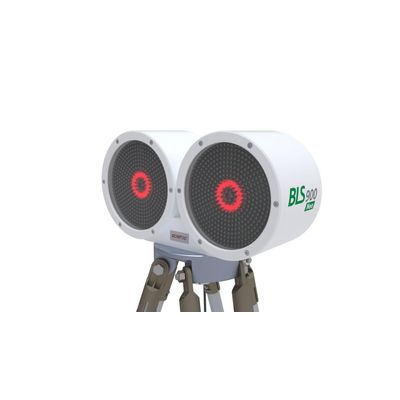
Scintec - Model BLS900 -Large Aperture Scintillometer
The Scintec BLS900 Neo measures atmospheric turbulence, heat flux and crosswind over path lengths between 100 m (with Path Reduction Aperture, otherwise 500 m) and 6000 m. As part of a meteorological station it can also be used to determine the evapotranspiration over extended areas.
A Scintillometer senses turbulence between an optical transmitter and a receiver. The operation principle is based on the modulation of light by atmospheric refractive index fluctuations in the air. The phenomenon is called scintillation and is the reason why stars twinkle at night.
Compared to conventional turbulence measurements with point sensors, scintillometers gather spatially representative results with lower statistical scatter and shorter averaging times.
The Dual-Disk Design of the BLS900 Neo provides for instantaneous corrections of absorption fluctuations, saturation of scintillation and outer scale effects. This results in significantly higher data quality and increased measurement ranges. All BLS Series Scintillometers use LED arrays. Wide emission angles virtually eliminate the need for transmitter alignment and maintain high data accuracy even when used on towers which are prone to vibration.
The Neo Version (New Emission Option) operates at a wavelength of 850 nm and features a significantly reduced power consumption and increased LED lifetime.
- maximum path length 6000 m
- Dual-Disk Design for unrivalled accuracy
- crosswind measurement capability
- built-in Receiver Alignment Monitor
- LED array allows transmitter to be mounted on vibrating towers
- measures turbulence over large spatial scales
- Signal Processing Unit performs all calculations
- 6 GB built-in data storage
- remote access
- infrared window heating available