

- Home
- Companies
- DURAG GROUP
- Products
- Durag - Model AP2E LaserCEM - LaserCEM ...
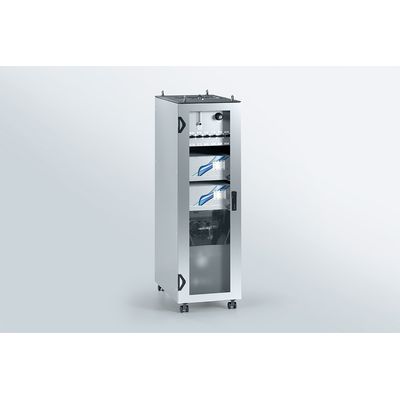
Durag - Model AP2E LaserCEM -LaserCEM - LASER INFRARED SPECTROMETER
The LaserCEM® can measure a wide choice of parameters with an unforeseen quality of measurement in terms of accuracy and resolution: HF, HCl, NH3, CH4, SO2, CO, CO2, NO, NO2, O2, N2O, H2S, CHOH, H2O…
- Lowest certified measuring range for NO: 0-78 mg/Nm3
- Lowest certified measuring range for HF: 0-1.5 and 0-10 mg/Nm3
- Direct measurement without modifying the sample
- Low energy and compressed air consumption
- Patented OFCEAS TDL technology
- No optical moving parts
- Communication, control and maintenance via Modbus, (TCP/IP, RS), analog, USB and Ethernet
LaserCEM Continuous Emission Monitoring System combines regulatory compliance, operational effectiveness, risk mitigation, and environmental responsibility to provide a comprehensive approach to your stack emissions management.
- True Direct Extractive CEMS - No sample pre-treatment. OFCEAS technology associated with low pressure sampling enables direct measurement and eliminates the risk of chemical adsorption, desorption, and condensation along the sampling line.
- Interference-free - OFCEAS technology offers exceptional selectivity, enabling simultaneous monitoring of multicomponent without interference, whatever the gas matrix.
- Low cost of ownership - dust filters’ replacement drastically reduced; low compressed air; very low power consumption (sampling line heated at 80 °C compared to 180°C required by other monitoring systems.)
- No re-zero, no drift - integrated auto calibration of the measurement system, preventing from drift under normal use of the instrument.
- Easy to use, easy to report emissions - LaserCEM® is able to analyze all kind of gases and concentration ranges, with limited service and maintenance costs. In combination with Durag Emission DAHS, the D-EMS 2020, tracking ELVs and sharing emissions reports to your local authority is amazingly simple.
- Evolutive
Modular system, allowing for the add of new gas parameters or new ranges: you to stay fit and compliant with future regulations or stack emissions monitoring objectives.
Perfectly suitable for:
- Continuous stack emission measurements for environmental compliance
- Municipal waste incinerators
- Biomedical and sludge incinerators
- Hazardous waste incinerators at chemical plants
- Coal-fired combustion plants
- Power generation, Boilers and Combustion processes
- FGD Emission Monitoring
- Efficiency control for DeNOx systems to control their performance
- Pre and post catalyst SO2 monitoring (DeSOx unit process control)
- Blast furnace and converter gas analysis
- Low NOx and ultra-low NOx measurements
- Industrial gas filling
- Biofermenters
- Gasification and pyrolysis processes
- Cement kilns
- Solvent recovery and destruction
- Crematoria
- Steel and Aluminum smelters
- Brick, tiles and glass manufacturing
- Catalyst protection monitoring
- Combustion research
- …
Certifications:
- The measurement system was tested by TÜV Rheinland Energy GmbH in accordance with the European Standards EN 15267 Part 1, 2 and 3 and is
- QAL1 certified according to EN 14181Certified by MCERTS Performance Standards for Continuous Emission Monitoring Systems (CEMS), Version 4 dated July 2018 EN15267-3:2007, & QAL 1 as defined in EN 14181: 2014 - Sira MC190347/02
Compliance with international environmental regulations, such as:
European Union:
- Industrial Emissions Directive – Directive IED 2010/75/EU
- BREF Incineration
- Large Combustion Plant Directive (LCP) 2001/80/EC
- Medium Combustion Plant Directive (MCP) 2015/2193
- Emission Trading System (EU-ETS) Directive
- BREF Forges & Fonderies
- BREF Industrie du textile
- BREF Systèmes de traitement des émissions atmosphériques de la chimie
- BREF Large Volume Inorganic Chemicals
- BREF Surface Treatment Of Metals and Plastics
- BREF Production of Chlor-alkali
- Installations classées pour la protection de l'environnement (ICPE)
- Guide incinération ou co-incinération de déchets non dangereux (Guide FEDENE & GIMELEC, réalisé par la FNADE, le SNIDE et le SVDU - Révision 4 – Février 2022)
- Fiches techniques Combustion
United Kingdom:
- Clean Air Strategy for England
- Environmental Permitting Regulations
- Pollution Prevention and Control (PPC) Regulations
- Industrial Emissions Directive (IED) Transposition Regulations
United States (US-EPA):
- Clean Air Act (CAA) and CAA Stationary Source Compliance Monitoring Strategy
- New Source Performance Standards (NSPS)
- National Emission Standards for Hazardous Air Pollutants (NESHAP)
- Title V Operating Permits
Canada:
- Canadian Environmental Protection Act (CEPA)
- Environmental Code of Practice for Stationary Combustion Turbines
- Canada's Air Pollutant Emissions Inventory
Australia:
- National Clean Air Agreement
- National Environment Protection (Ambient Air Quality) Measure
- State-specific regulations (e.g., Environment Protection Act in Victoria)
China:
- Environmental Protection Law of the People's Republic of China
- Air Pollution Prevention and Control Action Plan
- National Emission Standards for Air Pollutants (NESAP)
India:
- Environment (Protection) Act, 1986
- CPCB and SPCB guidelines for CEMS measurements (issued in Aug 2018)
- Air (Prevention and Control of Pollution) Act, 1981
- National Ambient Air Quality Standards (NAAQS)
Japan:
- Air Pollution Control Act
- Industrial Waste Management Law
- Volatile Organic Compound (VOC) Control Law