


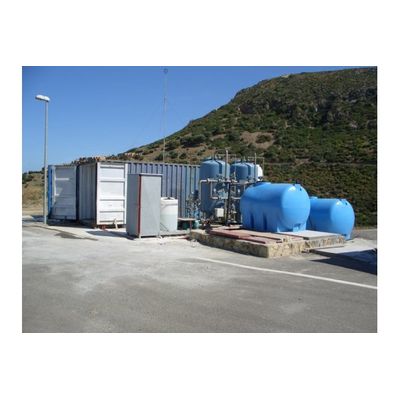
TA - Leachate Treatment Plants
Leachate is a liquid that mainly originates from the infiltration of water into the mass of waste or from its decomposition. The leachate produced by controlled municipal solid waste (MSW) landfills is a wastewater with a more or less high content of organic and inorganic pollutants, deriving from biological and physico-chemical processes within the landfills.
The machines designed for the treatment of leachate are mainly used for civil and industrial landfills or waste disposal platforms.
The water to be treated is composed of oils and greases , filings, chips, dirt, surfactants, traces of hydrocarbons, dissolved salts and organic compounds.
The purpose of the treatment is to concentrate the wastewater to reduce volumes before its recycling in landfill or disposal. The purified water (salt-free) can possibly be reused in the production cycle as washing water.
As an example, a plant for the purification of 30 m3/d leachate is illustrated below . The system allows obtaining approximately 20 m3/d of purified water that can be discharged into surface water ; the remaining fraction of concentrate (10 m3/g) is recirculated in the landfill where it is part of the cycle of natural purification processes that take place here (=> biogas production). This plant essentially consists of the following process stages.
Sand filter for the removal of suspended solids
Ultrafiltration section (UF), porosity 0.1 µm. In this section of the plant , good clarification of the wastewater is guaranteed , which is necessary for the correct functioning of the subsequent reverse osmosis stage .
The membranes usually installed are of the ceramic tubular type, therefore chemically unassailable and compatible with the filtration of wastewater with a high content of organic contaminants and with the possibility of washing at extreme temperatures and pH.
Concentration on spiral-wound polymer reverse osmosis (RO) membranes . This section will have a double stage and double passage to guarantee the highest possible concentration ratio and therefore obtain a quality permeate (dischargeable into surface water DL152) and not very concentrated to recycle or dispose of.
It should be underlined that the pre-treatment with ultrafiltration allows the use, for the reverse osmosis section, of spiral wound membranes with high efficiency, low cost and easy maintenance and replacement.