


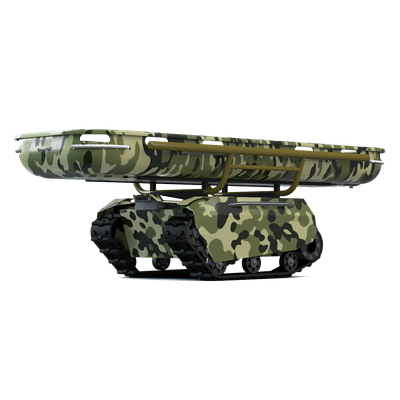
LeoTronics - TrackReitar Rescue Robots
The search and rescue robots from LeoTronics Robotics are designed to help evacuate injured people during disasters such as war and catastrophes. People are at risk of carrying out rescue missions. Our rescue robot is based on a universal platform, TrackReitar. The platform is reliable in making the robots stay stable. You can count on the platform to have a stable and easily manipulated search robot.
Rescue teams use robots to perform the most dangerous tasks. For example, they can employ robots to take the injured to safe locations. The robots are equipped with stretchers that can perform the work. Artificial intelligence makes the robots learn about the correct route during the evacuation process. During rescue missions, they use inbuilt programs to move from one location to another.
- Designed to challenges
- Can be equipped with any equipment and actuators for your tasks.
- Highly Customizable
Rescue robots from LeoTronics robotics come in a well-thought-out design. The design is simple but highly effective during different operations. You can apply the robots, and they will contribute to making you enjoy great success when working on various projects. The easy to adapt platform makes the robots widely applicable. You can apply them in a wide range of applications. They simplify the rescue missions. Some rescue mission is too dangerous. The application of the robots simplifies them.
Dimensions 1000(L) x 780(B) x 500 (H)
Wheelbase 440 mm
Weight 120 kg
The maximum speed of up to 10 km/h
Minimum ground clearance 200 mm
Rated traveling loads 100 kg
Climbing Capacity 36°
Minimum turning radius 0
Obstacle Ability 170 mm
Operating temperature -20 to 60C
The purpose of any rescue and other urgent works is to rescue people and help the injured, prevent localization of accidents, eliminate damages stemming from rescue works, and create conditions for subsequent reconstruction works.
The range of emergency rescue work is extensive. These include:
-
reconnaissance of traffic routes and areas of forthcoming work,
-
localizing and extinguishing fires,
-
tracing victims and extracting them from the rubble, damaged and burning buildings, gassed, smoky and flooded premises,
-
opening of destroyed, damaged, and blocked protective structures and rescue of people located there,
-
Providing first aid to victims and evacuating them to medical facilities,
-
Evacuation (withdrawal) of the population from dangerous sites to safe areas
-
Sanitation of people, decontamination of their clothes, territory, facilities, equipment, water, and food
-
localization of accidents on public utilities and technological networks, etc.
When carrying out emergency rescue and other urgent work in the hotbeds of destruction formed as a result of military operations, the following is additionally carried out:
-
Detection, neutralization, and destruction of unexploded munitions in standard equipment,
-
Repair and restoration of damaged protective structures,
-
Decontamination of foci of destruction,
-
a collection of material assets,
-
provision of food to the population in need,
-
disposal of contaminated food and other work to prevent the outbreak of an epidemic.
When carrying out emergency rescue work, situations dangerous to human life often arise. The use of so-called unmanned technologies can minimize the degree of risk for rescuers.
Mobile robots occupy a special place among the multitude of modern robotic devices. Their wide range of functionality and constant readiness for sudden use make mobile robots indispensable for emergency response services.
Robots are capable of acting quickly in unpredictable and dangerous environments. Their machine vision, communication, and motion systems operate in the most stressful conditions (smoke, dust, and fire in a disaster area). Robotic rescuers are most commonly used in geological emergencies.