


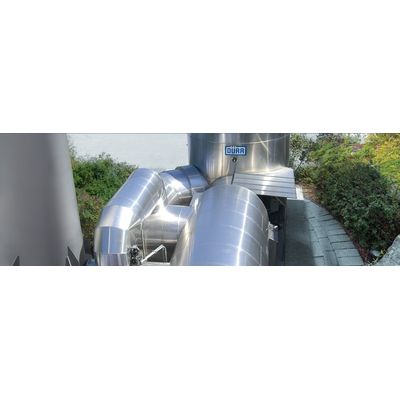
Dürr - Low-Pressure Catalytic Systems
The purpose of low-pressure catalytic systems is to remove volatile organic compounds (VOCs) using catalytic oxidation. Low-pressure catalytic systems are suitable for all catalytic applications. The pollutants are converted at atmospheric pressure or at a slight overpressure or underpressure.- Adaptable to a wide range of hydrocarbons
- No restrictions on the type or quantity of pollutants
- Individual heat recovery
- Lower oxidation temperature leads to a reduction in energy consumption
First of all, the exhaust air from the production process is heated by an air-to-air heat exchanger. The air is then heated further using a burner, thermal oil, or steam until it reaches the operating temperature of the catalyst. In the catalyst the complex hydrocarbons are converted to substances with a simple structure at a temperature of 300 to 350°C. Oxidation causes the hydrocarbons to break down into carbon dioxide and water.
The heat generated during the conversion of the VOCs is transferred to the untreated exhaust air from the production process via an air-to-air heat exchanger.
If the VOC concentration is so high that more energy is produced than is needed for the reaction, the excess heat can bypass the heat exchanger and be taken directly into the chimney without being used.
In autothermal operation the required inlet temperature is achieved by pre-heating the exhaust air in the heat exchanger. As a result, the support burner does not need to provide any additional heat. If the system is not operating in autothermal mode, the support burner is needed to bring the exhaust air to the required temperature.
The inlet, catalyst, and final temperatures are measured and monitored. If the maximum operating temperature of the catalyst is exceeded, fresh air is added to reduce the pollutant burden and therefore the temperature.
The low-pressure catalytic systems from Dürr are suitable for all catalytic applications. The low-pressure catalytic system is widely used in the chemical and pharmaceutical industries and for purifying exhaust air from paint shops and surface treatment plants. The low-pressure catalytic process is also found in the printing and coating sectors.
- Chemical Industry
- Pharmaceutical Industry
- Printing & Coating Industry
The following critical substances which are generated in production processes can be treated with low-pressure catalytic technology:
- Exhaust gases with varying volumetric flow rates and pollutant concentrations
- Exhaust gases containing different hydrocarbons
- Exhaust gases with a low oxygen content
These systems are not suitable for applications where substances are produced that can either deactivate or block the catalyst.