

- Home
- Companies
- Olpidürr S.p.A
- Products
- Ecopure - Model LPX - Low-Pressure ...
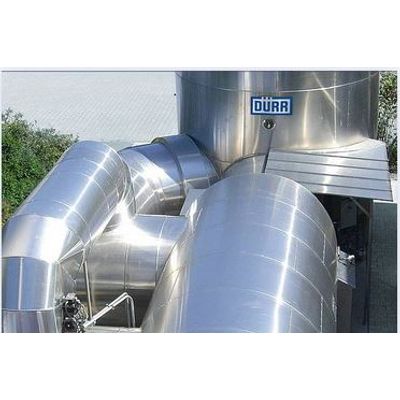
Ecopure - Model LPX -Low-Pressure Catalytic Systems
The purpose of Ecopure LPX low-pressure catalytic systems is to remove volatile organic compounds (VOCs) using catalytic oxidation. Ecopure LPX systems are suitable for all catalytic applications. The pollutants are converted at atmospheric pressure or at a slight overpressure or underpressure.
- Adaptable to a wide range of hydrocarbons
- No restrictions on the type or quantity of pollutants
- Individual heat recovery
- Lower oxidation temperature leads to a reduction in energy consumption
First of all, the exhaust air from the production process is heated by an air-to-air heat exchanger. The air is then heated further using a burner, thermal oil, or steam until it reaches the operating temperature of the catalyst. In the catalyst the complex hydrocarbons are converted to substances with a simple structure at a temperature of 300 to 350°C. Oxidation causes the hydrocarbons to break down into carbon dioxide and water.
The heat generated during the conversion of the VOCs is transferred to the untreated exhaust air from the production process via an air-to-air heat exchanger.
If the VOC concentration is so high that more energy is produced than is needed for the reaction, the excess heat can bypass the heat exchanger and be taken directly into the chimney without being used.
In autothermal operation the required inlet temperature is achieved by pre-heating the exhaust air in the heat exchanger. As a result, the support burner does not need to provide any additional heat. If the system is not operating in autothermal mode, the support burner is needed to bring the exhaust air to the required temperature.
The inlet, catalyst, and final temperatures are measured and monitored. If the maximum operating temperature of the catalyst is exceeded, fresh air is added to reduce the pollutant burden and therefore the temperature.
The low-pressure catalytic systems from Dürr are suitable for all catalytic applications. The Ecopure® LPX is widely used in the chemical and pharmaceutical industries and for purifying exhaust air from paint shops and surface treatment plants. The low-pressure catalytic process is also found in the printing and coating sectors.
- Chemical Industry
- Pharmaceutical Industry
- Printing & Coating Industry
The following critical substances which are generated in production processes can be treated with Ecopure® LPX catalyst technology:
- Exhaust gases with varying volumetric flow rates and pollutant concentrations
- Exhaust gases containing different hydrocarbons
- Exhaust gases with a low oxygen content
These systems are not suitable for applications where substances are produced that can either deactivate or block the catalyst.
The Ecopure® LPX Air Pollution Control System consists of the following main components:
- Heat exchanger
- Support burner
- Fan for startup or for supplying combustion air
- Reactor with catalyst
Depending on the type of catalyst being used, the reactor consists of a cylindrical or square case containing catalysts which are made from bulk material or which have a honeycomb structure. These are positioned on a special support grid. The Ecopure® LPX catalyst case, together with the other components listed, help to ensure that the process is as efficient as possible.
The exhaust air has to be heated to the required temperature for the catalyst in order for the catalytic reaction to start. A burner or an electric heater is often used for this purpose, but is generally only needed when the system starts for the first time. As soon as the oxidation process takes place, enough energy is released to preheat the exhaust air in an upstream heat exchanger. When combined with the intelligent control system, the various components of the air pollution control system allow for high levels of flexibility and energy efficiency.