


- Home
- Companies
- LSI-Lastem srl
- Products
- LSI-Lastem - Model E-Log-ELO3305 - Data ...
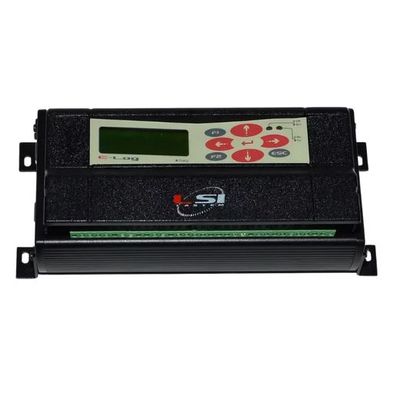
LSI-Lastem - Model E-Log-ELO3305 -Data Logger For Meteorological Monitoring
E-log has been explicitly designed for environmental applications: it is equipped with specific inputs for a wide range of sensors and calculations of derived quantities.
E-Log stores the data from the connected sensors and supports different communication protocols both in input and output.
Robust and reliable, E-Log makes measurements possible even in the most severe environments, while the 16-bit A/D converter ensures accurate and reliable data in classic meteorological, hydrological and air quality applications and – more generally – in any environmental application.
- N. 8/16 analog inputs, n. 4 digital inputs;
- Input extension using MASTER/SLAVE configurations;
- Extremely low power consumption;
- N. 99 measurements between channels for sensor acquisition and derived quantities;
- Internal library for calculating derived quantities and mathematical calculations;
- 8MB Flash Memory;
- Modbus-RTU Master/Slave, TTY protocols;
- Transmission (push) of data in ASCII format with FTP protocols;
- Model with Zig-Bee 2,4 GHz Radio for radio sensor reception and from other modules (ELO3515);
- Transmission (push) of data in ASCII format with FTP protocols;
- N. 2 RS232 ports (ELO3305);
- N. 1 RS232 port and N. 1 RS485 port (ELO3305.1);
- Digital outputs to implement external devices with programmable logics or events;
- Acquisition rate from 1 s to 12 hours;
- Elaboration rate from 1 s to 12 hours;
- Connection to the PC via RS232 (USB/Ethernet/Modem GPRS with external accessories);
- Display and keyboard;
- Model codes: ELO3305, ELO3305.1.
Free terminal inputs
- N.8 analog differential inputs (N.16 single – ended);
- N.4 digital inputs (Pulse/Frequency).
To increase the number of inputs, two E-Log units can be jointed together using a Master & Slave using a RS232 (ELO3305 and ELO3515) or RS485 (ELO3305.1) connection.
Inputs for Serial sensorsThe E-Log COM-2 port can be connected to sensors with different protocols:
- Modbus-RTU on RS232 or RS485 (with adapter external DEA504 for model ELO3305, directly for model ELO3305.1;
- GILL (Gill format, polar, continuous)
- BIRAL (SWS050 – SWS100, SWS200 –SWS250)
- LUFFT (UMB binary)
- BOSCHUNG.
E-Log can also be connected via RS232 to EXP301 radio receiver to receive signals from LSI LASTEM radio sensors (EXP line).
Sensors acquisition rateAcquisition rate is programmable for each input (from 1 second to 12 hours). E-Log manages 12 channels from analog sensors and 8 derived quantities in 1 second.
To limit energy consumption from sensors requiring power supply, it is possible to set an advanced power supply from the acquisition event, (warm-up) that is interrupted immediately after the acquisition itself.
The raw measured values can be stored directly as instantaneous values, or be stored as statistical processing (from 1 second to 12 hours):
- Average/Minimum/Maximum/Standard Deviation;
- Wind elaborations;
- Totals.
Internal library of derived environmental quantities. These calculations use acquired quantities, constant values and other calculated quantities. The library also includes mathematical functions. E-Log manages up to 99 channels between acquired, derived and calculated quantities.
Data memoryInternal memory (8 MB) allows to store data typically for several weeks. The registration structure is circular. Storage autonomy is a function of the number of connected sensors and of the configured processing rate.
Data communication (devices)It is possible to transfer data to a PC via:
- RS232, USB (with adapter included);
- RS485 with external adapter (DEA504 / 504.1) for model ELO3305, directly with ELO3305.1;
- Modem GPRS (DEA718.3);
- Radio (DEC015.1);
- Ethernet (DEA553);
Via GPRS modem, data are sent (push mode) to the IP address of a remote PC/Server in ASCII format and FTP protocol Alternatively, via GPRS or Ethernet, E-Log uses a proprietary binary protocol to transmit data using the LSI LASTEM communication programs: 3DOM, CommNET.
Data communication protocols (Modbus)In the E-Log models it is possible to send data to Modbus Master devices via:
- Modbus RTU: on RS232 or RS485;
- Modbus Encapsulated TCP on Ethernet (using DEA553 adapter);
- Modbus TCP over Ethernet (using DEA509 adapter);
- The data transmitted with the Modbus protocol can concern instantaneous values, but also mobile statistical values*.
*Mobile data are values whose statistical basis corresponds to the last observation period. Example: mobile temperature average over 10 minutes (each minute the value is updated always considering the average value of the last 10 minutes).
LSI LASTEM data loggers have an internal library of formulas for calculating a series of environmental quantities. These quantities are obtained from measured parameters, entered by the operator and other calculated quantities.
- Absolute Humidity (VDI3786 Part 4);
- Air changes (1997 Ashrae Fundamentals Handbook);
- Air Flow (1997 Ashrae Fundamentals Handbook);
- Air Speed (using Pitot and Darcy Tubes);
- Absolute Pressure (sea level);
- Dew Point (ISO7726);
- Heat Index;
- Evaporation;
- Mean Radiant Temperature;
- Radiant Temperature Asymmetry (ISO7726);
- Operative Temperature (ISO7726);
- Plane Radiant Temperature 1 & 2 (ISO7726);
- Partial Vapor Pressure;
- Psychrometric Humidity (ISO7726);
- Specific Humidity (VDI3786 Part 4);
- Sunshine Duration;
- TCH – Chill temperature (ISO TR11079);
- Wet Bulb Temperature (ISO7726);
- UV Exposition;
- UV index;
- Wind chill index (ISO TR11079);
- WBGT Index IN+OUT Formulas (ISO7243) – ELO008, ELO009;
- % dissatisfied by Floor (ISO7730);
- % dissatisfied by Vertical Temperature (ISO7730) – ELO009;
- % dissatisfied by Radiant Asymmetry (ISO7730) – ELO009;
- % dissatisfied by Air Draw (ISO7730) – ELO009;
- Daylight Factor (IESNA Lighting handbook);
- Light Intensity.