


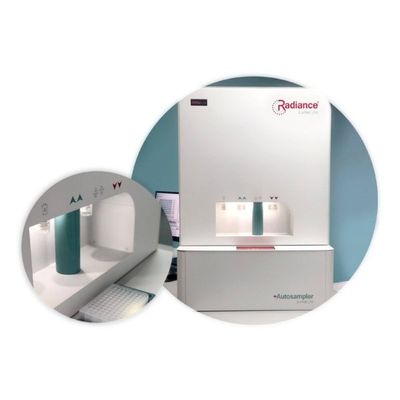
LumaCyte Radiance - Laser Force Cytology (LFC) Cell Analyzer
LumaCyte’s Radiance Laser Force Cytology (LFC) analysis platform instrument is a high-content, label-free microfluidic cell sorter and real time cell analyzer that enables scientists and researchers to characterize and sort individual cells by measuring their optical force.
- 96-well Plate Format : Radiance +Autosampler has a 96-well plate format allowing for unattended, automated processing and analysis.
- Flexibility and Power : Radiance +Autosampler is fully programmable via Illuminate™ software suite, giving users maximum flexibility and power for automating sample analyses.
- Viable Cells : Cells remain viable for growth and further analysis after sorting with Radiance.
- Sensitivity : Sensitive to subtle phenotypic changes including: viral infection, cell differentiation, live/dead, transfection, chemical exposure, etc.
- Mid-process Sample Changes : Illuminate software suite provides flexibility allowing for mid-process sample changes and additions should they be required.
- Small Benchtop Design : Benchtop design with a footprint (26” L x 20” W x 28” H) small enough to fit on any laboratory bench.
Vaccines & Viral Infectivity
Rapid viral infectivity for vaccine R&D, process development and optimization, formulations, and potency.
Biomanufacturing Process & Quality
Rapid detection and quantitation of viral vector production of proteins and antibodies during R&D and manufacturing.
Viral Safety
The rapid detection of adventitious viruses in bioreactors and production processes is critical for assuring biologic drug safety. The rapid assessment of viral infectivity is crucial to identifying a threat as it emerges in the manufacturing process.
Cell & Gene Therapy
Identify and quantify changes in cellular properties including AAV, lentivirus and retrovirus transduction and transfection during both gene and cell therapy development and production.
Cancer Biology
Tumor cells, tissues, and circulating tumor cell (CTC) enumeration, identification, and characterization.
Phenotypic Drug Discovery
Pre-clinical drug candidate screening, toxicology, and cell biology.
LumaCyte’s transformative microfluidic cell analysis and sorting technology, Laser Force Cytology (LFC), offers researchers and biomanufacturers a label-free single cell analysis capability where the use of antibodies or genetic labeling is not required. LumaCyte’s Radiance instrument uses a unique combination of advanced optics and microfluidics to automatically identify and characterize cells of interest based upon key intrinsic biophysical and biochemical cellular properties and dynamics. Laser Force Cytology (LFC) delivers a more robust and powerful sample analysis compared with conventional label-based flow cytometry.
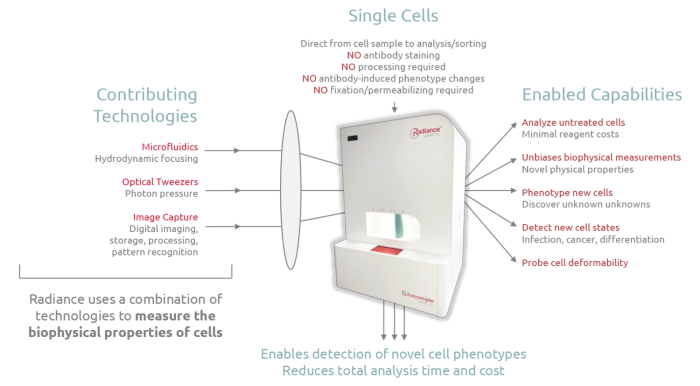
LumaCyte’s Radiance instrument measures dozens of parameters that reflect the intrinsic biophysical and biochemical properties of cells. Multivariate data (data consisting of multiple variables as opposed to a single variable) can have significant benefits for qualitative and quantitative analytical modeling/calibration, and better predictive results versus simple univariate data sources. The measurements can be used build a sophisticated model that can be used to better understand a process, identify new patterns, and predict important variables more precisely and accurately.
To the left is a selection of data collected with Radiance from a 3-component particle mixture including eccentricity (non-spherical aspect ratio), deformability (particle stretch while experiencing optical forces), and velocity (proportional to optical force). The video shows that the particles are partially resolved in eccentricity and deformability but have significant separation in the velocity dimension.
The power of a multivariate analysis tool is that even for very overlapped data, small differences can be utilized and correlations established using a vast array of machine learning tools including partial least squares regression (PLS) analysis, principal component analysis (PCA), linear discriminant analysis (LDA), and neural networks.