


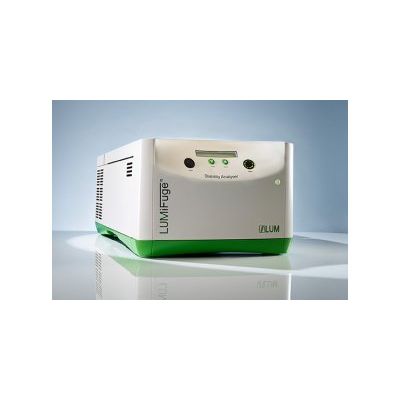
LUMiReader - Model PSA Series -Instantaneously Measures Analyser
The LUMiReader PSA instantaneously measures the extinction profile of the transmitted light across the entire length of your sample using the STEP-Technology. It may be recalculated in terms of clarification and particle concentration. Each LUMiReader contains an optical block and temperature control element. In addition, the specially designed PSA module also opens new horizons for high resolution particle sizing and allows you to measure the velocity distribution of separating particles. There is no need for you to know any material constants such as viscosity or density.
Our proprietary design ensures that the light strikes the sample across its entire height, ensuring maximum optical sensitivity and reproducibility.
The optical detector assembly features micro-scale spatial resolution capable of accurately measuring even the smallest local changes instantaneously across the entire sample height.
This design eliminates the time-consuming and less accurate task of scanning your sample, allowing you to capture even very fast micro-changes occuring in your dispersion without mechanical vibration.
The LUMiReader also uses a patented tilt technology based on the Boycott effect. The well-known principle allows accelerated, real-time stability testing at gravity by tilting the sample from its normal upright position. The magnitude of acceleration (up to 10 times) depends on geometric factors, such as tilt angle, vial dimensions, and sample type.
Analyse in a wide range of viscosities, temperatures, and concentrations. With the advantage of looking at the entire sample from top to bottom instantaneously, you can observe and understand different stability/instability phenomena concurrently; for example, creaming, sedimentation coalescence, aggregation and flocculation at original product concentration.
Comes with state-of-the-art software SEPView (Click icon to find out more).
The LUMiReader comes certified, factory pre-calibrated and is ready-to-go.
The LUMiReader PSA allows for the first time the determination of the volume based particle size distribution (ISO 13317) for emulsions and suspensions, without the necessity of knowing the refractive index or software input and no assumption regarding particle shape and shape distribution.
This opens new horizons for the characterization of industrial products, where above parameters are often not available or not applicable.
LUM’s patented STEP-Technology, the measurement of Space and Time-resolved Extinction Profiles, was extended to an unique new multi-wavelength approach: alterations of ratio of transmission at different wavelengths monitors any particle or droplet size variation over product life without sizing particles itself.
Giving particle size distribution (ISO 13317), separation velocity distribution and hydrodynamic particle density in addition to the direct stability result according to ISO TR 13097, the new LUMiReader PSA is one instrument for the comprehensive understanding of complex industrial products in an easy way.
- Abrasives
- Asphaltenes
- Carbon black
- Ceramics
- Crude oil
- Fine chemicals
- Food
- Gas oil
- Ink
- Petrol
- Pharmaceutical dispersions
- Polymers
- Sludges
- Slurries
and many more materials.
- Speed up separation analysis time (up to 10-fold)
- Analyze volume and number-based PSD according to ISO standards
- Immediately see and understand even complex dispersion behaviour
- Obtain volume PSD without having to know refractive index
- Optimize sensitivity by simultaneous multi-wavelength approach
- Measure stability directly
- Get velocity distribution even for fast-settling particles
- Calculate density of your dispersed particles
- Investigate temperature effects up to 60 °C
- Differentiate between the various instability mechanisms
- Handle any dispersing media: water, oils, organic solvents
- Uses disposable cells, customizable
- Particle size distribution
- Direct real-time stability testing
- Dispersion classification (Fingerprinting)
- Separation velocity distribution
- Sauter diameter distribution
- Droplet & particle density distribution
- Hansen dispersibility parameters
- Turbidity index
- Asphaltene separability number
- Flocculation & coalescence
- Sedimentation & creaming rate
- Clarification rate
- Accelerated gravity separation
- Comparative & predictive shelf-life analysis