- Home
- Companies
- Stable Micro Systems Ltd
- Products
- Stable Micro Systems - Model TA.HDPlus ...
Stable Micro Systems - Model TA.HDPlus -Mechanical Materials Testers
Discover where and how materials testing can be applied to measure the mechanical/physical properties of materials. Materials testing is a popular and well known field of measurement to obtain physical and mechanical properties of materials from powders or raw materials, components and composite finished products. It is a wide-ranging field offering force and distance (stress/strain) measurement solutions from the tension of a shoelace to the crush resistance of cardboard packaging, the actuation force of switches to the measurement of friction between two materials. Materials testing instruments such as the TA.HDplusC Texture Analyser are found imperative in quality control and production environments to maintain product quality and performance specifications and also in laboratory or R&D locations where it is important to assess the effects on materials due to for example, change of supplier, process or temperature.
The arm of a Materials Testing Machine/Texture Analyser instrument holds a load cell – a highly accurate strain gauge that allows the measurement of forces up to 750kg. The arm is moved up and down via the control ofExponent Connectsoftware which can be programmed to move at chosen speeds and moved to chosen distances or the instruments can operate as pre-programmed stand-alone units. During testing, stress and strain data from the compression/tension of a sample are recorded and analysed. Data is usually displayed as graphs which are then analysed and relevant parameters shown in a spreadsheet. These parameters will have been chosen as the important material characteristics to measure in order to determine whether the tested material is fit for purpose or complies with a determined standard value. Measurement values which fall outside of a quality boundary could result in physical failure during use or have quality changes during storage which could have safety implications and ultimately damage the reputation of the product and/or company.
What industries can materials testing machines be used in?
Materials and therefore the requirement for materials testing are everywhere in industries ranging from plastics, medical, paper and cardboard, leather and textiles, automotive, medical devices, building materials and the electronics industry.
What typical properties can materials testing instruments measure?
- Abrasion
- Actuation Forces
- Burst Strength
- Compressibility/Compactability
- Hardness
- Flexibility/Rigidity/Stiffness
- Friction
- Peel Strength/Seal Strength
- Stickiness/Adhesiveness
- Tensile Strength/Breaking Strength/Elongation
The TA.HDplusC/ TA.XTplusC100Materials Testers are experts in the measurement of all of these properties and many more, with ASTM Standard tests built into the software or using the flexibility of empirical or imitative force measurements. High accuracy and reliability are the instruments’ forte, with forces of up to 750kgf and distance resolutions of half a micron available. Testing is easy and repeatable as test settings are automatically loaded and additional data such as audio and visual can be recorded to help with analysis, such as in the event of a fracture.
At their most simplistic form, these tests all have one of two things in common – a test in either tension or compression. A multitude of probes and fixtures are available that attach to the Materials Tester for the support of the material or for specific application of force/deformation to the material. See materials testing attachments
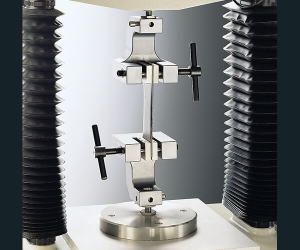
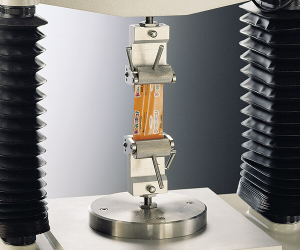
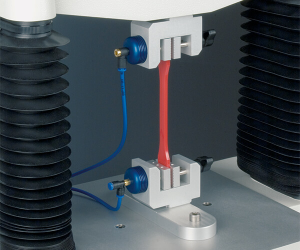
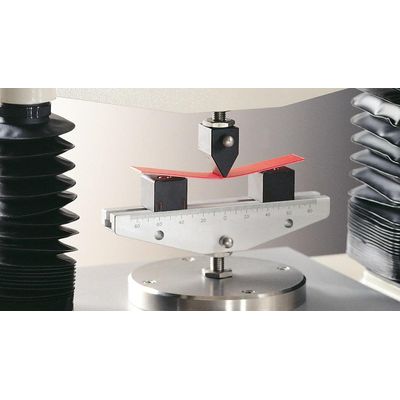
In compression mode, a number of tests types are available covering cutting/shearing, extrusion, fracture/bending, puncture/penetration, with a few typical examples shown below

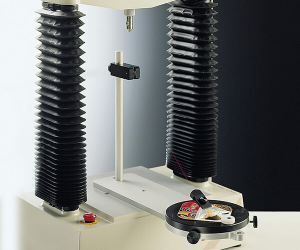
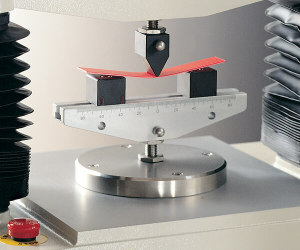
In many cases, non-standard applications can be accommodated through the design of a special rig, fixture or clamping device to hold the particular sample without needing to modify the testing machine itself.
AStandard Test Methodis a definitive procedure that produces a test result. In order to ensure accurate and relevant test results, a standard test method is explicit, unambiguous, and experimentally feasible, as well as effective and reproducible. A standard test method can be considered an experiment that determines one or more characteristics of a given sample and the detail of the test method is usually as a result of creation from a number of experts in that measurement field. Within the materials testing industry, for example, there are an enormous number of standard methods (e.g. ASTM, ISO) that have been developed to measure specific sample characteristics.
Typical examples of those that use Texture Analysers or Materials Testing equipment are:
- ASTM D882-02: Tensile test of thin plastic sheeting (thickness<1mm)
- EN 1944:1996 - Self Adhesive Tapes - Measurement of Unwind Adhesion at Low Speed
When reporting results in an academic paper or industrial report these standard methods will have been adhered to for the collection of the results and are more globally understood by others using the same standard methods. It is for this reason that standard methods have their place in the laboratory.
A large number of companies use one of a suite of Texture Analysers to calculate fundamental parameters which take into account the geometry and dimensions of the sample as well as the specifics of the test set up along with the relevant engineering equations. This type of testing allows easier comparison of different samples and comparison with literature data, but does require more sophisticated analysis to convert forces to stress and distances to strain.
Standard Method Data Analysis and Engineering Calculations
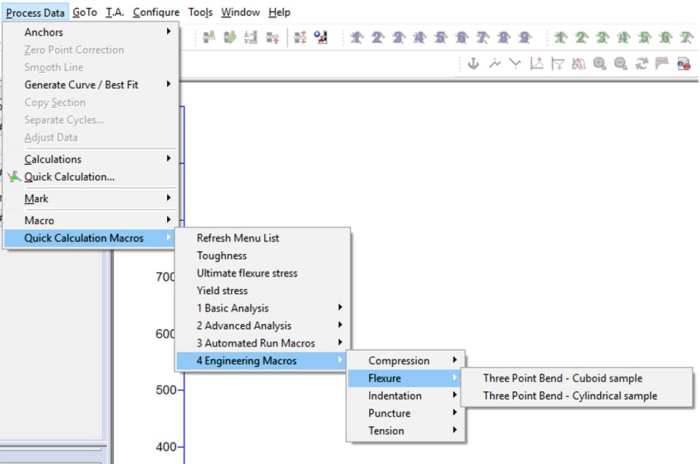
If fundamental testing is key to your operation and you are unaltered in your preference for this means of testing then standard engineering calculations are built intoExponentsoftware for quick calculation of specific moduli, stresses, strains, strengths and energies which are particularly suited to materials testing applications. Each calculation is designed to be used with a very specific test setup (for example, cuboid three point bend testing) as the specific equations required for analysis depend on the sample and test geometry.
Types of materials testing measurement and their analysis possibilities
Regardless of whether the test is performed in compression or tension, a resulting curve can be analysed to obtain the following typical parameters:
Strain rate; Young’s Modulus; Tangent, chord and secant modulus; Resilience; Yield stress; Strain to yield; x% proof stress; Maximum stress; Strain at maximum stress; Energy to maximum stress; Breaking strain; Hysteresis %; Energy to failure. See the full list of parameters
Whilst the equipment can provide a simple and flexible empirical or imitative solution it is also able to offer the traditional measurements well established within the materials industry mentioned above. Over the years, Stable Micro Systems has incorporated a large number of test procedures and analysis methods suitable to obtain fundamental materials parameters that could be used across a wide range of industries. WithinExponentsoftware all of the above analysis options can be accessed according to the test type:
Texture Analysers are very often used for quality control of irregular products by the use of empirical measurements. The force required to crush a tablet or the distance a biscuit bends before it snaps are invaluable pieces of information to manufacturers looking to develop new products or ensuring products perform correctly during spot checks. This type of test is ideal for products that have an unusual geometry, but it is also useful for testing more complicated systems, such as the combination of a product and its packaging (a box of eggs, the force to open a ring pull can or a yoghurt in its pot) with the added benefit of time saved by allowing a product to be tested straight off the supply line. Measurements of this nature do not fall within the specific (and therefore restricted) dimension criteria of fundamental materials testing and present classic examples of where empirical testing has its place.
In the food industry, for example, there are far fewer standard methods for physical property measurement. However, you may already be following one of few specific Standard methods to test your samples, e.g. ISO Gelatine Bloom Strength, AACC Bread Freshness, AACC Pasta Firmness, ASTM Petroleum Wax Firmness, ASTM Adhesive Peel Strength.
The limitations of applying standards is that their biggest advantage (of being specific) can be a major disadvantage (or restriction) to the measurement. All too often, operators are forced to use a standard method to measure a property of their product when:
- The property that the standard method measures is not the most important, or interesting, measurement that could be performed on the sample, or
- The sample preparation procedure may be difficult (or impossible) to conform with given the sample to be tested is different to the sample for which the test method was developed.
A well-written test method is important. However, even more important is choosing a method of measuring the correct property or characteristic. Not all tests and measurements are equally useful: usually a test result is used to predict or imply suitability for a certain purpose. However, it would seem more important to measure the most important characteristics of a product than to follow a seemingly pointless standard method that does not ideally characterise the product.
If you’re not bound by any existing constraints and are looking for the most simple testing solution, sometimes the easiest approach is to set up a test that closely imitates the way the product is evaluated in real life. This is called an ‘Imitative Test’. This type of test usually also makes data interpretation easier for you to understand.
The methods used for physical testing should measure the desired characteristics necessary to monitor the process, but need not always be comparable with other laboratories, where different criteria may be important. Where international comparison is important it is essential that methodologies be standardised. This would include all aspects of the testing procedure and this is an area of which the reference methods are primarily directed.
In contrast, where direct measurements are being made of the physical properties of a product, the experimental methodologies should not be constrained by reference methods. Instead, researchers are encouraged to develop and use methodologies that enhance the precision and accuracy of testing methods and lead to an understanding of the basic mechanisms. It is likely that new understanding will lead eventually to methods that more closely predict consumer assessment of product characteristics. The Stable Micro Systems range of Texture Analysers provide the flexibility of testing principles (e.g. compression, penetration, tension, extrusion, etc.) and the endless option of probes, fixtures and data analysis techniques within the software for texture analysis and fully customisable test settings.
Whilst standard methods are particularly useful for traditional material forms that have not changed over the decades and are fully accepted there lies another world where creativity has taken off into new materials and material forms for which these standard methods cannot be applied. One example of such an issue is in the field of pharmaceutical development. Traditional methods are well established for the testing of tablets, gels, suppositories, medicated liquids that are manufactured in their traditional form, however, innovative dosage forms have been developed such as disintegrating films, capsules, chewable pastilles for which there is no standard method to apply for the measurement of their physical (or textural) characteristics. Alternative testing methods that accommodate the testing of samples of varying types and dimensions and the range of additional material characteristics which can be measured, are required.
Not only are new non-standard methods viable where sample dimensions cannot be prepared according to the standard but also where the operator may wish to modify the test parameters (such as the test speed) to more closely mimic the situation under which the sample is to be typically used.
Here is a summary of typical texture analysis/materials testing tests that can be performed on materials or watch this video to see the highlights.
Discover how a Texture Analyser can apply and measure force to obtain physical/mechanical properties
What is Force Testing?
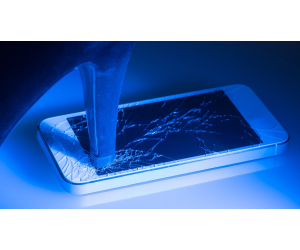
Force Testing is a simple means of determining how easily an item will fail, break or actuate something and is the simplest type of material testing assessment that is imperative to the safety of the world around us and the objects we use. It is a way that manufacturers can measure the ease or difficulty of how something can be pushed, pulled, bent, compressed, cut, peeled etc. and by measuring the force to perform these actions on products will determine whether they will function properly when in use and are therefore fit for purpose. In quality control, for example, such measurements will serve as a record of a product’s safety and performance and likelihood that it will function correctly in the manner in which it is likely to be used. Failure to do so may affect safety, acceptance and ultimately loyalty of the user/consumer thereby making this type of assessment an integral part of the manufacturing process.
How is Force Testing applied?
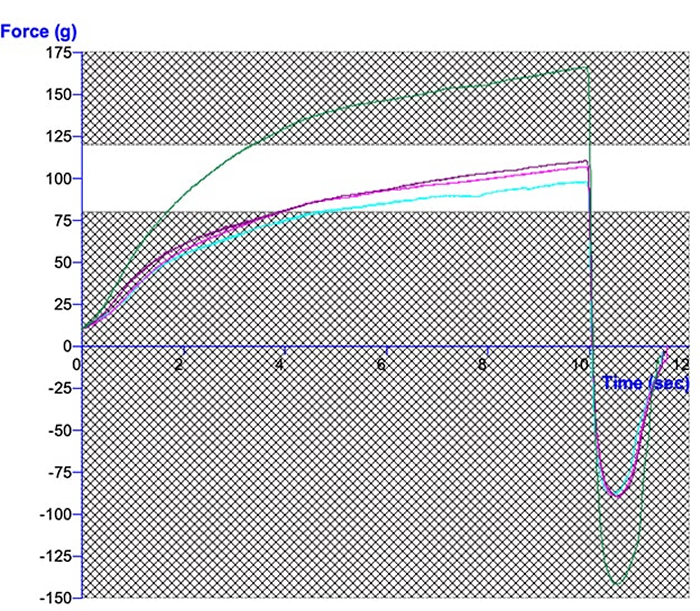
In its simplest use, force testing equipment can be employed to provide a single force measurement from a component or product such as the maximum force required to break in half, average force required to peel packaging, the minimum force to actuate an inhaler or the force to press a button in order that something will work. Force testing equipment can also be set up in a cyclic motion (i.e. multiple cycles of tension or compression) in order that something can be repeatedly tested to ascertain whether any weaknesses appear in the product/component through continuous application of a load that may occur during its lifecycle. Whilst single values can be displayed simply on a touchscreen in a production environment, typically force measurements are shown on a graph (against time/distance) with a displayed band of acceptance. Failure of the force to fall in this band would indicate that the product will not perform correctly or is not of the desired mechanical/physical quality.
How does Force Testing work?
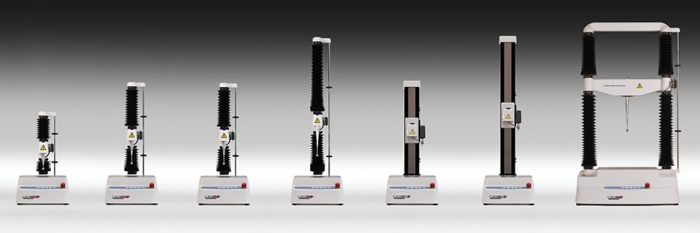
Texture Analysers/Materials Testing Instruments provide the means to measure force as the result of their major component: a load cell. The load cell is housed in the arm of the instrument and is driven at controlled speeds to chosen distances in order to test a product. A range of Texture Analysers are available varying in maximum force capacity and height options suited to the requirements of the application.
Our most popular force testing equipment:
Take a closer look at the range and compare Texture Analysers
When performing force testing in compression or tension they can be setup in a fundamental, empirical or imitative way.
Fundamental force testing using a Texture Analyser
A large number of users use their Texture Analyser to calculate fundamental parameters by taking into account the geometry and dimensions of the sample as well as the specifics of the test set up along with the relevant engineering equations. This type of testing allows easier comparison of different samples and comparison with literature data, but does require more sophisticated analysis to convert forces to stress and distances to strain.
One of the most commonly used fundamental tests is the measurement of Young’s Modulus. Fundamental tests generally assume (1) small strains (1-3% maximum); (2) the material is continuous, isotropic (exhibiting the same physical properties in every direction), and homogeneous; and (3) the test piece is of uniform and regular shape. Whilst fundamental force measurement tests are popular in the materials world most textural tests made on foods fail to comply with the three assumptions listed above. Fundamental tests are not used to any great extent in the food industry as they do not correlate as well with sensory evaluation as do empirical tests but they do have a place in some research laboratories.
Empirical force testing using a Texture Analyser
Texture Analysers are very often used for quality control of irregular products by the use of empirical force measurements. The force required to crush a tablet or the distance a biscuit bends before it snaps are invaluable pieces of information to manufacturers looking to develop new products or ensuring products perform correctly during spot checks. This type of force measurement test is ideal for products that have an unusual geometry, but it is also useful for testing more complicated systems, such as the combination of a product and its packaging, for example crushing a box of eggs, with the added benefit of time saved by allowing a product to be tested straight off the supply line.
Imitative force testing using a Texture Analyser
Imitative tests measure various force-related properties under conditions similar to those to which the sample is subjected in practice, that is, the properties of the material during handling and the properties of the sample during consumption or use. This class may be considered as a type of empirical test because the tests are not fundamental tests. If you’re not bound by any existing constraints and are looking for the most simple testing solution, sometimes the easiest approach is to set up a test that closely imitates the way the product is evaluated in real life. This type of force measurement test usually also makes data interpretation easier for you to understand.
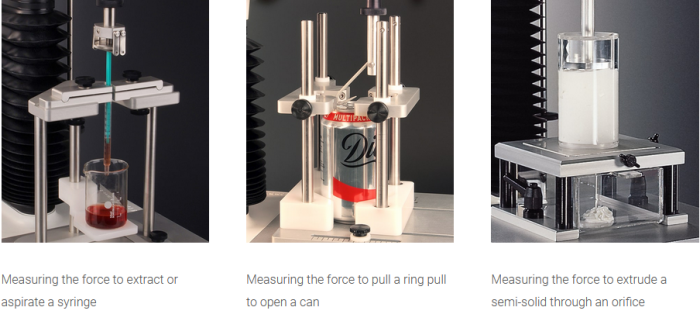
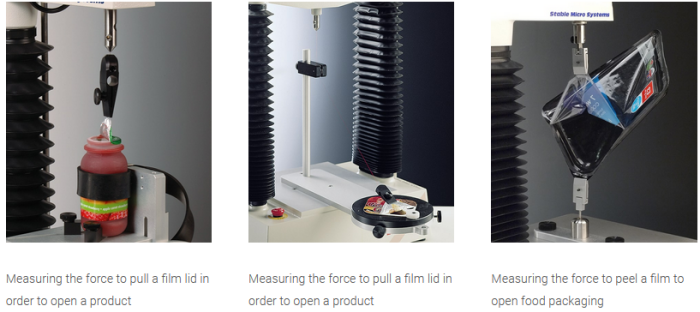
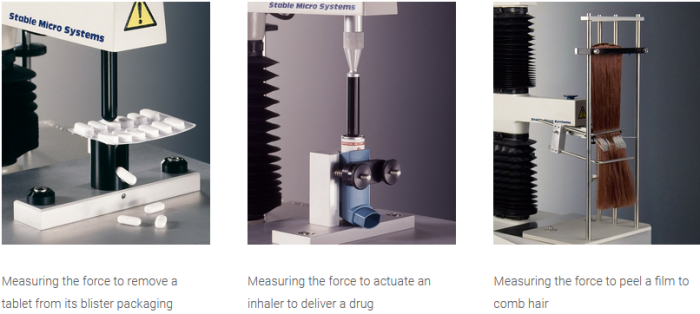
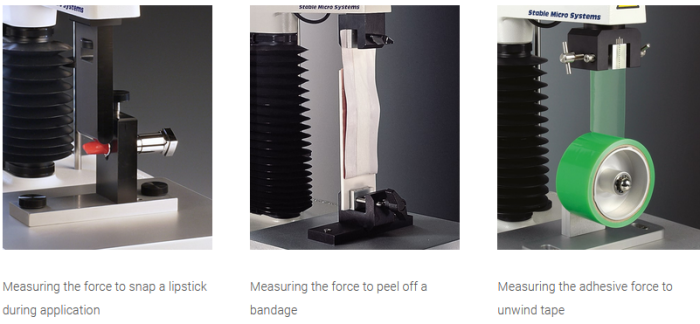
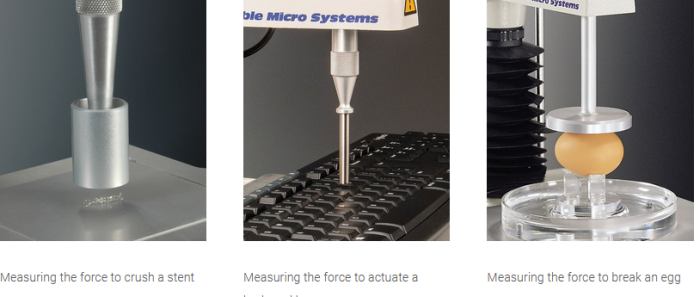
Let us show you a range of possibilities of how to measure the mechanical properties of materials.
Why measure the properties of materials?
Measuring the physical or mechanical properties of materials is an important requirement in all industries. Each raw material, component or finished product will have a desirable or specified set of properties whether it is hardness, strength of a seal, flexibility or adhesiveness, for example.
The physical/mechanical properties of a material or component describes their ability to resist deformation from an applied force which then determines the limits of a material’s functionality, performance expectations and lifetime of use. By a series of variations of tensile or compressive tests, materials testing equipment can offer a means of measuring and quantifying these properties in an objective manner whether it is by bending, extruding, compressing, stretching, puncturing or cutting a sample.
The mechanical properties of materials continuously change when exposed to various conditions such as heat or moisture and therefore properties need to be measured over conditions or environments to which the material, component or finished product is expected to be in use.
Types of Materials Testing measurement and their analysis possibilities
At their most simplistic form, material characterisation tests all have one of two things in common – a test in either tension or compression. A multitude of probes and fixtures are available that attach to the instrument for the support of the material or for specific application of force/deformation to the material.
Regardless of whether the test is performed in compression or tension, a resulting curve can be analysed to obtain the following typical fundamental parameters: Strain rate, Moduli (Young’s, tangent, chord, secant), Resilience, Yield stress, Strain to yield, x% proof stress, Maximum stress, Strain at maximum stress, Energy at maximum stress, Breaking strain, Hysteresis %, Energy to failure.
When specifically measuring in tension additional parameters may include: Necking onset, Ultimate tensile strength, Strain hardening parameter, Strength coefficient
Flexure using three point bend for cuboid and cylindrical samples: Yield stress, Young’s Modulus, Flexural strength, Toughness.
Indentation using conical and spherical probes: Indentation modulus, Hardness, Elastic energy, Plastic energy, Indentation Energy.
Puncture of uniform thickness thin films using spherical probes: Stiffness, Strength, Toughness, Failure strain.
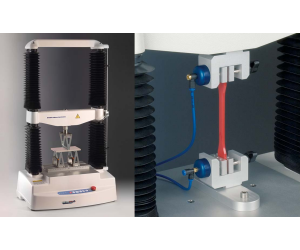
The TA.XTplusC and TA.HDplusC instruments are experts in the measurement of all of these properties and many more, with ASTM and ISO Standard tests built into the software or using the flexibility of empirical or imitative force measurements. Testing is easy and repeatable as test settings are automatically loaded and additional data such as audio and visual can be recorded to help with analysis, such as in the event of a fracture. We help make your testing quicker to access and the analysis of your product properties already prepared for you.
What other mechanical properties can materials testing instruments measure?
- Abrasion
- Actuation Force
- Burst Strength/
- Resistance
- Compressibility/
- Compactability Extensibility/
- Elongation
- Firmness
- Hardness
- Flexibility / Rigidity / Stiffness
- Coefficient of Sliding Friction
- Peel Strength/
- Seal Strength Springiness / Recovery / Stress Relaxation
- Stickiness/
- Adhesiveness
- Rupture Force
- Tensile Strength/
- Break Strength Toughness
Find out more about the mechanical testing options that can be measured in each industry
Within every industry there are mechanical properties that are particular to its products. Each product has properties that are either expected or undesirable and it is the job of a Materials Tester to objectively measure these properties to ensure your products meet their physical requirements and consumer expectations. Whether it’s in new product development or as part of quality control procedures, major manufacturers routinely apply materials testing techniques to carry out a wide range of measurements. Materials testing can measure a specific or range of characteristics or properties relating to the way a material behaves, breaks, ruptures, bends, etc. Tests can be performed to analyse raw materials or excipients, semi-finished goods, packaging and finished products – the application of materials testing could be at any stage of manufacture. Whether you are testing to see the result of substitution of a material/component or the adjustment of formulation or processing variables on end product acceptability. This could be to measure, for example, flow properties of creams and pastes, the compressibility/tensile strength of packaging, the break or bend of a product or the tackiness of adhesives.
Discover the typical materials testing solutions that have been developed for products in each industry below:
Measure the mechanical properties of materials with our comprehensive range of testing fixtures.
A selection of special attachments and typical measurements which are commonly used in materials testing are shown, although this does not necessarily include the complete range available for the testing of materials. Test procedures include: compression, puncture / penetration, tension, fracture / bending, extrusion, cutting / shearing.
High force and extended height models of instrument such as the TA.XTplus100C and TA.HDplusC are generally more suited to the materials testing applications.