


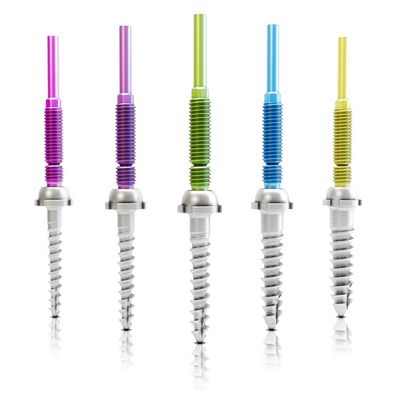
Medicrea - Model PASS LP -Low Profile PolyAxial Spine System
Marketed for the treatment of spinal pathologies (scoliosis, spondylolythesis, traum..) , the PASS LP™ thoraco-lumbar fixation system allows to connect the rod at distance from the spine and to perform a 3D correction through progressive stress distribution on all anchorages thanks to the ST2R technique (Simultaneous Translation on 2 Rods).
Connection at distance from the spine: The rod is connected in an easy way to the PASS LP™ anchorages, on threaded polyaxial posts and flexible guides , with no need for complex rod persuaders. The PASS LP™ anchorages design with polyaxial post design eases the rod connection
Load sharing: It distributes the load on all the fixation points and allows a gentle progessive correction thanks to the ST2R technique (Simultaneous Translation on 2 Rods)
Optimum safety *: The risk of back out or breakage is reduced by lowering constraints at the bone contact surface, thanks to the innovative design of the implants and the surgical technique
Surgeon-friendly: Compact, optimized Instrumentation is well adapted for the surgeon in the OR. Only one container for implants and two for instruments allow to cover all the type of indications **
Full polyaxiality: This is the most complete range of polyaxial anchorages with screws , self-stable hooks/claws, sacral plates and iliac fixation
Connection at distance at the spine: The PASS LP™ combines the advantages of a top loading system with the side connection of the rod, and offers simple solutions well adapted to all situations even the most challenging cases *
Lowest profile: the PASS LP™ offers the lowest profile polyaxial spinal system on the market**
Complete range to cover all indications *: deformities (scoliosis, kyphosis,…), degenerative (DDD, spondylolisthesis), trauma, tumors, a system to cover all the indications
Patient: 15 year-old female with AIS (Lenke 1A)
Indication: Idiopathic scoliosis
Surgery: Thoracolumbar posterior fixation with PASS LP™ system
Results
- 72% of reduction of the main curve in the frontal plane
- Restoration of an normal thoracic kyphosis (gain of 23°)
- 33% of correction of the vertebral rotation