


Synspec - Model GC955 810 -Mercaptan and Sulfide Analyser
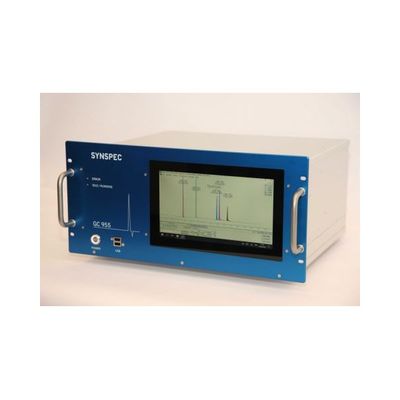
Monitoring of Sulfur Compounds in the Ambient Air. Synspec GC 955 810 gas chromatograph is specifically designed and built for the measurement of sulfur compounds in the ambient air. The two prominent groups of sulfur compounds that can be detected with this GC are mercaptans and sulfides but additional components such as benzene can be added also. The instrument is equipped with a built-in cooled pre-concentration system and PID detector. The analyser holds a CE approval for EMC conformity.
Synspec analyser for measurement of sulfur compounds in ambient air
Many sulfur compounds are toxic. The smell of sulfur components is a problematic issue at many industrial sites. Sulfur compounds may be emitted at the desulfurization plant in refineries.
Sulfur is also used for producing certain types of paper. Specialized sulfur compounds are produced for odorisation of natural gas. Some essential pharmaceuticals contain sulfur.
At waste deposit sites and at water treatment plants the stench problems are partly due to sulfur components.
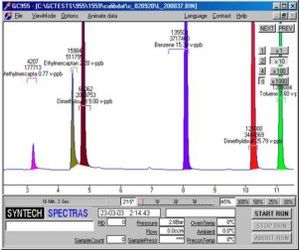
This analyser is a gas chromatograph with a built-in cooled pre-concentration system.
Sulfur components and also other hydrocarbons are first pre-concentrated and then separated on a special strongly separating column combination. The same type of sulfur column is used that is normally also used in the petrochemical industry.
The use of a sample dryer is not advised, to avoid loss of mercaptans by removing them with the moisture.
The setting for the column has been optimized to avoid interference from higher boiling hydrocarbons. In a standard instrument up to 40 peaks can be identified and quantified.
- Among many sulfur components that can be measured two groups stand out: the mercaptans and the sulfides.
- Mercaptans: methylmercaptan, ethylmercaptan, propylmercaptan, butylmercaptan (also named thiols);
- Sulfides and disulfides : hydrogensulfide, carbondisulfide, diethylsulfide, dimethyldisulfide (DMDS), dimethylsulfide (DMS), etc;
- Many other sulfur compounds are present in air, for instance, thiophene. Many of those also can be monitored.
- With the same system components like benzene can also be measured.
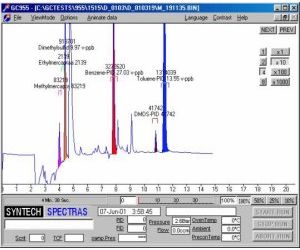
Three issues stand out when monitoring sulfur compounds: all are related to the reactivity of mercaptans. Sulfides are less reactive.
Reactions of mercaptans in air and on reactive surfaces:
- Many customers demand measurement of mercaptans but it is better to also include the sulfides.
- Mercaptans are unstable and can be converted by catalytic activity to the more stable sulfides or by oxidation into other compounds.
- The disulfides are even more stable and are formed out of the mercaptans.
- The smell of these compounds is not very different, only by measuring all these compounds you can determine the air quality.
- To prevent the reaction of mercaptans in/on the sample lines, these lines need to be selected carefully.
Calibration:
- Calibrating the mercaptans is complex: bottles with mercaptans are not stable, except if the bottle had special treatment.
- A permeation tube is better. However in reaction with oxygen the mercaptans will turn into sulfides.
- The only real option is to dilute with nitrogen.
- In that way the reaction cannot take place. However it will take some time to stabilize.
Sample conditioning:
- Drying the sample with a Perma Pure dryer is not recommended because mercaptans will disappear.
A standard industrial PC with Windows embedded is used in the GC. The user-friendly software stores all the chromatograms on the hard disk and data can be interpreted easily with this intuitive software. Data can be transferred by network and modem connection. Besides this, analog and digital output options are available to communicate with other data logging systems using several data protocols.
Simple operation, good reliability and low maintenance cost are important. With a worldwide network of distributors you can rely on your instrument with an individualized training and support is available to help you.
Synspec GC955 series 810 Mercaptan and Sulfur analyser
TECHNICAL DESCRIPTION
- PID detector. Lowest detection level depending on component from 0.2 ppb for Methylmercaptan to 0.01 ppb for disulfides. Standard range: 0-30 ppb ( can be extended upon request).
REPRODUCIBILITY
- typical <3% at 1 ppb (dimethylsulfide, with capillary column)
GAS CONSUMPTION
- Nitrogen, quality 5.0, 4 bar, 10 ml/min
DIMENSIONS
- 19” rack, 5 standard Height Units, depth 43 cm net
- (W 48,3 D 43 H 22 CM), WEIGHT 20 kg
POWER DEMAND
- 230 V AC, 100 VA (115 V AC available) 50/60 Hz
HARDWARE
- Internal industrial x86 based computer, suitable for measuring and saving data up to 10 years. Hard disk, full color touchscreen, various data connection options.
COMMUNICATION
- Direct control via touchscreen, keyboard or mouse. External data communication via RS232, analog and digital outputs, via TCP-IP.
- Standard available protocols : ASCII terminal, Hessen, Gesytec and MODBUS, other protocols on demand
INCLUDED SOFTWARE
- Windows embedded and GC955 software. Direct control via touchscreen, keyboard or mouse, via remote host (RS232/modem) or Ethernet.
APPROVALS
- CE approval for EMC conformity: EN 61000-6-2, EN 61000-6-3, EN 61010, EN 61326
OPTIONS
- It is possible to monitor also benzene and toluene in a 20 minute cycle. In a 30 minute cycle also xylenes can be monitored.