

- Home
- Companies
- Paibo Machinery Co., Ltd.
- Products
- Paibo - Metal Chips Briquetting Press
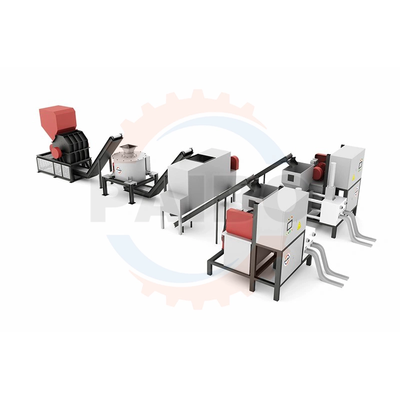
Paibo - Metal Chips Briquetting Press
As a professional manufacturer of Metal Chips Briquetting Press Lines, we provide a one-stop metal chips recycling solution and metal recycling process that handles metal chips, turnings, swarf, and shavings generated during machining operations.
This metal chips recycling system efficiently compresses loose, oil-contaminated metal scrap into high-density briquettes while recovering cutting fluids for reuse.
Integrating four core processes — grinding pretreatment, centrifugal de-oiling, briquetting, and automated transfer — the Metal Chips Briquetting Press Line maximizes metal recovery rate and helps enterprises reduce operating costs in metal recycling and scrap metal recycle industries.
How the Metal Chips Briquetting Press Line Works Swarf Grinding Machine
Long, irregularly shaped metal turnings produced during machining must first undergo pretreatment in a swarf grinding machine:
It crushes irregular turnings into uniform-sized materials using a shredding machine, laying an optimal raw material foundation for the subsequent briquetting process and avoiding uneven briquette density caused by differences in turning shapes.
The ground materials can reduce wear on core components of the compression system (such as pressure heads and molds), lowering the frequency and cost of daily equipment maintenance.
The machine is equipped with a smooth material conveying channel, which can effectively prevent blockages at the feed inlet of the metal chip briquetting line and ensure the continuous and stable operation of the entire production line.
Centrifugal De-oiling System
In this Metal Chips Briquetting Press Line, the ground metal chips are sent to a centrifugal de-oiling machine, where the high centrifugal force generated by the machine’s high-speed rotation enables efficient separation of cutting fluids from solid chips:
After separation, the oil and moisture content of the metal chips is significantly reduced, meeting the drying standards required for the briquetting process and allowing direct compression without additional drying.
The separated cutting fluids flow into a dedicated liquid storage tank and naturally stratify under gravity: the upper layer is recyclable cutting oil, and the lower layer is water-based coolant.
The system is equipped with an automatic oil skimmer or liquid concentration sensor, which can accurately separate the stratified cutting fluids and directly transport them to machining equipment for secondary use.
Key Performance Indicators: De-oiling rate reaches 92%–97%, and the purity of recovered cutting oil exceeds 95%, meeting the reuse requirements of machining workshops.
Briquetting & Secondary De-oiling
The dried metal chips are conveyed to a hydraulic metal chip compacting system and compressed into high-density metal briquettes under high pressure (adjustable according to material type), as part of our metal chips recycling solution:
The residual oil content of the final briquettes is strictly controlled within 2%, eliminating the need for additional degreasing treatment and allowing direct delivery to smelters for metal recycling and re-melting.
A small amount of residual liquid (3%–5%) separated during the briquetting process is collected through the diversion device at the bottom of the Metal Chips Briquetting Press Line and reintroduced into the cutting fluid recovery system, realizing full-process scrap metal recycle and resource circulation.
Briquetting reduces the volume of metal scrap by more than 90%, significantly reducing storage space, decreasing transportation frequency, and lowering logistics costs.
Automated Handling & Transfer System
The formed metal briquettes are transferred in the subsequent process using automated handling equipment:
Depending on the production line scale, robotic arms (suitable for high-precision, small-batch transfer) or rail-mounted automated transfer carts (suitable for large-scale, long-distance transportation) can be configured.
No manual intervention is required throughout the process, which not only reduces labor intensity and safety risks of manual handling (such as heavy object impact and metal scratches) but also achieves seamless connection between the briquetting forming process and the storage/loading process, ensuring 24-hour continuous operation of the Metal Chips Briquetting Press Line.
- Steel & Iron: Covers steel-iron chips from CNC machining workshops, steel-iron turning scrap from lathes, steel-iron shavings from milling machines, and steel-iron swarf from heavy-duty machine tools.
- Aluminum Alloys: Targets aluminum alloy chips from CNC precision machining and aluminum alloy turning scrap from die-casting processes.
- Copper: Includes copper chips from copper processing workshops and copper shavings from precision machining.
- Stainless Steel: Focuses on stainless steel turning chips and stainless steel swarf from milling machines.
- Non-Ferrous Metal Alloys: Such as brass chips, bronze turning scrap, and zinc alloy swarf — all suitable for metal recycling through our Metal Chips Briquetting Press Line.
- CNC machining workshops
- Metal fabrication and foundries
- Automotive and aerospace parts production workshops
- Aluminum/copper and alloy processing plants.
- CNC machining workshops
- Metal fabrication and foundries
- Automotive and aerospace parts production workshops
- Aluminum/copper and alloy processing plants.