- Home
- Companies
- Zygo Corporation - AMETEK, Inc
- Products
- Zygo - Model Compass 2 - Metrology ...
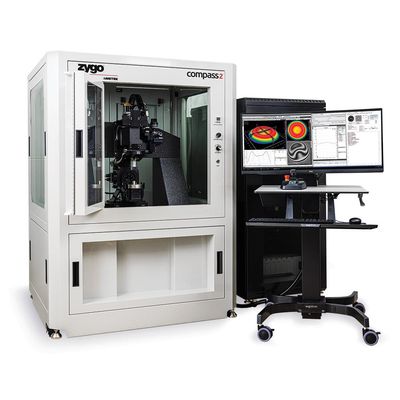
Zygo - Model Compass 2 -Metrology System
ZYGO`s Compass 2 metrology systems set the benchmark for automated, non-contact 3D surface metrology and process control for discrete micro lenses and molds critical to compact camera modules found in smart phones, tablets, and automotive vision systems. At their core is ZYGO’s Coherence Scanning Interferometry (CSI) technology which delivers industry-leading precision, versatility and speed for repeatable metrology and production process control.
There are two models of Compass 2 systems available, depending on your metrology needs
- Compass 2 – ZYGO`s advanced solution for precision metrology of micro lens surface form, deviation from prescription, and relational/dimensional parameters. This is the ideal choice for applications that require the analysis of rotationally symmetric spherical and aspheric, geometrically truncated, and freeform surfaces.
- Compass RT – A fast and flexible system for precision metrology of micro lens relational/dimensional parameters, plus general profilometry applications. This is the ideal choice when form deviation metrology is not required.
Production-Proven Technologies
At the core of the Compass 2 system is ZYGO’s CSI based optical profiler technology, which delivers industry-leading precision, versatility and speed for repeatable metrology and production process control. Unique to Compass™ and Compass™ RT are aspheric form and deviation metrology and relational / dimensional metrology of alignment features.
Form and Deviation
- Full surface, non-contact, 3D mapping of surface form for spherical, aspherical, and freeform lenses and molds with sub nanometer precision
- Advanced analysis of form deviation from design prescription
- Data integration with diamond turning machines for surface correction
Relational/Dimensional Metrology
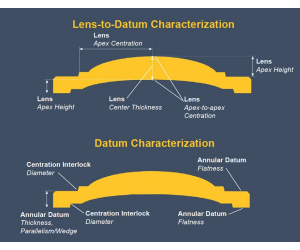
- Quantitative metrology and inspection of mechanical design features on single or dual-sided lens elements including Datum to Datum and Lens-to-Datum Characterizations