


- Home
- Companies
- Lumina Scientific Asia Pte Ltd.
- Products
- Lumina Fluidiclab - Microfluidic ...
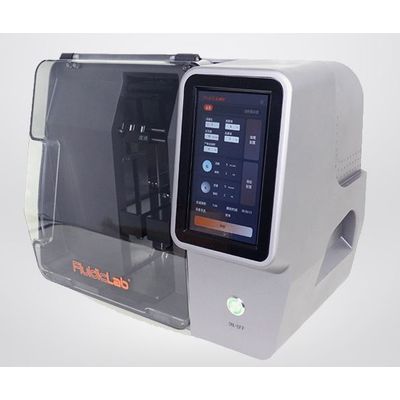
Lumina Fluidiclab - Microfluidic Intelligent LNP Synthesizer
The Microfluidic Intelligent LNP Synthesizer is a sophisticated platform designed for the precise formulation of lipid nanoparticles (LNPs). Key to its function is the rapid mixing of phospholipids and buffer solutions—including critical biomolecules such as mRNA and siRNA—within a microfluidic chip. This process enables the self-assembly of LNPs with highly controllable and uniform particle sizes. The platform stands out for its batch-to-batch reproducibility, reduced sample consumption, and ease of use, making it an invaluable tool for efficient pre-formulation screening. With intelligent control mechanisms and a low consumable cost structure, the synthesizer optimizes operations and minimizes resource use, ensuring efficient and effective research outcomes.
This microfluidic platform offers advantages such as highly controllable particle size, monodispersity, reproducibility between batches, low sample consumption, and ease of operation, enhancing the efficiency of pre-formulation screening for customers.
- Highly controllable and homogeneous particle size
- High batch repeatability
- Intelligent Control
- Low cost of consumables
- Easy to operate
- Efficient operation
In the process of preparing LipidNanoparticle (LNP), the key step is to mix phospholipids and buffer (the buffer contains mRNA, siRNA and other biomolecules) at high speed in the microfluidic chip to self-assemble into LNPs. the microfluidic LNP preparation platform has the advantages of highly controllable particle size and monodispersity, high reproducibility between batches, low sample consumption and easy operation, which can greatly improve the efficiency of customer’s pre-formulation screening. The microfluidic LNP preparation platform has the advantages of highly controllable particle size and monodispersity, high reproducibility between batches, low sample consumption, easy operation, etc., which can greatly improve the efficiency of customers’ pre-formulation screening.
Highly controllable and homogeneous particle size
- Particle size is controllable from 40 nm to 200 nm with a monodispersity (PDI) below 0.02.
High batch repeatability
- Fully automated system with no plumbing connections, no start-up and no cleaning, eliminating variability from batch to batch.
Intelligent Control
- It can automatically detect abnormal conditions such as chip clogging and leakage, and stop the machine automatically, saving users’ valuable raw materials.
Low cost of consumables
- Chips are *highly strong, resistant to 50 atmospheres, and can be cleaned and reused.
Easy to operate
- No need for external computer, full touch screen configuration, experimental parameters can be loaded or saved, and preparation can be started within 30 seconds of power on.
Efficient operation
- The equipment is compatible with domestic and foreign disposable syringe models, with a single running time of 9~40s, and hundreds of formulations can be screened in a day.
Intelligent Control
- Built-in pressure and position sensors for precise control of sample flow rate.
- Dual-channel independent control with flexible setting of flow rate ratio.
- Automatically detects abnormal conditions such as chip clogging and leakage, and automatically stops the machine.
- Rapidly reaches the set flow rate and drastically reduces the volume of pre-waste liquid.
- LNP particle size: 40~200 nm.
- Total flow rate range: 0.04 ~ 40 mL/min (ethanol and water set at 1:3).
- Fishbone mixing structure, laminar mixing time <3 ms.
- COC material, pressure resistance over 50 Bar, no risk of leakage and clogging.
- No tubing is required, and the chip is connected directly to the syringe.
- Compound phospholipids and buffers, ready to use.
- Can wrap mRNA mRNA, siRNA, CRISPR/Cas9 and other nucleic acids.
- >95% transfection rate.
- Low toxicity.
- A complete experimental program is available.