


- Home
- Companies
- Midwest Industrial Supply, Inc.
- Products
- Midwest - Subgrade Stabilization
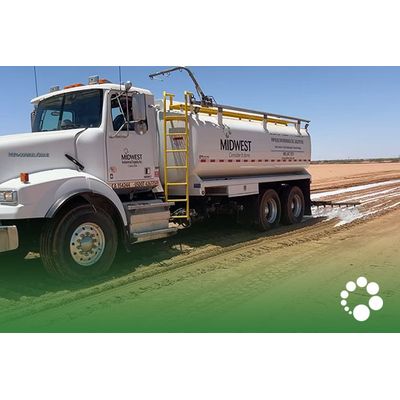
Midwest - Subgrade Stabilization
Roads built over weak or moisture-sensitive soils often face long-term structural issues like cracking, rutting, and settlement. Treat the subgrade at the earliest stage of construction to improve load-bearing capacity for a more stable foundation. This lowers construction and repair costs with a longer-lasting paved surface.
Start with the best for the best results. Midwest’s polymer-based, high-performance Subgrade Stabilization System improves underlying strength and stiffness even in poor soils. Whether weak, moisture-sensitive, or variable, the Midwest polymer binder formulation blends into subgrade soil during new construction and before base installation. These polymers coat soil particles to form a flexible yet durable matrix that resists water, cracking, and deformation under load. This stands in sharp contrast to lime or cement, which only performs well within a narrow soil range.
Midwest Subgrade Stabilization improves roadbed support for paving and infrastructure.Every new road or infrastructure project requires a stable foundation. Whether it is an access road, haul route, or city street, it all starts with a strong base beneath the surface. Midwest’s proprietary, polymer-based systems stabilize weak or variable subgrade soils during the earliest phase of road or site construction. These treatments typically reach depths of six inches or more, making them the deepest of any of our stabilization systems.
Our polymer subgrade stabilization formulation is blended into native soils using standard equipment to enhance foundation strength, reduce moisture sensitivity, and prepare the roadbed for base layers and pavement.
- Engineered structural solution functions as a bound base layer
- Improves structural support and allows for reduced asphalt thickness
- Achieves strong bearing capacity while maintaining flexibility
- Outperforms traditional base and subbase treatments
- Greater resistance to shrinkage and reflective cracking
- Nanotechnology-based flexible bond reduces cracking over time
- Improved resilience to moisture and water intrusion
- Absorbs stress from traffic loads and shifting subgrades
- Holds up under repeated loading to extend life and cut repair expenses
- Non-caustic formulation eliminates risk of chemical burns
- No respiratory hazards or dust exposure during mixing or spreading
- Requires minimal PPE and no specialized handling
- Liquid binder improves on-site visibility and working conditions
- Helps prevent long-term hazards by preserving surface quality
- Minimizes material transport by treating existing subgrade
- Fewer trucking and aggregate costs
- Lower long-term maintenance burden from stabilized foundations
- Shorter construction timelines reduce labor and equipment hours
- Competitive lifecycle cost vs. cement or lime
- Tailored to each soil’s plasticity, gradation, and moisture content
- Versatile across weak, cohesive, and granular soils
- Compatible with heavy construction equipment
- Engineered to meet construction specifications and demanding timelines
- Application with common reclaimers, mixers, and grading equipment
- Applied at ambient temperature with no hazardous dust
- Quick-drying and traffic-ready within days
- No specialized crew training required
- Low carbon footprint compared to cement or lime
- Reduces CO2 emissions by treating in-place soils and avoiding energy-intensive additives
- Uses non-toxic chemistry that eliminates hazardous runoff concerns
- Minimizes dust pollution for improved air quality
- Safe for use near wetlands, waterways, and other sensitive ecosystems