


- Home
- Companies
- Meacon Automation
- Products
- Meacon - Model MIK-LDG - MIK-LDG ...
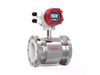
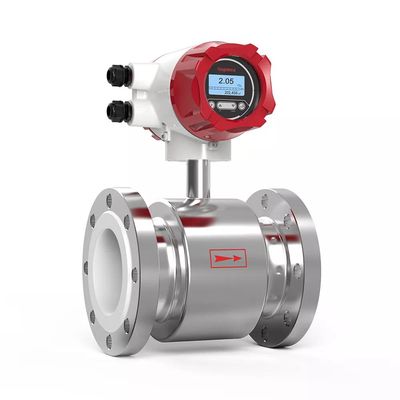
Meacon - Model MIK-LDG -MIK-LDG Stainless steel body electromagnetic flowmeter
Magnetic flowmeters operate under the principle of Faraday’s Law of Electromagnetic Induction to measure liquid velocity. Following Faraday’s Law, magnetic flowmeters measure the velocity of conductive liquids in pipes, such as water, acids, caustic, and slurries. In order of usage, magnetic flowmeter use in water/wastewater industry, chemical, food and beverage, power, pulp and paper, metals and mining, and pharmaceutical application.
Measuring principle
Mag meter works based on Faraday’s law, and measure conductive medium with conductivity more than 5 μs/cm and flow range from 0.2 to 15 m/s. An Electromagnetic Flowmeter is a volumetric Flowmeter that measures the flow velocity of a liquid through a pipe.
The measurement principle of magnetic flowmeters can be described as follows: when the liquid goes through the pipe at the flow rate of v with a diameter D, within which a magnetic flux density of B is created by an exciting coil, the following electromotive E is generated in proportion to flow speed v:
E=K×B×V×D
Introduction
SUP-LDG electromagnetic flowmeter is applicable for all conductive liquids. Typical applications are monitoring accurate measurements in liquid, metering and custody transfer. Can display both instantaneous and cumulative flow, and supports analog output, communication output and relay control functions.
Application
Electromagnetic flowmeters have been used throughout industries for more than 60 years. These meters are applicable for all conductive liquids, such as: Domestic water, industrial water, raw water, ground water, urban sewage, industrial wastewater, the processed neutral pulp, pulp slurry, etc