


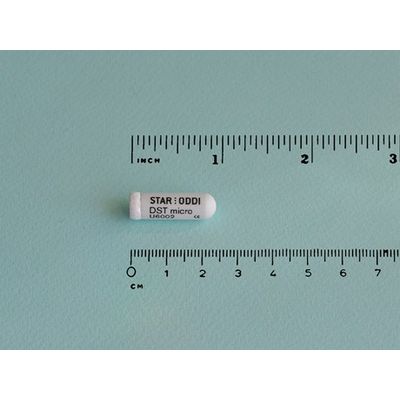
Model DST micro-TD -Small Temperature and Depth Fish Archival Tag
- Small and reliable archival fish tag
- Long life and flexible interval setup
- Depth sensors for different ranges
- Fish implantation or external attachment
- User defined text on the housing
High performance in small size
Dimensions are only 25.4 mm x 8.3 mm and it weighs 3.3 g in air. Despite the small size of the logger, the DST micro-TD Data Storage Tag has high reliability and long lifetime. Therefore it suitable for long term behaviour and migration studies of small fish, smolt and marine animals.
Application
The DST micro-TD is designed as an archival tag for migration, feeding and dive behavioral studies of small fish, seabirds and marine animals. The recorded time seris data enable scientists to gain valuable information on migration routes and behavioural patterns over a long period of time. The tag can be implanted or attached externally.
Long life and flexible interval setup
DST micro-TD can store 87,168 measurements in total which means it can store data for 2.5 years when using a 30 minute interval, as an example. It is possible to set the logger to record with multiple intervals, shifting between different intervals during the measuring period. Also it is possible to choose different intervals for measuring depth and temperature.
Depth sensors for different ranges, selected by the user
You can choose between depth calibration up to: 150 m, 300 m or 1000 m. The shallower the range the better the resolution and accuracy.
Fish implantation or external attachment
The logger is designed as an implantable tag and can be implanted in the abdominal cavity. It can also be attached externally on a fish or marine animal using a tag holder kit, ensuring easier and safer attachment.
User defined text on housing
For tag and release of animals into the wild the tags can have a customized text on the housing, for recapture purposes. It is important to have the return information when the tags are used on commercially fished species, so that fishermen can return a tag with valuable data to the scientist. Normally there is a reward for a tag return.
Spaghetti tag for spotting fish
When the DST logger is implanted in fish it is possible to have a yellow plastic tube, a spaghetti tag, attached to the DST. The tube sticks to the exterior of fish, making it easier for fishermen to spot the tagged fish.
The logger and the accompanying items are designed for ease of use throughout the research process, from setting up the logger, attaching it, to retrieving and analysing the data. The logger is supported by the SeaStar software and a Communication Box which have to be purchased with the first order.
Programming the LoggerTo set the logger for starting measurements it is placed into the Communication Box that connects with a USB cable to a PC computer. In the SeaStar software, the user sets the start time, start date and sampling interval before starting the tag for measuring. The tag synchronizes its internal clock with the date & time on the computer being used.
Single or multiple intervalsThere are two modes for sampling, either at a single interval throughout the period or multiple intervals. When choosing multiple intervals programming it is possible to define up to seven different intervals and number of measurements for each interval. Shifting between wide and narrow intervals can help in extending the measuring period due to memory limitation and have more frequent measurements during certain time periods, for example spawning periods.
Memory and Battery Life CalculationsThe software automatically calculates when memory fills based on certain interval settings, making it easier for the user to decide how to program the tag. Estimation on battery consumption during that time period is also calculated.
Uploading the DataAfter fish recapture, the tag is inserted into the communication box and the recorded data is uploaded to the software. The results are displayed both in graphic and tabular form and the data can be exported to other programs. The time series data shows each measurement with its own time stamp.
Long battery lifeAfter data retrieval the data storage tag can be re-used, as long as the batteries inside last. Battery life estimation is always reported upon connection with the tag. Due to the low energy consumption circuitry design the battery life can be several years, depending on usage and sampling interval used.