


Smiths Detection Inc.

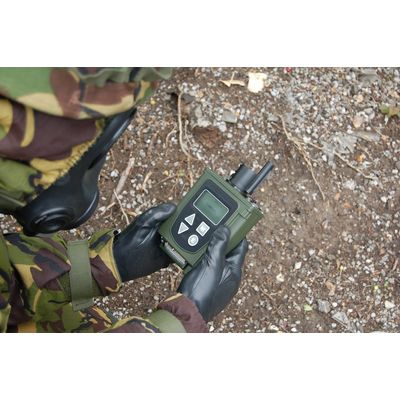
Model LCD 3.3 -Personal Chemical Warfare Agent Detector for Armed Forces
The most widely deployed personal chemical detector, deployed with armed forces globally. The LCD 3.3 can be handheld or clipped to a belt or harness, enabling the user to work without obstruction. It features both audible and visual alarms plus a clear, easy-to-read liquid crystal display, and is supplied with a carrying pouch to allow hands-free operation.
Most popular related searches
ion mobility spectrometry
chemical warfare agent detector
chemical detection system
chemical warfare agent
manganese dioxide
chemical agent detection system
spectrometry
chemical agent
manganese
chemical warfare agent detection
- It can be fitted with a survey nozzle (supplied) to aid in the detection of residual persistent contamination while in survey mode. Data logging records up to 72 hours of mission data for future analysis.
- The device is simple to operate and requires no calibration or complicated routine maintenance.
- RS232, RS422 and USB connectivity (when in a PCA) allows post mission analysis and software updates.
- The LCD 3.3 also complies with MIL-STD-810G, MIL-STD-461F and MIL-STD-1275D.
- Size: 10.54 x 17.93 x 4.65cm (4.15 x 7.08 x 1.83in)
- Weight: 0.65kg (1.5lbs) including batteries
- Power: 8 - 32Vdc 110/240V ac using PSU (Power Supply Unit)
- Batteries: 4 x AA lithium iron disulphide or 4 x AA alkaline manganese dioxide. (re-chargeable NiMH AA batteries can be used)
- Detection technology: Advanced non rad Ion Mobility Spectrometry
- Agents detected: Nerve, blood, blister, choking and a selected library of TICs
- Accessories: Additional accessories are available to increase the capability of the LCD 3.3
- Software Development Kit (SDK): Provides 3rd party integrators and OEMs with the software to interface LCD 3.3 with a variety of platforms
- Available colours: Green or Black
- Operating temperature range: -32º to + 60ºC
- Battery life: Alkaline type 40 hours/Lithium type 75 hours
- Combined CWA identification and TIC detection library
- Up to 72 hours continuous use from a single set of commercial AA batteries
- Uses non-radioactive ion mobility spectrometry technology
- Capable of vehicle and platform integration